Does resignation end all liability? Who will face the law over the Radda and Gendaria incidents
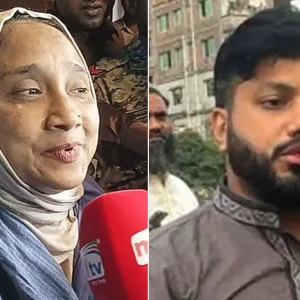
A private health centre in Dhaka's Mirpur has been demolished with an excavator, and a video of a state minister chasing people with a firearm in Gendaria has spread across social media. After allegations were raised against two ruling-party public representatives in two separate incidents, both resigned. But the question now being asked is whether resignation ends all liability — or whether, even after losing political office, they will still face investigation, legal action and trial over the allegations.
The government and the ruling party are presenting the steps as a message of political discipline and accountability. The first incident brought reserved women's seat MP Ferdousi Ahmed Mishti into the discussion; the second put Liberation War Affairs State Minister Ishraq Hossain at the centre of controversy. Those involved say the two incidents are not of the same nature. In Radda, a criminal case has been filed over allegations of attack, vandalism and looting. In Gendaria, the questions concern the public display of a personal firearm, the claim of self-defence, and compliance with licence conditions. The allegations differ, but the core question is one: how far will the investigations go, and what action will follow if offences are proved?
The first incident began late on the night of September 24, when the Radda MCHFP Centre in Mirpur-1 came under attack. According to the institution, more than 200 people carrying local weapons and heavy machinery entered the health centre, beat and detained the security guards, and then demolished one tin-shed and three semi-pucca buildings with an excavator. The ultrasound, immunisation and laboratory rooms were damaged, and medicines and medical supplies were looted.
The institution, which has served mothers and children since 1974, says the damage exceeds one crore taka, and that treatment for poor women and children has been disrupted. After the attack, allegations surfaced of local BNP leaders and activists being involved in an attempt to grab the land, and Mishti's name entered the discussion. Several people known as her close associates were accused of involvement, and her past links with the 'Samamana Dokandar Samabay Samity' also came to light.
Mishti, however, has denied the allegations. She says she has no current connection with the society and was not involved in the attack or vandalism at the health centre. On the prime minister's instruction, she resigned as an MP on October 1, and her seat was later declared vacant.
The legal process has also moved. Radda Centre's executive director Nasrin Akhtar filed a case with Shah Ali police station on September 26, naming local BNP leader Hanif Mia and a further 200 to 250 unidentified people as accused. Mishti's name was not in the initial FIR. Under the law, even if someone is not named in the FIR, evidence of involvement found in the investigation can bring them within the legal process; equally, without proof, no one can be labelled a criminal.
Several questions have come to the fore. Who ordered the attack, who supplied the excavator, who organised the attackers, and who was behind the land-grab attempt? There is also the question of why police could not prevent an attack that allegedly continued for hours. After the incident, Shah Ali police station's then officer-in-charge Jahangir Alam was withdrawn, although the police administration described it as an administrative decision.
Home Minister Salahuddin Ahmed told reporters on October 1 that if the investigation found Mishti's involvement, a charge sheet would be filed against her too, and he made clear that party action and legal action are separate. However, there is no confirmed latest information on whether any evidence has been found against her or whether she has been questioned.
Before the Radda affair had faded, a new controversy erupted in Gendaria. On October 17, during an anti-drug programme near Gendaria railway station, Ishraq Hossain was seen chasing several people with a firearm in hand. He published the video himself on social media. Ishraq claims 30 to 35 people advanced menacingly towards his motorcade, so he and his security guards displayed licensed weapons in self-defence. He further claims that, with local police help, several drug dens were raided and six people were detained and handed over to police.
Amid the controversy, Ishraq Hossain resigned as state minister on Monday and set out his position at a press conference. The DMP's detective chief, Md Shafiqul Islam, said on October 18 that the local deputy commissioner had been asked to observe the incident and submit a report, and that action would be taken if any violation of the law was found.
A personal firearms licence is granted for self-defence, but it is not a free permission to display weapons in public at will or to perform the duties of law enforcement. Clause 25 of the Firearms Licensing, Renewal and Use Policy 2025 restricts displaying weapons in a manner that creates fear or annoyance in others. The decision will therefore have to rest on the video, the circumstances, the perceived threat and the licence conditions. Former IGP Baharul Alam has also pointed to the role of the district administration, the licensing authority, in the matter.
Additional IGP Sayedur Rahman has said, 'The law is equal for everyone. Whether someone is influential or not, no one is being spared in any way. When an incident occurs, police investigate impartially and take action according to the law.' On firearms licences, he said a district magistrate may grant one considering the need for self-defence, but police opinion is taken beforehand and specific conditions apply; fundamentally, the district magistrate grants the licence, not the police. On Ishraq's claim that he had to use a weapon because police were not adequately equipped, he said, 'That is his claim. We are always equipped with the necessary gear.' Acknowledging that influential people can create obstacles to investigations, he said no such complaint has reached them so far, and no one has sought any exemption.
Human rights defenders are more explicit. Ijazul Islam, executive director of the Human Rights Support Society (HRSS), says a tendency can be observed in the country: when serious allegations arise against a politically influential person, the situation is managed by making them resign or by taking organisational action. In his view, resignation can be part of political and moral accountability, but it can in no way be seen as a substitute for a criminal trial or for determining legal liability. The same investigation and legal process that applies to an ordinary citizen facing such allegations should apply to a minister or an MP.
Ijazul Islam adds that what matters most is how the investigation proceeds after the resignation — who the real offenders are, whether there was a planner or an order-giver, and whether the investigation is bringing these things out. If discussion stops at resignation and no subsequent legal process is visible, a public perception of impunity can take hold. At the same time, an allegation does not make anyone guilty; determining liability through an impartial investigation is the main thing. He also stressed that investigating agencies must be allowed to work independently, free of influence.
BNP vice chairman Shamsuzzaman Dudu, for his part, has said Ferdousi Ahmed Mishti had to resign after initial allegations over the attack on the Radda health centre, and that legal action will surely be taken if the allegations against her are proved in the investigation. He said that by directing ministers and MPs to resign over controversial conduct, the prime minister has warned others — something that did not happen in the past.
The consensus among those concerned is this: resignation can be part of political accountability, but it neither proves an offence nor stops an investigation into a possible one. Whether the law continues to apply in the same way after power is relinquished is what remains to be seen.