UK to send Typhoon jets to Saudi Arabia against Houthi attacks, in a role London stresses will be purely defensive
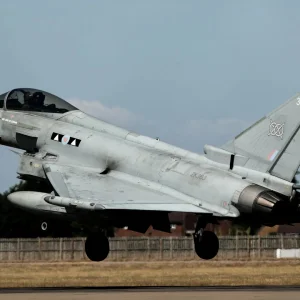
The United Kingdom will deploy Royal Air Force (RAF) Typhoon fighter jets to help defend Saudi Arabia as missile and drone attacks by Yemen's Houthis increase. The BBC reported the news, citing the UK government.
The defensive mission will help protect Saudi cities and key infrastructure from aerial attacks by the Iran-backed group. Prime Minister Andy Burnham has approved the step. The decision follows Houthi attacks on the Saudi capital Riyadh and on energy facilities along the country's coast.
In a written statement on Tuesday, Defence Minister Wes Streeting said the jets would operate in a defensive role and would not carry out offensive attacks against the Houthis. The Ministry of Defence said an A400M transport aircraft and advisers are also being sent, alongside an extension of the previously agreed air-to-air refuelling support for Saudi air operations.
Behind the move lies Yemen's long civil war. The Houthis are fighting Yemen's internationally recognised government, which Saudi Arabia backs. The group seized power in 2014 after ousting the government from the capital, Sanaa.
Since a form of truce in Yemen collapsed, Saudi Arabia has struggled since September to defend its airspace against Houthi attacks. The Houthis have launched a new offensive against the recognised government and taken effective control of the strategically important Bab al-Mandeb strait. When forces guarding Saudi airspace struck back, the Houthis attacked targets deep inside Saudi territory in response.
The Houthis have hit Saudi infrastructure including King Khaled Airport, energy facilities and key ports. Last week Saudi authorities said 19 people had been killed in Houthi attacks on the country's airports. On October 10, a missile strike on Riyadh's international airport killed 13 people and injured 308 — the deadliest attack in Saudi Arabia in more than a decade.
The attacks are also seen as retaliation for strikes on Houthi-controlled territory, including Sanaa in western Yemen. Earlier this week, more than 73 security personnel were killed in a Houthi missile attack on the Al-Alam camp near the city of Ataq in Yemen's central Shabwa province. A spokesman for the Saudi-backed Yemeni armed forces said three ballistic missiles were fired at the camp; the Houthis' military spokesman said they had targeted a gathering of the Saudi enemy.
On the other side, according to the Houthi-run health ministry in northwestern Yemen, at least 141 people have been killed and 395 injured by Saudi airstrikes and shelling since September 3 — casualties are rising on both sides of the border, the backdrop against which the British deployment was decided.
Yet the UK-Saudi military relationship is far older than this crisis — older, indeed, than the Saudi kingdom itself. In December 1915, Sir Percy Cox, a senior British official in the Gulf, concluded the Treaty of Darin with Abdulaziz Ibn Saud, then ruler of Nejd in central Arabia; in return for allying with Britain against the Ottoman Empire, Britain backed him with cash and weapons. A new treaty followed at Jeddah in May 1927, and in 1932 Abdulaziz founded the Kingdom of Saudi Arabia.
Cooperation in air defence is also long-standing. In 1966 Saudi Arabia contracted to buy 40 Lightning fighter jets and 25 jet trainers from the British Aircraft Corporation, along with a radar system. In 1985 the two governments signed the famous oil-for-arms Al-Yamamah agreement, under which Tornado and Hawk jets were supplied; Reuters has described the deals as the largest export contracts in British history, with Saudi Arabia setting aside up to 600,000 barrels of oil a day to pay for Tornado jets and other equipment.
When Iraq invaded Kuwait in August 1990, King Fahd asked friendly governments for help; on August 11, 12 RAF Tornado fighters flew from Akrotiri in Cyprus to Dhahran in Saudi Arabia, with further detachments later at Tabuk and Dhahran. British aircraft patrolled the no-fly zone over southern Iraq from Saudi bases until 2003.
The bond continued into the Typhoon era. In September 2007 Saudi Arabia agreed to buy 72 Typhoons from the UK in a deal worth 4.43 billion pounds, which manufacturer BAE Systems called the Salam Project. In March 2018, during Crown Prince Mohammed bin Salman's visit to London, a memorandum of intent was signed to finalise the purchase of 48 more Typhoons. Germany, a Typhoon partner with a veto over exports, halted arms sales to Saudi Arabia after the killing of journalist Jamal Khashoggi, but dropped its objection in January 2024.
The relationship has not always been free of controversy. In June 2019, the UK's Court of Appeal ruled that the government had acted unlawfully by licensing arms sales to Saudi Arabia for possible use in Yemen without assessing whether past incidents had breached international humanitarian law; new licences were halted. In July 2020, then Trade Secretary Liz Truss told Parliament licences would resume, saying there was no clear risk the arms would be used in a serious violation of the law.
In recent years Britain has also struck the Houthis directly — RAF Typhoons joined US attacks on Yemen in 2024 following Houthi attacks on Israel-linked Red Sea shipping in response to the bombardment of Gaza. In September this year Britain sent a Voyager tanker to assist Saudi Arabia with air-to-air refuelling of its fighter jets — British-built Typhoons flown by the Saudi air force.
All told, this Typhoon deployment is the latest chapter in a military partnership more than a century old. London stresses the role will be purely defensive; but with attacks and counter-attacks accelerating, attention will now be on what effect the deployment has on tensions in the Middle East.