Aguilar's Attack on Voter ID Comes Back at Him: House Democrat Under Fire in California After Fraud Bust in His Home State
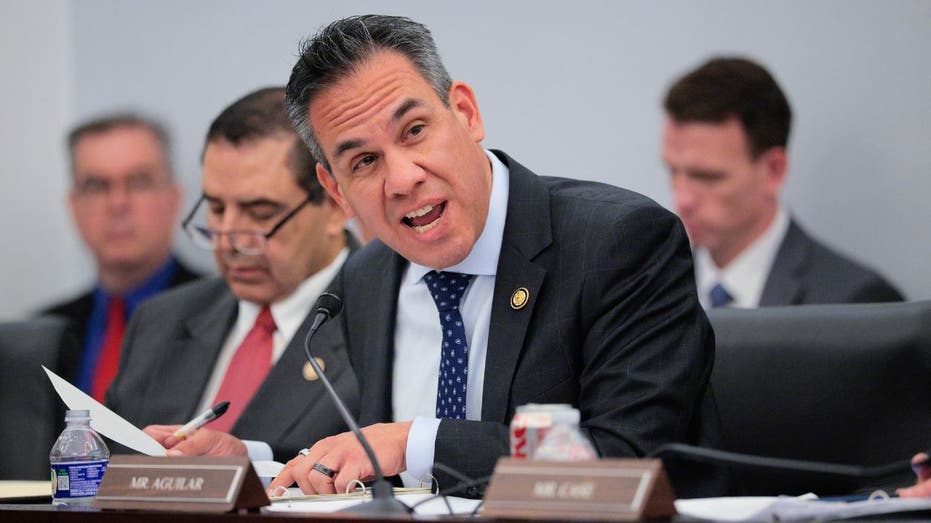
Pete Aguilar, the No. 3 Democrat in the U.S. House of Representatives, is facing sharp criticism in his home state of California over remarks he made opposing voter identification. At a press conference earlier this month he spoke against a measure on Californians' ballot this Election Day which, if passed, would require voters to show government-issued photo identification at the polls.
Just weeks after Aguilar's comments, the Department of Justice announced a crime bust in which several U.S. permanent residents were accused of registering to vote despite not being citizens. Republicans argue that the case proves exactly why the ballot measure, called Proposition 39, is needed.
Republican Representative Ken Calvert hammered Aguilar's opposition in blunt terms. He pointed out that people must show ID to board an airplane, cash a paycheck, rent an apartment or even buy cold medicine at a store, and called it complete nonsense — and an insult to every voter's intelligence — for Democrats to claim that requiring photo ID before casting a ballot is somehow racist or a form of voter suppression.
Another Republican representative, Vince Fong, said voter ID is basic election security that the vast majority of Americans support, and that 36 states already require it in some form. In his words, if ID is needed to rent a car, stay at a hotel, open a bank account or board a flight, the same logic applies to voting — and the Justice Department's recent voter fraud bust in California is exactly why such safeguards matter.
Representative Young Kim made a similar point, saying that showing photo ID is a simple standard already required to board a plane, purchase alcohol or pick up a prescription. This is not controversial and should not be complicated, she argued; elections deserve at least as much consideration as a beer or a bottle of wine.
Aguilar, for his part, criticised Proposition 39 at a press conference earlier this month alongside Democratic gubernatorial candidate and former Biden administration Cabinet secretary Xavier Becerra. He raised the scenario tried in Arizona, where voters were asked to put their driver's licence numbers on their ballots, and asked what happens if a voter misses a single digit — whether that vote would simply not count.
Aguilar also asked what would happen to Californians who are married but have not changed their name when they go to vote, and whether they would no longer be able to vote at all. He called the measure a voter suppression effort pushed by Republicans, saying Republicans can win only when they suppress the vote, and that Donald Trump and MAGA Republicans, bankrupt of ideas and solutions, are trying to change the rules of the game instead.
California's government, meanwhile, criticised the Justice Department's operation and pointed to reports saying that more of those charged were registered as Republicans than as Democrats. A release posted on Governor Gavin Newsom's state website said that for nearly a decade Trump has baselessly alleged that mass voter fraud rings were employed by Democrats and used illegal immigrants to sway elections across the country, often pointing to California.
The release added that courts at all levels have rejected claims of vast voter fraud and of elections being rigged against the president. In other words, California's Democratic administration holds that a federal enforcement operation should not be used as the argument for rewriting the state's voting rules.
The wider context is that voter ID laws currently exist in 36 states, and polls have shown they command the support of a majority of Americans. Even so, several efforts in Congress to pass federal voter ID legislation in recent years have been thwarted by Democrats.
With Election Day approaching, the California argument has become part of the national contest as well. Republicans are using Aguilar's earlier remarks to argue that his opposition no longer holds after fraud accusations surfaced in his own state, while Democrats counter that ID requirements can end up stripping eligible voters of their right to vote.
The final decision on Proposition 39 will be made by California's voters themselves on the Election Day ballot. Until then, attention will stay on how Aguilar answers the attack; his campaign was contacted for a response to his Republican House colleagues' comments, but no detailed reply had been reported by the time of this report.