Dengue Kills Four More in a Day as 1,512 Are Hospitalised; Patient Surge Strains Hospital Care
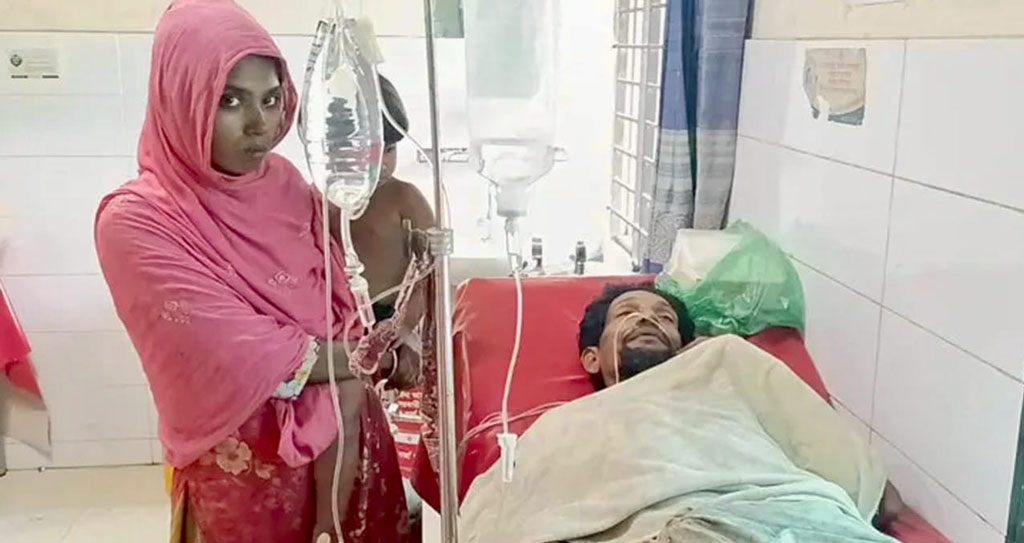
The stream of dengue patients shows no sign of stopping. Every day, large numbers of people infected with dengue are being admitted to hospitals, and the pressure is straining medical care in hospitals in the capital and across the country. According to the Directorate General of Health Services, four people died of dengue across the country in 24 hours.
The four deaths occurred between 8am on Wednesday and 8am on Thursday. In the same period, 1,512 new dengue patients were admitted to hospitals.
Compared with last year, the number of infected patients this year is almost double, and deaths are also higher. From the start of last year until 22 October, the number of dengue patients was 62,367. This year, from the start of the year until 22 October, 118,502 people have been infected — almost double.
The death toll is also alarming. By this time last year, 255 people had died of dengue. This year, 368 people have died, more than last year.
A visit on Thursday (22 October) to Shaheed Suhrawardy Medical College Hospital in the capital revealed the current situation. Nurses on duty said that although the dengue wards remain under pressure, beds have been somewhat emptier for two or three days because of the Puja holiday.
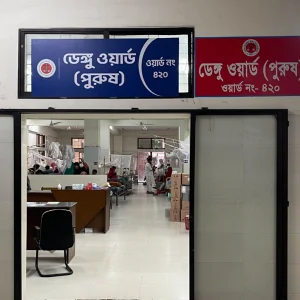
A nurse on duty in the male dengue ward said the ward has 50 beds and currently 38 patients. In her words, there is normally no room even to set foot there; the beds are a little emptier now only because of the Puja holiday, and such a scene is not seen at other times.
The nurse in charge of the women’s ward said it has 41 beds and currently 23 admitted patients. By 4pm on Thursday, 18 patients had been discharged. Patient pressure has eased somewhat because of the Puja holiday; four or five patients had arrived since morning that day, whereas before, all 41 beds of the ward were full.
She said ward number 420 of the hospital is designated for male dengue patients and ward 424 for female patients. In addition, separate corners for dengue patients have been made in various wards. When pressure rises in the two designated wards, patients are sent to those corners.
Mahiuddin Sarkar admitted his brother-in-law to the hospital on Thursday after he was infected with dengue. He said his brother-in-law had been ill for three days. On Wednesday he was at their home in Narsingdi, where a lab test returned a positive dengue result. He was then brought to the hospital in Dhaka. Mahiuddin said they had no problem getting a bed after arriving, treatment is going well, and the ward staff’s behaviour and quality of service are good.
Humayun Kabir Swapon has been at the hospital for four days with his younger brother, who has dengue. Swapon, who arrived on Monday, said they got a bed right away, had no problems, treatment is fairly good, and he has no major complaints about the doctors and nurses. However, the number of doctors felt somewhat low, which he thought might be because of the Puja holiday.
Swapon did complain about his experience in other wards, however. He said that while the dengue ward is fairly good, the condition of other wards is not. Recalling 25 days spent admitted with his father in another ward, he said men and women had to use the same washroom there — a situation much like a prison. Among the big problems is the shortage of lifts: such a large hospital, but only a few lifts.
He also described problems in getting emergency care. In his view, more ticket counters are needed in the hospital’s emergency department. Many patients come to a government hospital; seriously ill patients aged 60 to 85 in particular have to stand in long lines to collect tickets. Without a ticket, a doctor cannot be seen, which makes getting emergency treatment difficult. He believes adding counters with more staff if needed would benefit people.
A member of staff on duty at the hospital, speaking on condition of anonymity, described the manpower crisis. Large wards of the hospital hold 170 to 250 patients — how is it possible to serve so many patients with two nurses, he asked, noting that their own ward is run by one doctor and three nurses. Because of staff shortages in the large wards, doctors and nurses come under enormous pressure.
He said government hospitals receive far more patients, so the workload is much higher, but however many patients arrive, care must be given. After a new patient arrives, completing the necessary work takes at least 30 to 40 minutes — giving saline, arranging lab tests and blood, and taking measures according to the doctor’s advice, alongside talking to the patient and understanding their problems. There is a shortage of nurses almost everywhere now; without increasing manpower, this problem will not be solved, he said. In his view, it is not enough to check saline at the hospital — management, whether necessary equipment exists, and whether there is adequate manpower also need to be looked at.
All in all, with infections now almost double last year’s figure, the dengue situation is putting direct pressure on the hospital service system. Which way the situation goes in the coming days will depend both on the patient stream easing and on resolving the manpower crisis.