After the Riyadh Airport Attack: Where the Houthis' Arsenal Comes From, and Why Saudi Arabia Cannot Stop Every Strike
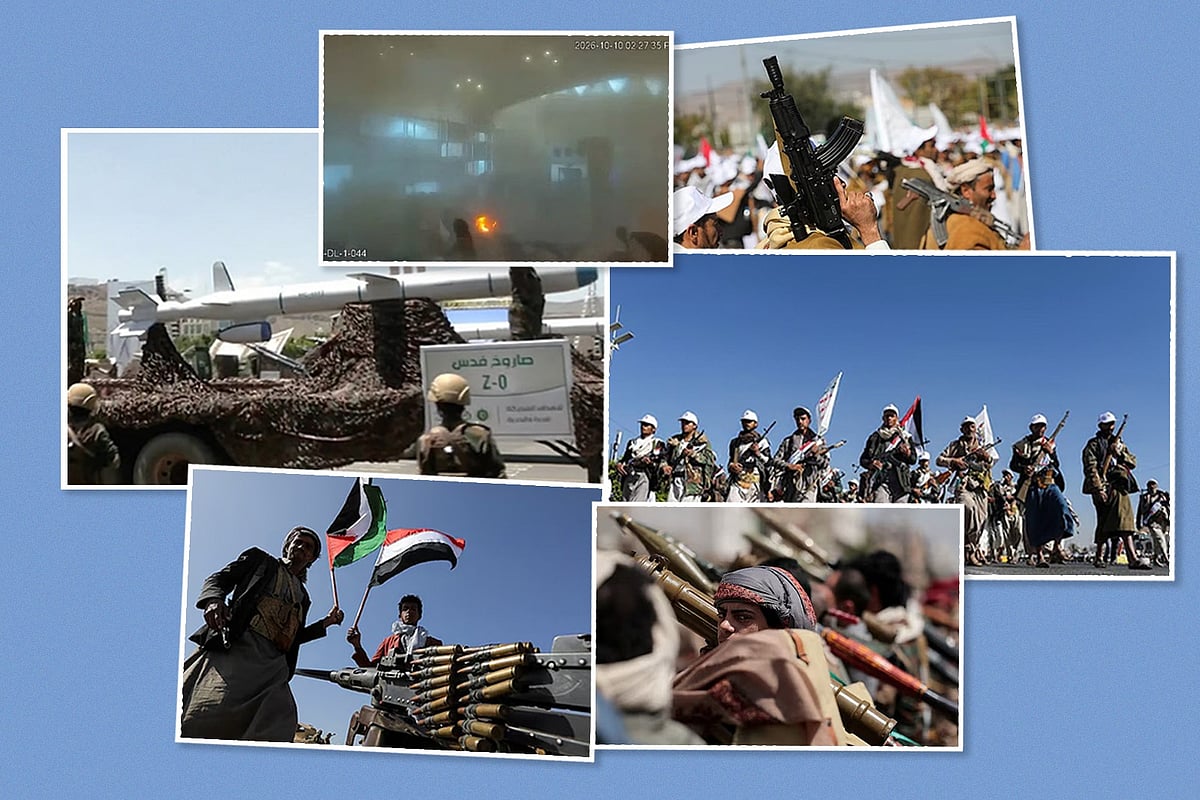
It was a Saturday, just past 3pm. Terminals 3 and 4 of Saudi Arabia's King Khaled International Airport — used for domestic flights — were crowded, with long lines of passengers passing through immigration, most of them recognisable from their clothing as Umrah pilgrims. At around 3:15pm, a sudden intense flash of light was followed by a huge explosion, and the scene was reduced to rubble in moments.
CCTV footage captured that missile strike inside the Riyadh airport on October 10. Yemen's armed Houthi rebels claimed responsibility. Twelve people were killed at the scene and more than three hundred were injured.
The attack was a shock not only for Saudi Arabia but for the world. The Middle East has been turbulent for years, but Saudi Arabia had largely succeeded in keeping that turbulence away from its own borders. Crown Prince Mohammed bin Salman has painstakingly presented his country as a hub for investment, tourism and major sporting events. Weeks of repeated Houthi strikes have shattered that bright, peaceful image at a stroke.
The Houthis belong to Yemen's Zaydi community, a branch of Shia Islam, in a country where the majority are Sunni. The Zaydis live mostly in Yemen's impoverished north. Alleging discrimination, the Houthis first rose in resistance in the 1990s.
The organisation was initially known as 'Ansar Allah', meaning 'supporters of God', and was later named after its late religious leader Badruddin al-Houthi. His son Hussein led the movement until he was killed by government forces in 2004. Another son, Abdulmalik, then took over, becoming known for fiery speeches — and under his leadership a marginalised group from the northwest became the force controlling the capital, Sanaa, and a regional power.
The Houthis' big breakthrough came in 2014, when they swept into Sanaa. In response, a Saudi-led military campaign against them began in March 2015 and Yemen descended into a devastating civil war in which hundreds of thousands died and a major humanitarian crisis unfolded. A ceasefire with the Saudi-backed Yemeni government followed in 2022; a large part of the country's north remains under Houthi control.
Today the Houthis field thousands of fighters, trained for combat in rugged mountain terrain and hardened by long war. They control the areas where much of Yemen's population lives, and their missiles and drones have become a major threat to the oil-rich Gulf neighbours.
The Houthis are part of Tehran's 'axis of resistance', alongside Lebanon's Hezbollah, Palestine's Hamas and various armed groups in Iraq. Saudi Arabia and the United States have long accused them of being an Iranian proxy, supplied with weapons and money by Tehran — charges Iran has always denied. Unlike Hezbollah, the Houthis do not regard Iran's supreme leader as the 'ultimate authority', but their relationship with Tehran has grown steadily closer over the years, especially after the Gaza war began in October 2023.
In 2024 the Houthis began attacking commercial shipping in the Red Sea, saying the vessels were linked to Israel and that the attacks supported Palestinians in Gaza. When the United States and Israel attacked Iran on February 28 this year, the Houthis joined the war on Tehran's side in March, claiming drone and missile strikes on Israel, though without causing major damage there.
After the Iran war, the Strait of Hormuz was effectively shut — before the war, a fifth of the world's oil and liquefied natural gas moved through it. That made the Bab al-Mandeb strait, the gateway at the southern end of the Red Sea and a key route between the Mediterranean and Asia, Saudi Arabia's most important oil export path. The Houthis pushed back government forces, seized the strait and a large stretch of the Red Sea coast, and began striking Saudi ships and oil infrastructure — putting the world's largest oil exporter in serious danger.
Saudi Arabia moved to crush the Houthis; people involved in the planning say a key aim of the proposed operation was to reverse the gains of the Houthis' rapid advance. But the Houthis have not let that plan succeed, answering strike with strike. In July, Saudi Arabia bombed Sanaa's airport to prevent a Houthi delegation from landing there, and tit-for-tat attacks have continued since. According to Saudi authorities, the Houthis have targeted Riyadh's King Khaled airport alone at least 20 times; most attacks were intercepted, but not all — and that is where the Houthis have gained the edge.
So how did their arsenal become this powerful? After seizing Sanaa, they captured a large share of Yemen's state weapons stockpile. Iranian technology and components, smuggling and their own production then enriched it further. According to Niranjan BS, a strategic weapons analyst at the defence intelligence firm Janes, those components have mainly entered Yemen across the Arabian Sea.
The Houthis possess a range of ballistic and cruise missiles and drones usable in the air and at sea. Several medium-range ballistic missiles are derived from Iranian models, including the 'Khaibar Shekan'. The short-range 'Asef' is modelled on Iran's 'Khalij Fars' anti-ship missile. The 'Quds-4' version of the Quds cruise missile family is believed to have a range of about 2,000 kilometres. Their drones include the 'Waed-1' and 'Waed-2', local versions of Iran's Shahed-131 and Shahed-136 one-way attack drones.
They also field the 'Palestine-2', a two-stage ballistic missile with an estimated range of about 2,000 kilometres and believed hypersonic capability. The 'Toofan' is thought to be a renamed version of Iran's 'Ghadr', with a range of 1,350 to 1,950 kilometres. There are also the short-range 'Burkan' and 'Badr' series, believed to be of Iranian origin.
A Middle East Institute report found that Iran has given the Houthis significant military support, especially in missile and drone systems. Components made in Iran are smuggled into Yemen by small boats, container ships or across the Oman-Yemen border, and assembled there. Media reports also say components have come from China, and Conflict Armament Research has uncovered a large network of foreign suppliers assisting the Houthi weapons programme.
A rebel group formed only a few decades ago has thus become a significant player in Middle East geopolitics, whose missiles and drones can reach Saudi airports, oil facilities and commercial ships. With Hormuz and Bab al-Mandeb — two main arteries of global energy — under pressure at the same time, the shockwaves of this conflict are not confined to the Gulf; their effect on world energy prices and supplies will remain a major question in the days ahead.