US officials dispute reports of migrant baby facing judge alone, laying out a detailed timeline
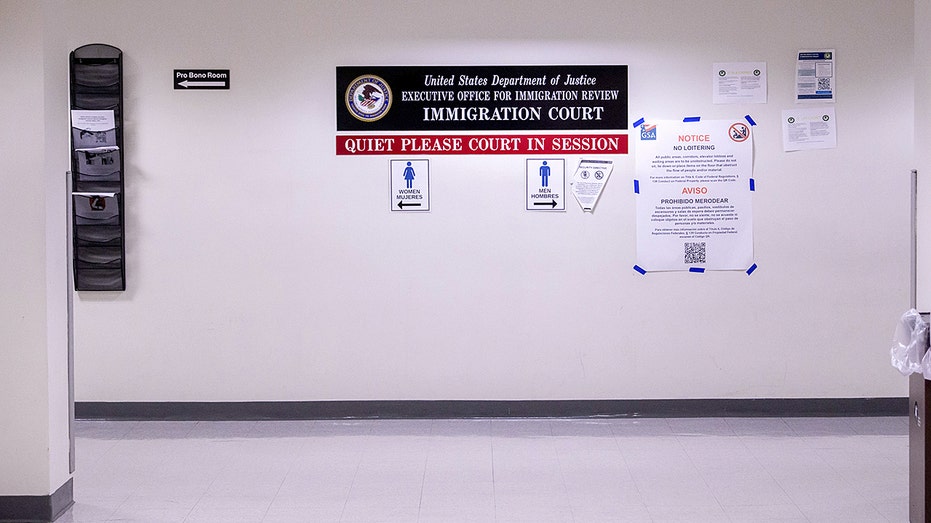
Officials at the US Office of Refugee Resettlement (ORR) have pushed back against reports that a one-year-old boy was left to navigate immigration court without counsel, saying the child was accompanied by his mother at every proceeding and that legal representation was later secured for him.
ORR Acting Director Angie Salazar and Senior Advisor John Fabricatori argued that contractor failures and a lack of invoice oversight created the initial court lapses behind headlines alleging systemic gaps in legal representation for children.
"We don't have this big movement where we have a bunch of 1-year-olds who are going to court," Fabricatori said.
According to the ORR timeline, US Customs and Border Protection officers first encountered the one-year-old boy and his 17-year-old mother near Naco, Arizona, on 25 June. The child was accompanied by his mother at all court proceedings, officials said.
The critical gap occurred in July under the agency's former contractor, the Acacia Center for Justice. On 1 July, Acacia completed legal orientation and consultation for the mother and child, but failed to file an E-28 notice of appearance before the immigration court.
Consequently, during the child's first scheduled court hearing on 8 July, no attorney was present — not even as a friend of the court — despite Acacia holding an active federal legal services contract at the time. The federal legal services contract with Acacia officially ended on 31 July.
According to federal contract records, the Department of Health and Human Services had awarded the Acacia Center for Justice a $356.3 million bridge contract for legal services for unaccompanied children in November 2023, under the Biden administration. Of that total, more than $236.9 million had been outlaid before the contract was dissolved. The network previously provided counsel to roughly 20,000 migrant children across the United States, according to its website.
Salazar said she had been signing off on invoices for legal services amounting to more than $20 million in some months. "So it made no sense to me that legal service providers were saying kids were unrepresented for a lack of funding," she said, adding that the invoices received were completely redacted, leaving no way to know exactly what service had been provided in a given month.
Following the end of the Acacia contract, the ORR entered into a $20 million contract with the US Committee for Refugees and Immigrants (USCRI), which expires on 31 December. USCRI officially initiated legal services on 5 August.
During an appearance on 7 August, the mother and child were granted additional time to obtain counsel, while USCRI representatives attended subsequent hearings on 17 and 28 August as a friend of the court.
On 31 August, a motion filed by the friend of the court and the mother requested court-appointed counsel at government expense, which was later denied by the immigration judge.
Progress continued into September: child advocates were officially appointed on 23 September, and USCRI filed a formal E-28 notice of appearance on 25 September to become the attorney of record. On 29 September, USCRI officially represented both mother and child in immigration court. The judge subsequently granted a continuance on 2 October, leading into a follow-up hearing scheduled for Friday.
Officials explained that the July breakdowns highlighted the core reason the administration terminated Acacia's multi-million-dollar contract. "USCRI was showing up in court as a friend of the court to ensure that there was at least somebody present in case Acacia did not show up," Fabricatori said. "Now, as those cases are being looked at, USCRI is able to go in and actually meet with these children and then represent them in a follow-up hearing."
Salazar emphasized that ORR officials track which children are represented by which lawyers on specific dates, while respecting attorney-client privilege. Fabricatori said the former provider had refused to provide those measurables, including the alien registration numbers needed to determine which cases it was actually representing.
Salazar noted that about 2 percent of migrant children in ORR custody are under the age of five. Another 85 percent are aged 13 to 17, with 62 percent falling into the 16-to-17 bracket.
"What we said to our new grantee, USCRI: 'We want you in 100 percent of the hearings where kids in our care are showing up to their immigration hearings,'" she said. "That is happening. I think we're at like 98 percent."
Fabricatori added that there are currently 1,690 migrant children in ORR custody. "Under Biden, they had 22,000 in care a day. So it's a very vast difference," he said. "We've been able to lower that census, get kids through the court process quicker, and get them back with their parents if possible."
The Acacia Center for Justice was also contacted for comment on the officials' account.