He Cut Off His Own Leg, Then Flew Out Hanging From a Drone: Ukrainian Soldier's 491 Days in the Kill Zone
Crouched in a small hole beneath the boiler of a bombed-out school, Kostiantyn Vlasenko faced a terrible decision: he realised that to survive, he would have to cut off his remaining leg. The 49-year-old Ukrainian infantryman was trapped in that boiler room for about eight months, and spent a total of 491 days on a drone-dominated battlefield.
Last February, a Russian drone strike cost Vlasenko his left leg. The same attack broke and twisted his right leg so badly that he could not even crawl. About three months later, he was forced to cut that leg off too — using a knife he had with him, then binding the wound with a bandage to stop the bleeding. That decision saved his life.
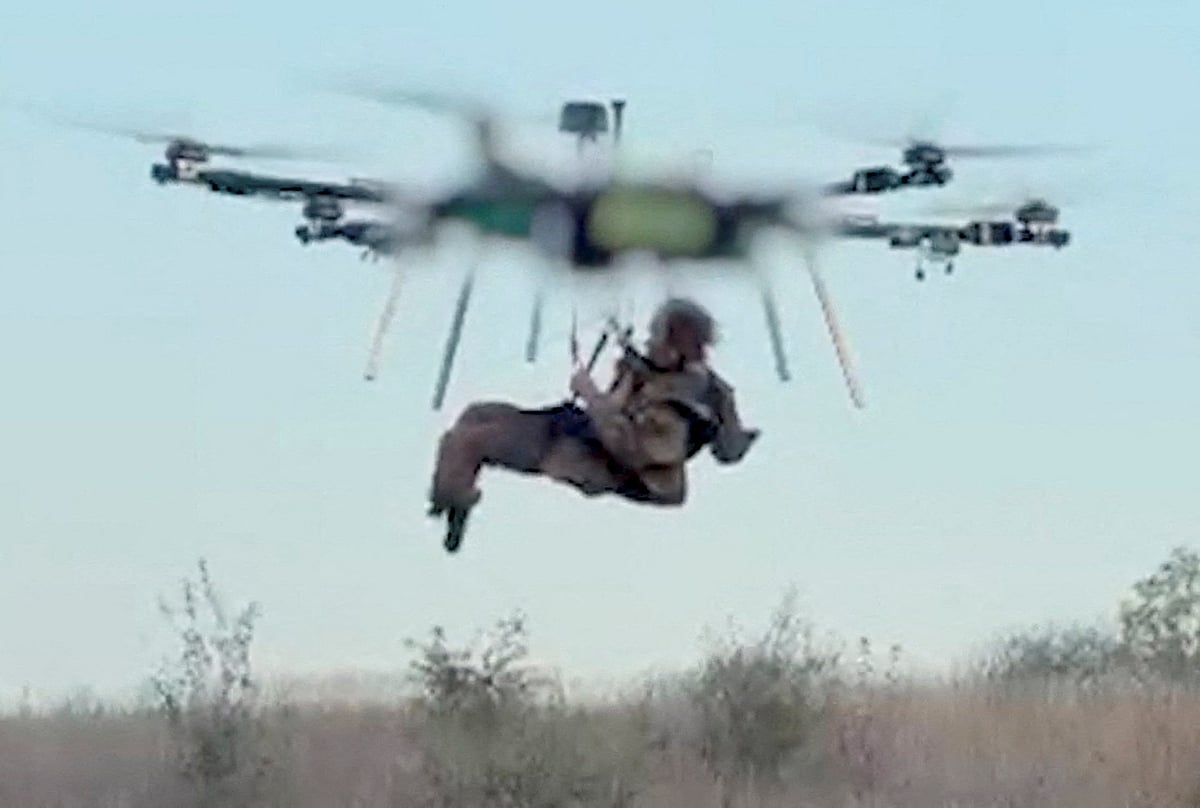
On 4 October he was rescued in dramatic fashion. A huge six-rotor drone, controlled remotely, lifted the harness-wearing Vlasenko into the air and carried him 15 kilometres (9 miles) to safety. According to Ukrainian commanders, it is the first known case of a soldier being evacuated by air by drone — in a five-year war in which drones have been used on an unprecedented scale and have changed the very definition of modern warfare.
The area is known as the 'kill zone'. Its skies swarm with drones; the slightest movement can mean death, and nowhere is safe. Soldiers on both sides are forced to dig deep into the earth, often trapped in their positions for months. Drone use has largely stalled Russia's advances, but casualties remain very high.
Vlasenko was deployed with the 30th Mechanized Brigade in the Kharkiv region. Sent to the front line last May, he joined a comrade named Basky. The two crowded into a small earthen hole, supplied daily by drones dropping food and other items from above; on Vlasenko's birthday, a drone even dropped chocolate and expensive cigarettes.
Last autumn, when rotation time came, two replacement soldiers were killed on their way in; two more sent to recover their bodies were also killed. The married soldier recalls that this was when he understood it was a turning point — that no one was going to get out of there.
After ten months together, Vlasenko and Basky were forced to abandon their position in mid-February when the hole flooded. They sheltered in a ruined school building, but the relief was short-lived. When they went outside to collect dry clothes and food packets dropped by comrades, a Russian surveillance drone spotted them.
Another Russian drone then dropped a bomb on them. Basky was killed on his 50th birthday. The blast shredded Vlasenko's left leg, and falling to the ground he badly injured the other leg too. Unable to move, he somehow took shelter in a hole beneath the school's old metal boiler — a space only about 80 by 60 centimetres.
Vlasenko says his left leg slowly 'rotted'. His lower right leg was so badly wounded that the bone was protruding. In the end he decided to cut that leg off as well: it had to be done, he says, because it was dangling behind him and the bone kept coming out further. After that, he had no legs left.
As Vlasenko began to lose hope, his commanders in the rear searched for a way to rescue him, planning with the 92nd Assault Brigade and other teams. An officer in charge of the rescue plan, who gave only the call sign 'Alex', said the drone threat made evacuation from the kill zone by pickup truck or armoured vehicle almost impossible. Wheeled driverless ground vehicles were tried, but two sent to reach Vlasenko were destroyed by Russian drones. At that point, the officer said, the rescue seemed impossible.
Then the officers learned of a new heavy drone built by a local company, Gurzuf Defence. With six vertical rotors and a black frame, it looks like a giant insect and can carry 90 kilograms up to 25 kilometres. After more than a year on the battlefield, Vlasenko was estimated to weigh about 70 kilograms; he would have to be flown 15 kilometres to a safe spot behind the lines.
At the start of October, Vlasenko found unexpected items in his regular supply drop: a belt and a phone loaded with an instruction video. He knew the risks, but understood it was his best chance of survival. The next day, 4 October, the six-rotor drone arrived. Vlasenko clipped himself to a carabiner hanging from the drone's cable, and the drone lifted him 70 metres (230 feet) into the air.
Three small drones escorted the main drone to distract Russian attack drones, while four Ukrainian small drones, artillery and large fixed-wing drones bombarded Russian drone positions for two straight hours to suppress enemy fire. After 15 tense minutes, the rescue drone reached its destination, whose exact location the military has kept secret for security reasons.
Lying in a hospital bed in Kharkiv, his two bandaged legs before him, Vlasenko told Reuters: 'I had already buried myself. I knew there was no hope of getting back alive.' Even after everything, the flight to safety brought its own fear. He was not afraid of falling, he said — falling somewhere in a forest would not have frightened him. What he feared was falling into water, because he cannot swim.
Ukraine's military has confirmed Vlasenko's ordeal and rescue; camera footage from the rescue drone also bears witness. One of the Ukrainian soldiers who has spent the longest time on the front line in the war against Russia is now recovering in hospital, the battlefield finally behind him.