From a 2.67 GPA in His First Semester to Harvard: Sylhet-Raised Asif Moktadir on Turning Around and Getting Admitted
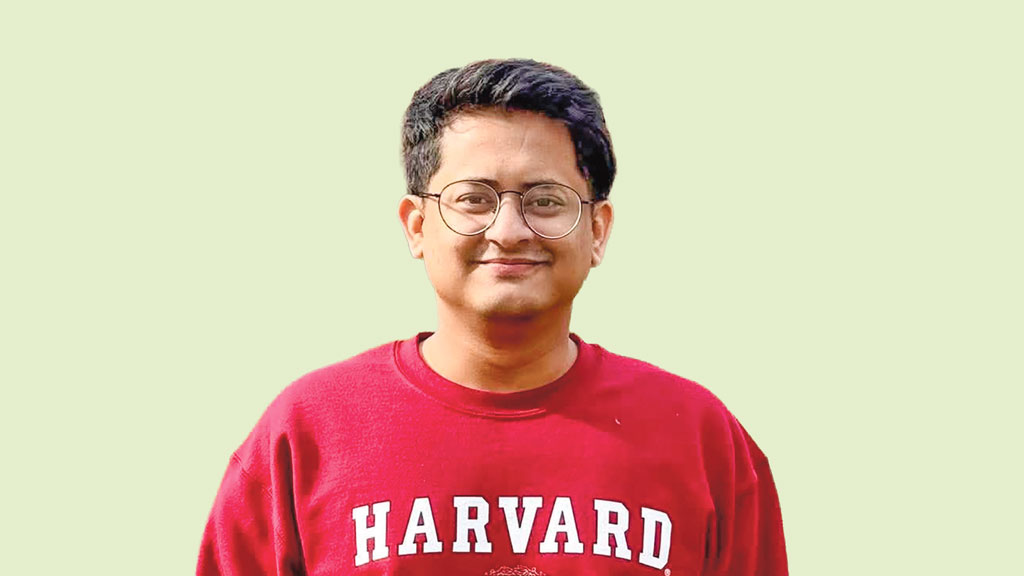
Asif Moktadir, who grew up in Sylhet, travelled to the United States with a dream of higher education. In his first semester at Buffalo State University, his GPA was just 2.67. He was unsure whether he would be able to continue his studies at all. That same Asif is now studying health policy at Harvard.
He told his story of struggle and recovery as a guest on Ajker Patrika's podcast “Successful People, How They Are.” The interview was conducted by Abdur Razzak Khan, and the conversation also produced his experience-based advice on the qualifications and preparation needed for admission to Harvard.
Asif said that when he went to America on a family visa, he never imagined he would be able to study at Harvard. After his higher secondary education in Bangladesh, he had studied for three semesters in the Genetic Engineering and Biotechnology department at Shahjalal University of Science and Technology. In America he had to start again from the beginning, which required a great deal of resolve.
After completing a bachelor's degree in Biological Science, he did a master's in Physician Associate Studies and later completed a doctorate in Medical Science. Working as a clinician, he felt he needed a still higher degree to serve patients better. To test himself, he applied to Columbia and Harvard. He was surprised to be accepted by both. After much thought, he chose Harvard. He is now in his first semester in Public Health there.
Describing the early challenges of studying in America, Asif raised three issues. The first was a lack of adequate information: how his three semesters of credits from Bangladesh would transfer, where to make contact, what the American admission process was and how he would pay tuition fees all worried him. The second was cost. And a major problem for immigrants is language, because they are accustomed to Bangla.
On cost, he said he was very fortunate to receive government assistance as an undergraduate, so he did not have to spend much from his own pocket. For his master's and doctorate he took loans, which he will repay gradually. He began working in a coffee shop, not to pay tuition, but for his own expenses and to help his family a little. That is very normal in America, he said; professors' children also work in restaurants or retail stores, and his own university adviser had worked in a coffee shop.
Asif also spoke frankly about his own mistakes behind the first-semester setback. At a public university in Bangladesh he used to take 20 to 22 credits a semester. In America students usually take 12, 15 or 18 credits, which he had not understood. Out of stubbornness he took many difficult courses. Fear of the language, adjusting to a new education system, and balancing study with work and life together made the period hard.
Seeing his first-semester result, he wondered whether he could continue. But he did not want to waste the opportunity after coming so far. His childhood dream and his parents' dream were in his mind. He kept in regular contact with professors, asked American friends about their study methods and watched how they studied. In that way he found a rhythm, and then received three Dean's Awards.
Having completed three semesters in Bangladesh, he was able to transfer about 35 credits, so he finished his bachelor's degree in three years instead of four. The university was near his home and tuition was comparatively low. At first he was afraid to ask questions in English in class and sat quietly at the back, worried what teachers and classmates would think if he made mistakes. Later he understood he could not advance without asking questions and mixing with others. He then began practising spoken English, asking questions and joining group study, which also taught him about the cultures of different countries.
Explaining why he chose Harvard, Asif said his goal was to study in the Ivy League. Columbia's result came first and gave him confidence. But he had decided at the time of applying that if it was not Harvard, he would not study further. He likes the city of Boston, Harvard has brand value and a worldwide alumni network, and great scientists and famous figures come to give seminars. Another major reason is cross-registration: even while studying Public Health, a student can take classes at the Business School, the Medical School and even at MIT.
His advice on admission qualifications is to keep extracurricular activities, undergraduate CGPA, the statement of purpose and recommendation letters strong. Harvard does not look only at GPA; it wants to see why an applicant wants to study a particular subject. Writing the statement of purpose should begin as early as possible, because it needs repeated editing. The admissions review committee does not know the applicant, and that statement is the only medium through which the applicant is introduced to them. Copying artificial intelligence or online templates will not work, because everyone's reasons are different. The statement must tell the story of what event in life inspired the applicant to study the subject. If the CGPA is low, the reason can be mentioned briefly. Generic writing such as “I am very hardworking, I want to help people” will not do; it must be written so the review committee says it wants that student in its department.
For recommendation letters, his advice is to take a letter from someone who knows the applicant well. A famous professor who does not know the applicant will write a generic letter, and committees receive thousands of such letters. Someone who knows the applicant can properly present their research, how they overcame weaknesses, their strengths and where they may be in five years. The request must be made well in advance, because professors are busy. On extracurricular work, too, he believes it is a mistake to get involved in everything and list it all, as that suggests there was no specific goal. Work related to the intended subject should be done, such as olympiads, debate, coding competitions or writing a book.
On cost, Asif said Harvard is extremely expensive. Departments offer their own scholarships, yet the remaining amount is still large. After admission, contacting the financial aid office brings lists of internal and external scholarships. Many scholarships are small, but applying to several can reduce tuition considerably. His knowledge of applying from Bangladesh is limited, because he applied from America. Asif likes writing; two of his books were published at the 2022 and 2023 book fairs. Many referred patients do not follow up for language or other reasons; to help them he runs a non-profit organisation called “Referral Assist,” where volunteers help with taking appointments and reminders. Another non-profit, “Achieve,” aimed to hold seminars on career choices for students. He has also worked in journalism. His journey is now a practical example for many students: a first setback is not the final word, and it is possible to turn around by changing method.