53 Years of the Marine Fisheries Academy on the Karnaphuli: Training the Heroes of the Blue Economy
On the banks of the Karnaphuli River in Chattogram stands the historic Marine Fisheries Academy, playing a pioneering role in harvesting the sea's endless resources and turning the promise of the blue economy into reality.
By providing international-standard training in oceanography, marine engineering and nautical science, the academy has become a centre for producing trusted, skilled manpower for the maritime sector. Its principal, Captain Faiz Uddin Ahmed, has spoken about the many aspects of study and careers there.
Captain Faiz Uddin Ahmed said that in its 53 years, the academy has made special contributions through modern marine education and research to creating new knowledge about the formation and dynamics of the Bay of Bengal, the management and farming of fish and other natural resources, biodiversity conservation and coastal livelihoods. That knowledge is playing an important role in setting Bangladesh's blue-economy goals and building its capacity.
The principal added that, to raise the academy into a world-class maritime institution, the Department of Architecture has prepared a modern master plan design for its existing 10.33 acres of land. The design has already been approved by the administrative ministry, and work is under way to prepare a DPP for including the master plan in the TO&E and taking up the project.
The academy stands on 10.33 acres in the Ichhanagar area of the fishing port, on the opposite bank from Chattogram's Sadarghat, 10 nautical miles inside from the mouth of the Karnaphuli River.
Its history goes back to the period after the Liberation War. To remove war-wrecked ships and mines from the Chattogram port channel in the Bay of Bengal and make the port usable again, the then government of Bangladesh appointed Russian experts.
Recognising the need for sustainable use of Bangladesh's marine resources, the study of oceanography and the creation of skilled manpower, the Marine Fisheries Academy was established on 1 September 1973. At the start it was a development project of the Bangladesh Fisheries Development Corporation under the Ministry of Fisheries and Livestock.
Later, from 1 July 1993, the academy emerged as an institution under the government's revenue budget. Under its approved organisational structure, the principal, as head of the institution, runs all its activities according to the administrative ministry's directions.
After Bangladesh won its vast maritime boundary in the Bay of Bengal, a new door of blue economy opened before the country, and the biggest challenge in realising it is filling the shortage of specialised, skilled manpower. From the beginning, the academy has been training marine cadets to international standards.
Cadets graduating from here work with distinction not only on domestic fishing vessels and merchant ships but also in international fleets, earning foreign currency. The academy's remit includes building skilled manpower for deep-sea fishing vessels, trawlers and commercial ships, ship engine operation, shipbuilding and repair, and the fish processing and quality control industry.
The academy runs graduate-level education including pre-sea training. It also provides ancillary training to naval officers and sailors in essential subjects including basic safety at sea, and refresher courses to prepare officers for the Certificate of Competency examination. There is also a four-year BSc (Honours) course.
So far, about 2,353 cadets, including 94 women cadets of the 44th batch, have completed pre-sea training at the academy and received certificates. In 2011, from the 32nd batch, women cadets were given the opportunity to enrol for the first time alongside male cadets.
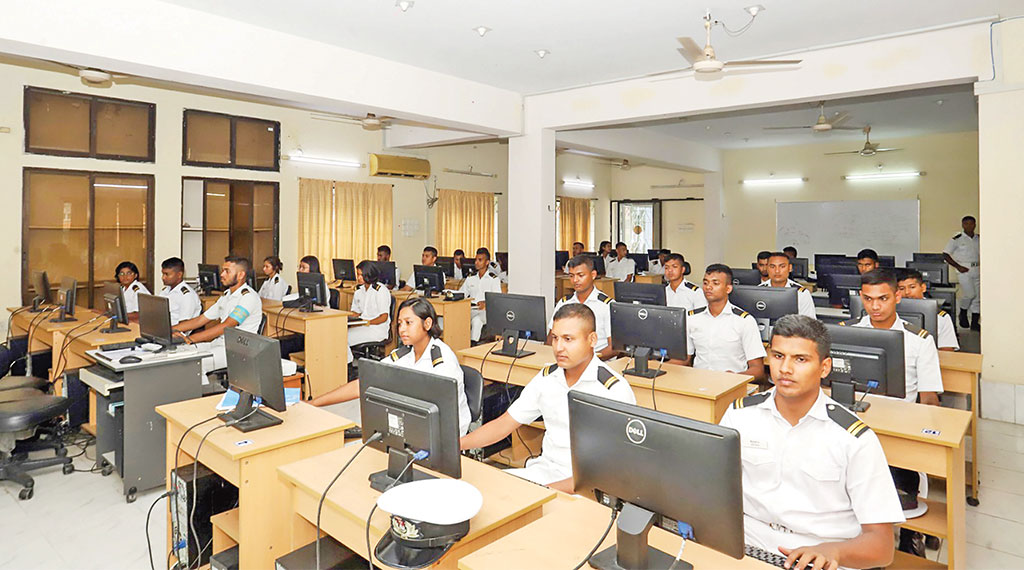
To make cadets skilled in fish harvesting, modern trawler operation, marine environment protection and modern navigation technology, the academy has added state-of-the-art simulators, laboratories and practical training facilities. There is also an ICT lab with 40 workstations, a marine workshop, an electrical lab, a seamanship lab, a library, a swimming pool and a fire-fighting simulator, while ICT and digitisation have been included in the course curriculum.
Through skilled manpower development, foreign currency earnings, employment in the international arena and contributions to diverse industrial sectors, the academy continues to play a role in Bangladesh's socio-economic development. The authorities hope that, alongside its contribution to the blue economy, the academy will also play its desired role in building a 'new Bangladesh' — after the conquest of the sea, this institution is now raising the real heroes of that conquest.