
Prime Minister Tarique Rahman in Tokyo: One trillion yen in possible Japanese investment, no specific figure announced yet
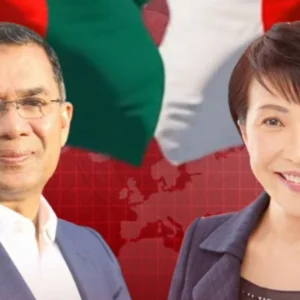
Prime Minister Tarique Rahman arrived in Tokyo on Monday, 26 October, on a four-day state visit at the invitation of Japanese Prime Minister Sanae Takaichi. On the first day he met former Japanese Prime Minister Taro Aso, the President of the Japan International Cooperation Agency (JICA) and the Chairman of Marubeni Corporation.
Discussion covered a plan to attract one trillion yen, or about 6.35 billion dollars, in private investment from Japan over the next five years. However, the full amount is not confirmed investment and no specific figure for new investment was announced during the visit.
The meetings discussed expanding investment in information technology, artificial intelligence (AI), renewable energy, advanced manufacturing and fertiliser plants. Improving the investment environment, creating new business opportunities and increasing Japanese cooperation in ongoing development projects were emphasised.
In a meeting with Masumi Kakinoki, Chairman of Marubeni Corporation and President of the Japan-Bangladesh Committee for Commercial and Economic Cooperation (JBCCEC), the Prime Minister called for more Japanese investment in information and communication technology, renewable energy and advanced manufacturing. He noted major investment opportunities in these sectors through foreign direct investment (FDI) and public-private partnership (PPP).
That meeting also sought Japanese cooperation to modernise Karnaphuli Fertilizer Company Limited (KAFCO) and assess the possibility of building a second fertiliser plant in Bangladesh. However, no investment amount, financing structure or implementation timeline was announced.
Marubeni's chairman expressed hope that trade between the two countries would increase and new business opportunities would be created through effective implementation of the Economic Partnership Agreement (EPA). The Prime Minister said, 'The government is committed to ensuring an investment-friendly environment. Regulatory reform, simplifying investment approval processes and strengthening public-private partnership are under way for that purpose.'
Earlier, on 11 October, a Marubeni delegation led by its President and CEO Masayuki Omoto met the Prime Minister in Dhaka. That meeting discussed cooperation in information technology, AI, cyber security, fertiliser and energy, and expanding Japanese investment in Bangladesh.
In a meeting with JICA President Dr Tanaka Akihiko, the Prime Minister stressed completing major ongoing development projects on schedule and quickly advancing priority projects awaiting approval. He requested continued concessional loan support, increased technical cooperation and, considering the global energy situation, budget support as in the previous year.
The meeting also proposed increased cooperation on a Bangladesh-Japan skills development partnership, establishing a technology and innovation city, agricultural modernisation, agro-processing and light engineering. The JICA President reaffirmed a commitment to work together for Bangladesh's prosperity, but no specific figure for new loans or assistance was announced.
On the first day, Tarique Rahman also met a delegation of the Japan-Bangladesh Parliamentary Friendship League led by former Prime Minister Taro Aso. Cooperation was sought there on increasing political, economic and people-to-people contacts, as well as Japanese investment, technology transfer and skilled human resources. At the same meeting, the Prime Minister sought Japan's cooperation for the safe, voluntary and dignified repatriation of Rohingya displaced from Myanmar.
According to the Export Promotion Bureau (EPB) and Bangladesh Bank, bilateral trade between Bangladesh and Japan exceeded 3.28 billion dollars in fiscal 2024-25. Japan is now Bangladesh's ninth largest export destination. Bangladesh exports ready-made garments and other products to Japan and imports cars, electronics, iron and steel and other industrial products from Japan.
According to EPB, in July-September of the current fiscal 2026-27, Bangladesh's ready-made garment exports to Japan were 343.65 million dollars and Japan's share of the country's total garment exports rose to 3.25 percent.
Dr Fahmida Khatun, Honorary Fellow of the Centre for Policy Dialogue (CPD), said, 'Japan's plan to attract one trillion yen or about 6.35 billion dollars in private investment to Bangladesh over the next five years has created a major possibility for Bangladesh. But this money is not yet confirmed investment. Turning the plan into reality will depend on finalising specific projects and investors' decisions.'
She said implementation could create opportunities for new factories in vehicle production, industry, energy and special economic zones, and for technology and skills transfer, quality employment and development of local suppliers. But she said policy continuity, uninterrupted energy supply, fast administrative approvals, improved ports and transport, skilled labour and contract certainty must be ensured.

