Measles with pneumonia complications: critically ill children from Jashore and Noakhali rely on Dhaka children's hospital
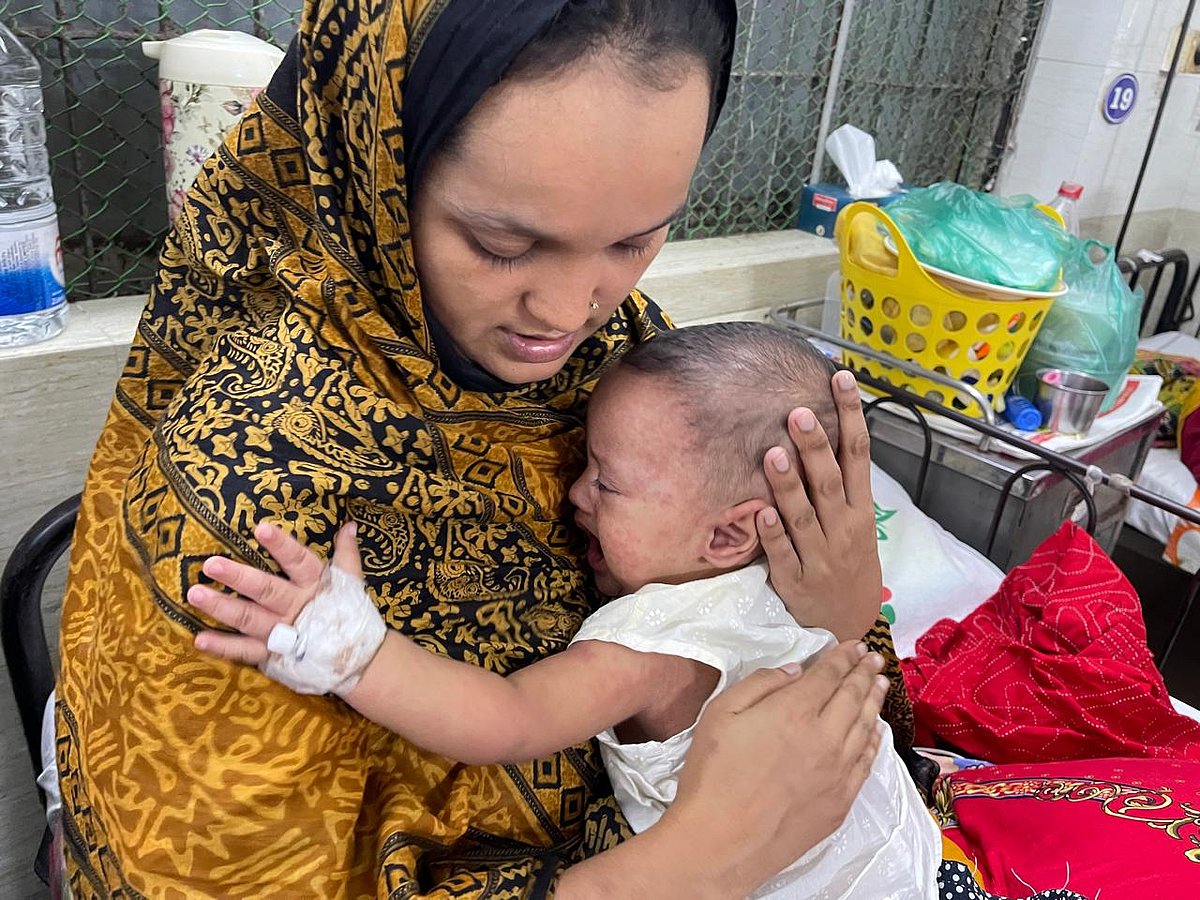
Sanzida Khatun has come to Dhaka from Jhikargacha in Jashore with her two-month-and-27-day-old son Ayman Sadik. When the child developed pneumonia and severe breathing difficulty, he was kept for 16 consecutive days in the intensive care unit (ICU) of a local private hospital. His condition did not improve; instead, the pneumonia complications after measles increased further.
With no alternative, Sanzida Khatun brought the critically ill Ayman to Bangladesh Shishu Hospital and Institute in the capital. After treatment there, the child's condition has improved somewhat, but his cough and breathing difficulty have not completely gone.
Not only Ayman from Jashore — children arriving from remote areas of Noakhali are in a similar condition. Nurjahan Begum has come to Dhaka from the Jahajmara area of Hatiya, the island upazila of Noakhali district, with her two-year-old daughter Hamida.
Nurjahan Begum said her daughter had fever and a rash for 15 to 20 consecutive days. At one stage, a blood test also detected malaria. Later, when severe breathing difficulty began, she brought her daughter to Dhaka.
Nurjahan Begum complained that even after arriving in Dhaka in such a critical condition, they initially faced difficulty getting the oxygen they needed at the hospital.
In the case of seven-month-old Raizan, from Companiganj in the same district, measles was detected after pneumonia. Even after seven consecutive days in the ICU, his breathing difficulty has not completely gone.
Children infected with measles are thus being brought to the children's hospital in the capital from various districts and remote areas in complex and critical condition. Doctors say two major crises have arisen for these children — why the disease is reaching a severe stage, and what kind of treatment they receive after arriving at the hospital.
The hospital's director, Professor Mirza Md Ziaul Islam, said the main problem is being created by delays in starting treatment. Because measles is not correctly identified in remote areas and cases are left untreated even after symptoms such as pneumonia appear, the condition deteriorates rapidly.
Professor Ziaul Islam said the biggest complication of measles is pneumonia. Malnutrition has been added to that. About 90 percent of the children arriving at the hospital are suffering from malnutrition. Because of malnutrition, their immunity has completely broken down, putting their lives at risk.
The hospital's medical officer, Marzia Afroz, said children from newborn to two years of age are at the highest risk from measles. The risk is especially severe for children who have not received regular vaccination.
Marzia Afroz said that if diarrhoea, vomiting, seizures or pneumonia appear alongside measles, breathing difficulty cannot be managed with ordinary oxygen. At that point it becomes difficult to save the patient without an intensive care unit (ICU) and even ventilation.
According to hospital authority sources, about three and a half thousand children infected with measles have so far received treatment at this hospital. At least 97 to 98 of those children have died. At present 97 children are under treatment at the hospital, of whom 25 were newly admitted on Monday alone.
Most of the infected children need round-the-clock oxygen and ICU care. But although the hospital has 700 beds in total, it has only 14 ICU beds. As a result, ensuring ICU care for critical patients is often difficult.
A shortage of care staff has been added to that. Dr Marzia Afroz said that compared with the number of complex patients arriving, the number of doctors, nurses and other staff per patient is very low.
Director Professor Mirza Md Ziaul Islam claimed that despite the shortage of doctors, they are trying to keep services normal. About 300 doctors are currently working at the hospital. A plan has been taken to recruit 50 more doctors within the next month to make services more dynamic.
Doctors say the main way to ensure children do not reach a critical condition is to ensure regular vaccination at the scheduled time. If a child shows fever, cold and cough or a rash on the body, parents should not neglect it and should take the child to a doctor at the outset. Experts have urged that as soon as any danger sign such as breathing difficulty, seizures, repeated vomiting or diarrhoea appears, the child should be taken quickly to a specialised hospital without wasting time.