
Voting in Israel: today's election will decide whether Netanyahu stays
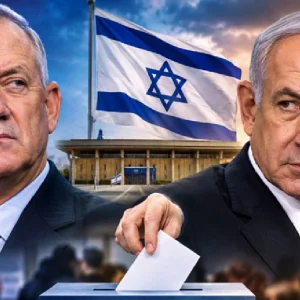
Israeli citizens will give their verdict on Tuesday (27 October) in today's election on the future of long-serving Prime Minister Benjamin Netanyahu and the country's shift towards the right. News agency AFP reported this.
The election, expected to be closely fought, is being held at a time when Israel is becoming increasingly isolated internationally.
About 7.3 million people in Israel are going to vote. Among them, more than 500,000 young people will vote for the first time. In Israel's 120-seat parliament, 61 seats are needed for a majority. No single party is thought likely to come close to that number in the election.
The latest published opinion polls show Israel's longest-serving prime minister Netanyahu almost level in popularity with his main rival, the centrist Gadi Eisenkot. Former army chief Eisenkot is new to politics.
According to the polls, most first-time young voters consider themselves followers of centre-right or right-wing political ideology. Tens of thousands of Israelis are also thought to have returned to the country from abroad to vote in this election, considered important for determining Israel's future course.
Netanyahu, 77, has served as Israel's prime minister for more than 19 years in total, with breaks. In his election campaign he placed special emphasis on his experience. He also brought forward his relationship with US President Donald Trump. Netanyahu claims only he has the ability to keep Israelis safe.
Since 7 October 2023, under Netanyahu's leadership Israel has become involved in multiple wars. In those wars, vast areas of Gaza have been reduced to rubble, Israeli forces have taken positions in southern Lebanon, and Israel, with US support, carried out a large attack on Iran for the first time. At the same time, inside the country Israelis have also faced attacks from Iran, Hamas, Lebanon's armed group Hezbollah and Yemen's Houthi rebels.
Netanyahu returned to power again in December 2022. At that time he included far-right and hardline nationalist parties in his government. Since then, the influence of those parties in Israeli politics has increased significantly.
Opponents are criticising Netanyahu for taking a position in favour of keeping ultra-Orthodox Jewish religious students exempt from compulsory military recruitment, despite a shortage of manpower in the military. His government's dependence on ultra-Orthodox Jewish parties in this area is also one of the reasons for the opposition's criticism.
However, one of the biggest accusations against Netanyahu is that he has not accepted responsibility for the 7 October 2023 attack. That attack is considered the deadliest day in Israel's history.
Former army chief and 66-year-old opposition leader Gadi Eisenkot has promised to form an independent commission of inquiry to investigate the security failures behind that attack. An informal alliance of various political parties has formed under Eisenkot's leadership with the aim of ousting Netanyahu. The alliance, led by his party 'Yashar', includes parties of various ideologies from right-wing to centre-left.
Eisenkot has opposed the establishment of a Palestinian state and expressed support for Israeli settlements. At the same time, however, he has promised strict action against Jewish settlers involved in violence.
Neither Netanyahu nor Eisenkot has publicly announced forming a governing coalition with parties mainly representing Arab voters. Arabs make up about 21 percent of Israel's total population. If the election result is by the expected margin, those parties could play a decisive role in forming a government.
It may take a few days for the final result to be published. After that, reaching an understanding among various parties to form a government could take a few weeks, even a few months. If the understanding among the parties fails, a situation could arise for holding a new election in the country again.

