
A new ice age began, then stopped: Barnes Ice Cap study shows human influence, scientists say
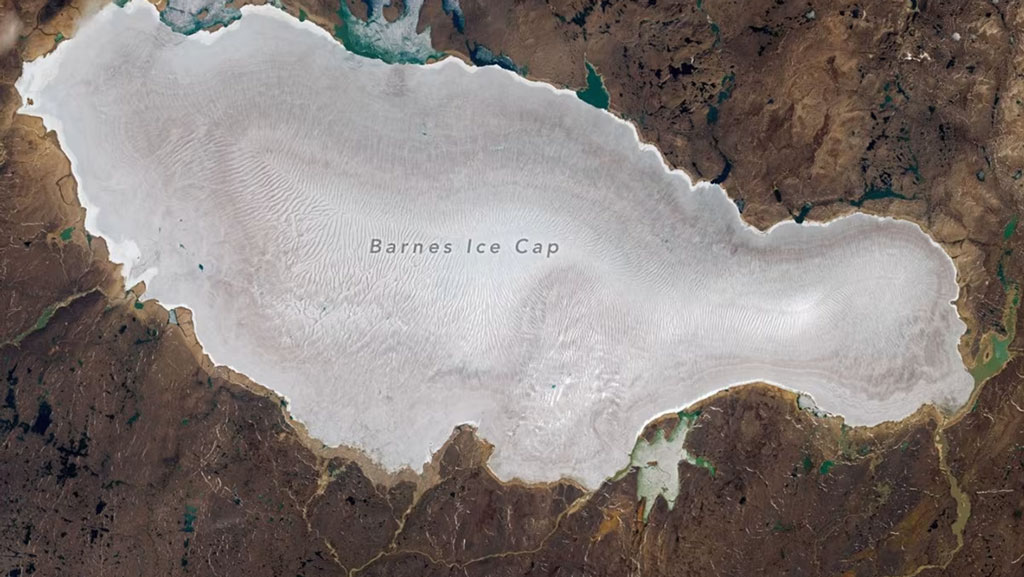
As greenhouse gases have risen in the atmosphere from the burning of fossil fuels, the onset of Earth's next ice age has probably been halted. That finding comes from a new study of an ice cap in Canada's Arctic region, published in the journal Science.
Scientists have warned, however, that this should not be seen as good news for humanity. In their view, the study is proof of the deep influence humans now exert on Earth's natural systems.
According to the research, around 20,000 years ago the vast Laurentide Ice Sheet stretched from the Arctic Circle to the US state of Illinois. In places it was nearly two miles thick. Surviving as a remnant of that huge ice sheet is the Barnes Ice Cap on Baffin Island in Canada's Nunavut region, roughly the size of the US state of Delaware.
The study found that about 3,000 years ago the Barnes Ice Cap shrank to its smallest extent. Then, as temperatures fell, it began slowly expanding again about 2,000 years ago. Researchers say that expansion could be considered the early beginning of a new glacial period, or ice age.
But around the 1960s the picture changed dramatically. As human-caused global warming pushed summer temperatures up, the ice cap began shrinking again.
Nicholas Young, a geochemist at Columbia University's Lamont-Doherty Earth Observatory and one of the study's authors, said a new ice age had been beginning and everything had been proceeding naturally, but then the process suddenly stopped. In his words, it is a powerful example of how large a change humans can make to Earth's natural systems.
To trace the ice cap's past movements, scientists collected ancient moss buried beneath the ice and dated it. They also analysed radioactive isotopes in nearby rocks to learn how long those rocks had been ice-free. From that evidence they reconstructed the history of the ice sheet's expansion and retreat.
Scientists differ, however, over the interpretation. Meredith Kelly, a professor at Dartmouth College in the United States, praised the study's methods but stressed the need for comparative analysis with glaciers in other regions.
Andre Ganopolski, a physicist at Germany's Potsdam Institute for Climate Impact Research, argues that even without global warming the next ice age might have taken another 50,000 years or so to begin. In his view, there is not enough evidence to call one ice cap's expansion the start of a new ice age.
In the 1970s, some scientists' belief that Earth was heading towards a new ice age drew wide media discussion. Newsweek magazine's report, headlined 'The Cooling World', was also much discussed at the time. Climate-change sceptics often cite those forecasts as an example of scientists being wrong.
Young says the new research offers a chance to look at that debate afresh. But he cautioned that it would be wrong to conclude that global warming has saved humanity from the danger of an ice age. Ice-age changes unfold over thousands of years. Rather, the study shows how profoundly human activity has altered Earth's climate system. Scientists fear the influence of greenhouse gases could also push back the possibility of a future ice age for a long time.


