Registration now mandatory for e-rickshaws, maximum five per national ID: what the new rules say
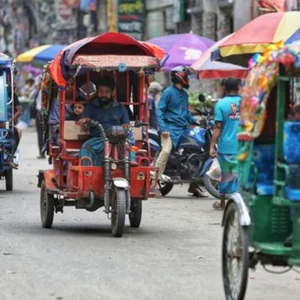
The government has made registration mandatory for battery-run rickshaws in city corporation areas. At the same time, these slow-moving vehicles have been banned from national highways, expressways and main bus routes.
The Local Government Division issued the gazette notification on Thursday (29 October). Titled the 'Three-Wheeled Low-Speed Battery-Run Rickshaw (E-Rickshaw) Movement Rules, 2026' for city corporation areas, the rules will apply to all city corporations in the country. They replace the earlier notification issued on 14 December 2025.
The rules set out provisions on e-rickshaw registration, routes, speed limits, parking and battery charging. A maximum of five e-rickshaws can be registered against a single national identity card (NID).
The fees have been set as follows: the one-time registration fee is 8,000 taka for a two-passenger e-rickshaw and 10,000 taka for a four-passenger one. Renewal will cost 4,000 and 5,000 taka respectively, while the fitness certificate fee is 1,000 taka.
After an application is submitted in the prescribed form with the necessary documents, the authorities will verify them. If the technical and safety standards set by BUET are met and the documents are in order, registration must be given within 30 working days. If an application is rejected, the reasons must be given in writing within seven working days; the applicant may appeal to a higher authority within 10 working days, and the authority's decision will be final.
Registration will be valid for five years. Every registered e-rickshaw will get a separate QR-coded number, a number plate and a blue book, and the plate must be fixed in a visible place. A person may register up to five e-rickshaws from one or more city corporations against a single NID, but an e-rickshaw registered in one city corporation cannot be run commercially in another.
For registration and renewal, the BUET technical and safety standards must be met, along with a fitness certificate and the countersignature of a traffic department representative; without these, registration or renewal cannot be granted. E-rickshaws already in operation can also be brought up to the prescribed standard through necessary structural changes.
An e-rickshaw's economic life will be 12 years from the date of registration; after that period, its registration and number plate will be cancelled. Every e-rickshaw must have a speedometer. Defective or unregistered e-rickshaws cannot be operated. If a vehicle becomes unfit to run because of a mechanical fault, a sign reading 'unfit to operate due to mechanical fault' must be displayed visibly on it and repairs arranged.
The city corporation and the traffic department will fix specific routes and zones for e-rickshaws, and a rickshaw registered in one zone will not be allowed to enter another zone. With the government's prior approval and in consultation with the traffic department, each city corporation will determine the number, routes, zones and colour of e-rickshaws.
E-rickshaws will not be allowed on prohibited roads including national highways, expressways, elevated expressways, main bus routes, Bus Rapid Transit (BRT) corridors and footpaths. They must keep to the left side of the road, illegal overtaking and lane changing are barred, and drivers cannot use mobile phones while driving.
Passenger limits have also been fixed: a two-passenger e-rickshaw may carry no more than three people including the driver, and a four-passenger one no more than five including the driver. No commercial goods may be carried other than passengers' hand luggage. The horn's sound level cannot exceed 40 decibels.
The maximum speed limit for e-rickshaws is 25 kilometres per hour. Near schools, hospitals, places of worship and crowded areas, however, they cannot be driven faster than 15 kilometres per hour.
The authorities may arrange training for drivers in traffic law, road safety and battery-run rickshaw maintenance, with help from recognised training institutes. In consultation with the traffic department, the city corporation will arrange parking for e-rickshaws in every ward or at suitable places.
Batteries may be charged only at charging points approved by the authorities and licensed by the city corporation, or at designated garages. The rules call for renewable energy, especially solar power, to be used for charging. Charging stations, garages and battery-swap centres may be set up under public-private partnerships, in consultation with the local electricity distributor and the traffic department and with government approval. Illegal use of electricity will be dealt with under the existing law.
The Environment Conservation Act, 1995 and its rules and directives must be followed in the production, import, use, recycling and management of e-rickshaws and their batteries. Old or defective batteries cannot be dumped in open places, soil, water bodies or with general waste; burning batteries is also prohibited.
Banks, financial institutions and government, autonomous and private organisations may provide loan support to drivers and owners for approved vehicles and the necessary infrastructure. E-rickshaws operating in violation of the rules may be stopped jointly or separately by the traffic department, law-enforcement agencies and executive magistrates.