Japan visit outcome: up to 100 billion yen in private investment possible in five years, 200,000 jobs may be created
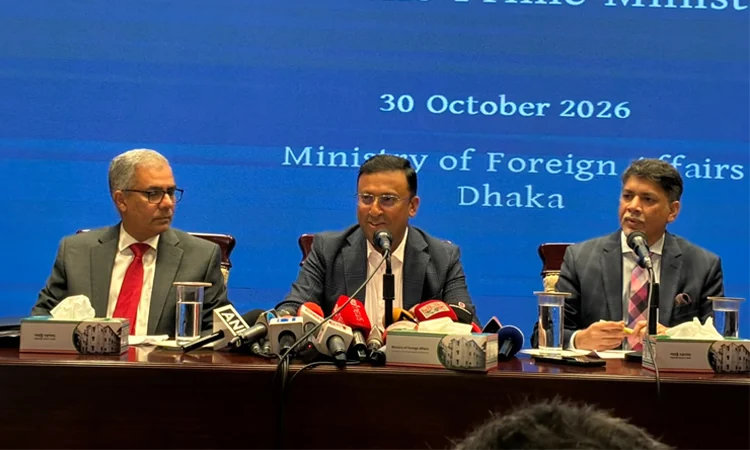
During Prime Minister Tarique Rahman's four-day visit to Japan, Tokyo reaffirmed its commitment to continuing development cooperation with Bangladesh. New possibilities have also been created for increasing private investment and developing human resources, State Minister for Foreign Affairs Humayun Kabir has said.
He made the remarks at a press conference held at the Ministry of Foreign Affairs on Friday afternoon, presenting the outcomes of the prime minister's Japan visit from 26 to 29 October.
Humayun Kabir said, "This visit reaffirmed Japan's commitment to continuing and expanding development assistance to Bangladesh, alongside creating greater opportunities for private investment and human resource development."
The state minister said the visit served as an important step in transforming the two countries' long-standing development cooperation into a mutually beneficial economic and investment partnership. Describing the visit as effective and fruitful, he said Japan's development partnership with Bangladesh had been further strengthened through it, and a foundation had been laid for a broader economic relationship centred on investment, employment, technology and human resources.
Humayun Kabir said the outcomes of the visit reflected the government's "Bangladesh First" foreign policy, which prioritises national interest, mutual respect and strengthening international economic partnerships. He said Bangladesh wants to move away from dependence on conventional concessional loans and development aid, and build relationships based on investment, technology transfer, job creation and shared economic opportunity.
In the question-and-answer session, the state minister said, "Bangladesh will be an investment partner. Whoever we do business with, it will be on the basis of genuine mutual investment partnership." He said the two countries' emerging relationship would be built on mutual respect and shared economic interests, with neither country in a subordinate or dependent position.
Highlighting one of the visit's most important achievements, the state minister said Prime Minister Tarique Rahman and Japanese Prime Minister Sanae Takaichi welcomed the prospect of Japanese private investment in Bangladesh of up to 100 billion yen, or about $6.3 billion, over the next five years. He said such investment could create employment opportunities for around 200,000 people in Bangladesh.
Humayun Kabir clarified that the proposed investment indicates a private-sector prospect, not a promise of government lending. Asked when such investment might materialise, he said a Japanese economic delegation was expected to visit Bangladesh soon, at a mutually convenient time after consultations and joint ministerial-level talks. He said Bangladesh would evaluate the investment proposals carefully, considering national priorities, affordability, competitiveness and job creation.
The state minister added that the government would prioritise investments that ensure proper value for money and protect the country's economic interests.
He said the two countries had agreed to upgrade the long-standing "Bay of Bengal Industrial Growth Belt" (BIG-B) initiative into "BIG-B for Shared Prosperity". The upgraded initiative plans integrated development of energy, deep seaports, industrial facilities, information and communication technology infrastructure and communications, alongside increased public-private cooperation. He clarified, however, that discussions under the initiative during the visit were limited to the bilateral economic relationship between Bangladesh and Japan, saying, "No third country was discussed."
Humayun Kabir said Japan had reaffirmed its commitment to continued cooperation in Bangladesh's major infrastructure and development priorities. The discussions covered preparations for the speedy opening of the third terminal of Hazrat Shahjalal International Airport, accelerating implementation of Dhaka's mass rapid transit (MRT) projects, and future Japanese cooperation in the construction, operation and management of the Matarbari deep seaport.
Prime Minister Tarique Rahman expressed gratitude for Japan's emergency support loan of 50 billion yen, or about $314 million, to strengthen economic resilience and ensure stability of energy supply. In a meeting with Dr Akihiko Tanaka, president of the Japan International Cooperation Agency (JICA), the prime minister stressed completing the ongoing development projects financed by Japan on time, and called for continued concessional financing and expanded technical cooperation. Asked about the terms of Japanese loans, Humayun Kabir said Bangladesh would evaluate future financing arrangements against other alternatives available internationally, to ensure affordability and economic benefit.
The state minister said human resource development, technical cooperation and industrial modernisation emerged as important priorities of the prime minister's visit. The prime minister held discussions with representatives of leading Japanese businesses and corporations including Fast Retailing, the parent company of Uniqlo, Marubeni Corporation, Mitsubishi Corporation and Toyota Tsusho Corporation. Those discussions emphasised expanding Japanese investment in Bangladesh's ready-made garment industry, renewable energy, information and communication technology, advanced manufacturing and infrastructure, and also covered technology transfer, skills development, environmentally friendly production and diversification of export products. The prime minister also took part in a Japan-Bangladesh economic forum dialogue and called on Japanese businesspeople to make use of Bangladesh's investment potential.
Humayun Kabir said the government was committed to improving the business environment through greater transparency and reform in taxation, customs clearance, remittances and licensing. During the visit, the prime minister toured JERA's LNG terminal and power plant in Futtsu and a logistics hub in Chiba Prefecture. He clarified that the purpose of visiting the LNG facility was to gain practical experience and technical knowledge for Bangladesh's own energy infrastructure planning, not to discuss importing LNG from Japan. The prime minister also visited Toyota's production plant in Nagoya on 29 October, where company officials reaffirmed their interest in setting up factories in Bangladesh to produce cars and other machinery.
The state minister said six cooperation agreements and memoranda of understanding were signed during the visit on topics including economic relations, the business environment, agriculture, fisheries and livestock, coastal security, climate cooperation and information technology, and arrangements on investment support and local government development management were also finalised. The two countries reaffirmed their commitment to continued cooperation in sustainable urbanisation, healthcare, disaster management, environmental protection, human resource development and balanced regional growth. Humayun Kabir said Bangladesh also sought Japan's continued engagement in efforts to find a sustainable solution to the Rohingya crisis. The two prime ministers also exchanged views on global peace and stability, freedom of navigation by sea and air, reform of the UN Security Council and nuclear disarmament.