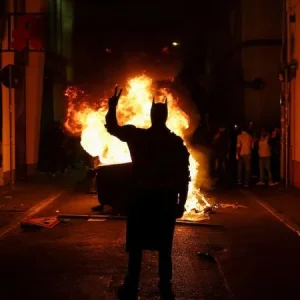
Third week of protests in France: clashes in Paris and other cities, 565 arrested

Clashes broke out in Paris and several other cities in France after protest marches fuelled by discontent over issues including the rising cost of living. The clashes between protesters and police took place on Saturday evening local time, and police arrested more than five hundred people across the country.
Most of the protest marches remained peaceful until Saturday afternoon. Towards the end of the march in Paris, however, police moved in to disperse the protesters. Police also fired tear gas in the cities of Lyon and Toulouse. Tension flared at the end of the march in Marseille, but the situation there calmed down as night fell.
This was the third consecutive week of protests in France since rioting and looting on 17 October, when shops, government buildings and businesses across the country were widely vandalised. The number of protesters this time was smaller than on the previous two Saturdays, however.
According to France's interior ministry, 320,000 people took part in protests across the country on Saturday.
Interior Minister Laurent Nunez said of Saturday's protests: 'We are ready to confront those who want to get involved in clashes tonight. There will be a firm response.' He added that 565 people had been arrested in protests in various cities across the country and that four police officers had been injured.
Saturday's protests took place amid Halloween festivities. Jerome Rodriguez, a protester in Paris, said: 'Whatever happens, the state of France's economy is bad, because the country is now run by a bunch of incompetent people. They are dealing in billions of euros, while ordinary families are struggling over a few cents.'
Students first took to the streets in France against the steady decline of the education system, overcrowded classrooms and the university admission system. Trade unions later joined them, and the 'Yellow Vest' movement became active again, joining the protests with demands to reduce the cost of living.
The unrest has come at a sensitive time for President Emmanuel Macron's government. On Friday, the credit rating agency Fitch unexpectedly marked the outlook for France's debt as 'negative', making investors' concerns about the country's financial situation clearer.
France's public debt has reached close to 120 percent of the country's gross domestic product (GDP), while the cost of borrowing is also rising. Macron's government is under pressure to cut public spending in this situation, leaving it with fewer options for bringing the situation under control.
France's protests have encouraged youth, or Gen Z, movements in various European countries. Protests were also held in several German cities on the same day; in Frankfurt, masked protesters were reported to have looted various shops. People also took to the streets in Italy.