Onion Output Up Nearly Six Lakh Tonnes in a Year, Potato Down Three Lakh Tonnes
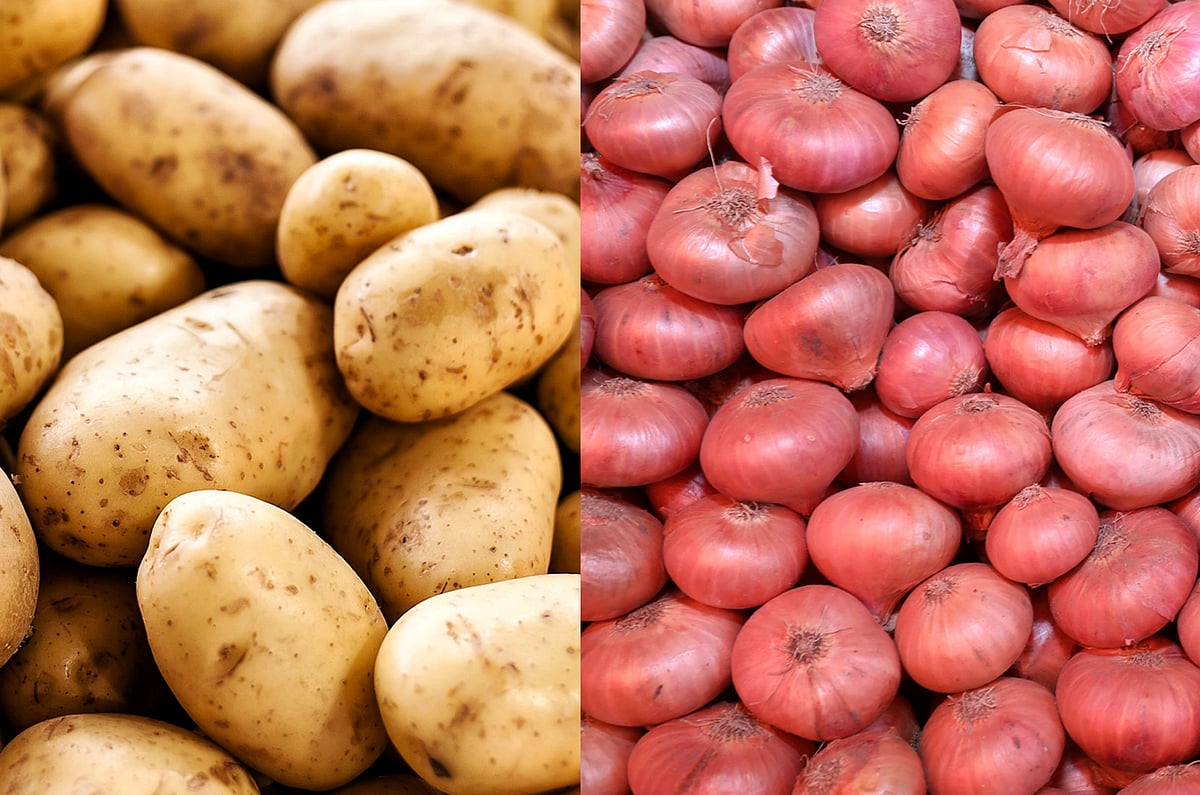
Onion production in Bangladesh has risen by nearly six lakh tonnes in a single year. Over the same period, output of Aman rice, garlic, winter chilli, maize and soybean also increased. Potatoes moved in the opposite direction — production fell by about three lakh tonnes in a year. Wheat output declined slightly as well.
The figures come from the quarterly (April–June) report of the agriculture wing of the Bangladesh Bureau of Statistics (BBS), which compares acreage and production of various crops in the 2024-25 and 2025-26 fiscal years.
According to the BBS, onion production stood at 32 lakh 21 thousand tonnes in 2024-25 and rose to 38 lakh 20 thousand tonnes in 2025-26 — an increase of 5 lakh 99 thousand tonnes, or 18.6 percent, in one year.
The area under onion cultivation also expanded. Onion was grown on 5 lakh 35 thousand 599 acres in the previous fiscal year, rising to 5 lakh 69 thousand 787 acres in 2025-26. Agriculture Minister Mohammad Amin Ur Rashid has said that, thanks to the higher production, the country did not need to import onions this fiscal year.
Garlic and winter chilli production rose alongside onions. Garlic output was 5 lakh 65 thousand 682 tonnes in 2024-25 and increased to 6 lakh 5 thousand 446 tonnes last fiscal year. Winter chilli production rose over the same period from 5 lakh 61 thousand 397 tonnes to 6 lakh 16 thousand 340 tonnes.
Potatoes, however, showed the reverse picture. Production was 1 crore 15 lakh 73 thousand tonnes in 2024-25 and fell to 1 crore 12 lakh 72 thousand tonnes in 2025-26 — a drop of 3 lakh 1 thousand tonnes in a year. The area planted with potatoes also shrank over the same period.
Agricultural economists say market prices play a major role in whether production of a crop rises or falls, and they believe that effect is visible in both onion and potato output.
Agricultural economist Jahangir Alam Khan said, "Farmers received good prices for onions the previous year, so they were keen to expand production the next time. Cold-storage facilities for onions have also improved."
For potatoes, Jahangir Alam Khan believes the situation was exactly the opposite. In his view, farmers did not get a fair price for potatoes over the past two years and made losses even after storing them in cold storage, so growers reduced potato cultivation.
Among rice varieties, Aman posted positive growth. Aman production was 1 crore 65 lakh 14 thousand tonnes in 2024-25 and rose to 1 crore 73 lakh 59 thousand tonnes in 2025-26 — an increase of 8 lakh 45 thousand tonnes in a year. Agriculture specialists believe favourable weather played a role.
Wheat production declined. Output was 10 lakh 41 thousand tonnes in the previous fiscal year and fell to 10 lakh 28 thousand tonnes the following year — a decrease of 13 thousand tonnes, or 1.2 percent. Over the same period, wheat acreage fell from 6 lakh 93 thousand 724 acres to 6 lakh 85 thousand 156 acres.
Among other crops, winter maize production increased. Winter maize output was 48 lakh 73 thousand tonnes in 2024-25 and rose to 50 lakh 48 thousand tonnes last fiscal year. Soybean production also grew, from 1 lakh 8 thousand tonnes in the previous fiscal year to 1 lakh 36 thousand tonnes the next.
Alongside crop production, the BBS also published data on agricultural labourers' wages. According to the bureau, in March the average daily wage of a male agricultural labourer was 628 taka and that of a female labourer 461 taka. In June, with one meal included, the daily wage was 622 taka for men and 437 taka for women. With two meals, male labourers received 639 taka and female labourers 460 taka. With three meals, male labourers received 664 taka and female labourers 515 taka.
The BBS said the wage data were collected by interviewing a sample of 10 agricultural labourers from every upazila in the country. Where no agricultural labourer could be found in an area, information was also taken from farmers who hire daily labourers for farm work.