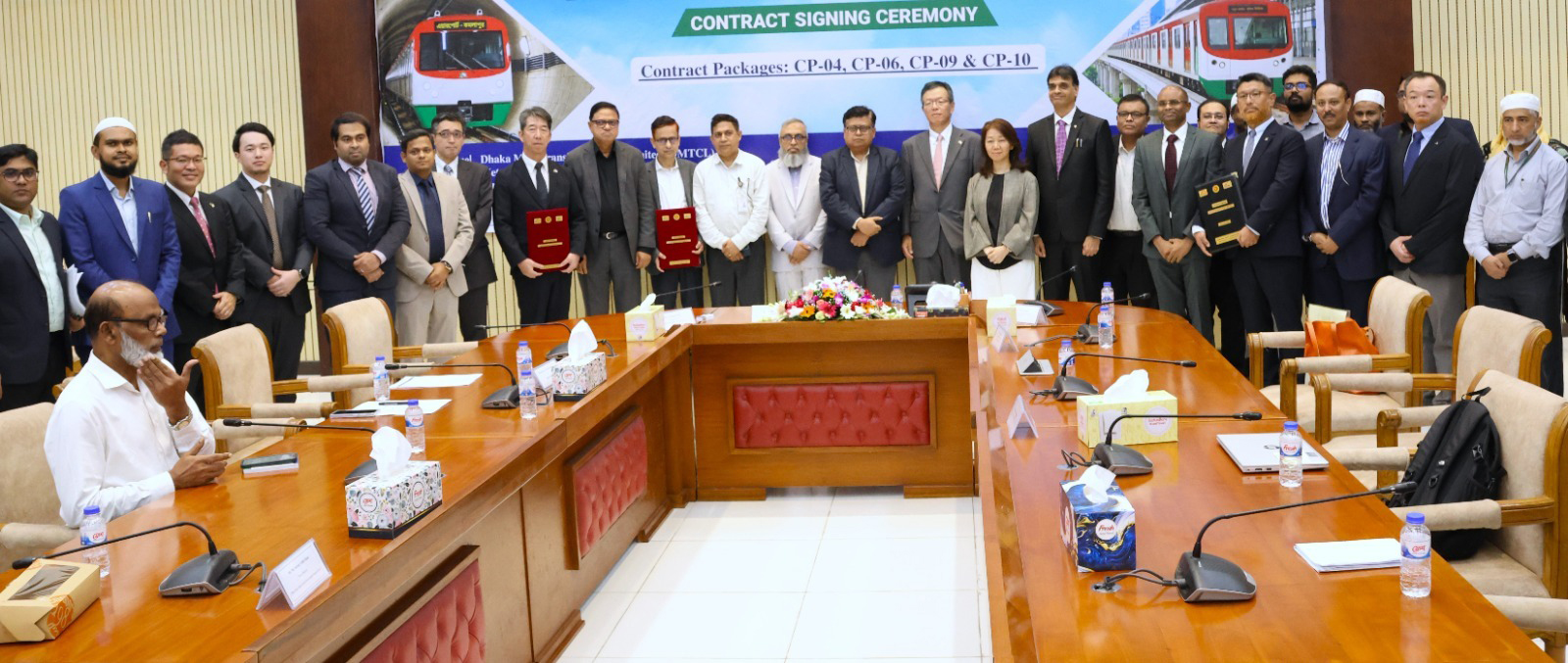
Construction contracts signed for four packages of underground metro rail MRT Line-1

Construction contracts have been signed for four packages of MRT Line-1, the capital's first underground metro rail project. Under the contracts, tunnels and stations will be built, rail lines laid, and electrical infrastructure, signalling and telecommunications systems installed.
The contracts were signed on Wednesday (November 4) at the conference room of the Metro Rail building at Diabari in Uttara in the capital.
The contracts are being seen as important progress in developing the infrastructure of the country's first underground metro rail project, which is being implemented with joint financing from the Government of Bangladesh and the Japan International Cooperation Agency (JICA).
Dr Mohammad Ziaul Haque, secretary of the Road Transport and Highways Division, was chief guest at the signing ceremony. Md Shawgat-ul Alam, managing director of Dhaka Mass Transit Company Limited (DMTCL), gave the welcome speech.
Japanese Ambassador to Bangladesh Saida Shinichi and JICA Bangladesh Office Chief Representative Takahashi Junko were special guests. Senior officials linked to the project, consulting firms and representatives of the contracting companies were also present.
Under two of the four packages, tunnels and stations of the underground rail will be built. Under contract package CP-04, 4.447 kilometres of underground rail line will be built from the north end of Rampura underground station to Natun Bazar station.
Under contract package CP-06, 5.182 kilometres of underground rail line will be built from the north end of Nadda underground station to Airport station. Together, the two packages will build a total of 9.629 kilometres of underground route.
Under contract package CP-09, the track works of MRT Line-1 will be implemented. This package will lay the necessary track including rails, turnouts, points and crossings, alongside building electrical infrastructure.
Under the fourth package, CP-10, the signalling and telecommunications systems needed to operate trains will be installed. These include a communication-based automatic train control system, an optical fibre-based transmission network and an LTE-technology radio communication system. Installing platform screen doors and an Enterprise Resource Management System (ERMS) is also part of this package.
In his speech as chief guest, Secretary Dr Mohammad Ziaul Haque said easing traffic congestion in the capital, reducing travel time and ensuring modern, quality public transport services for citizens are among the government's priorities.
He said implementation of MRT Line-1, the country's first underground metro rail, would open a new horizon in the capital's public transport system, and that signing contracts for four important packages was a significant milestone in implementing the project.
The secretary directed that maximum safety and quality be ensured in construction work in compliance with labour law and other relevant laws of the country. Stressing completion of the work within the scheduled time, he said the temporary suffering of ordinary people due to construction work must not be prolonged.
In his speech as special guest, Japanese Ambassador Saida Shinichi praised the long-standing friendly relations and development cooperation between Bangladesh and Japan. He thanked the Government of Bangladesh for taking initiative to restart and accelerate implementation work after overcoming stagnation in the metro rail project.