Private Sector Credit Growth Falls to 4.17 Percent, the Lowest in More Than Three Decades, Central Bank Data Shows
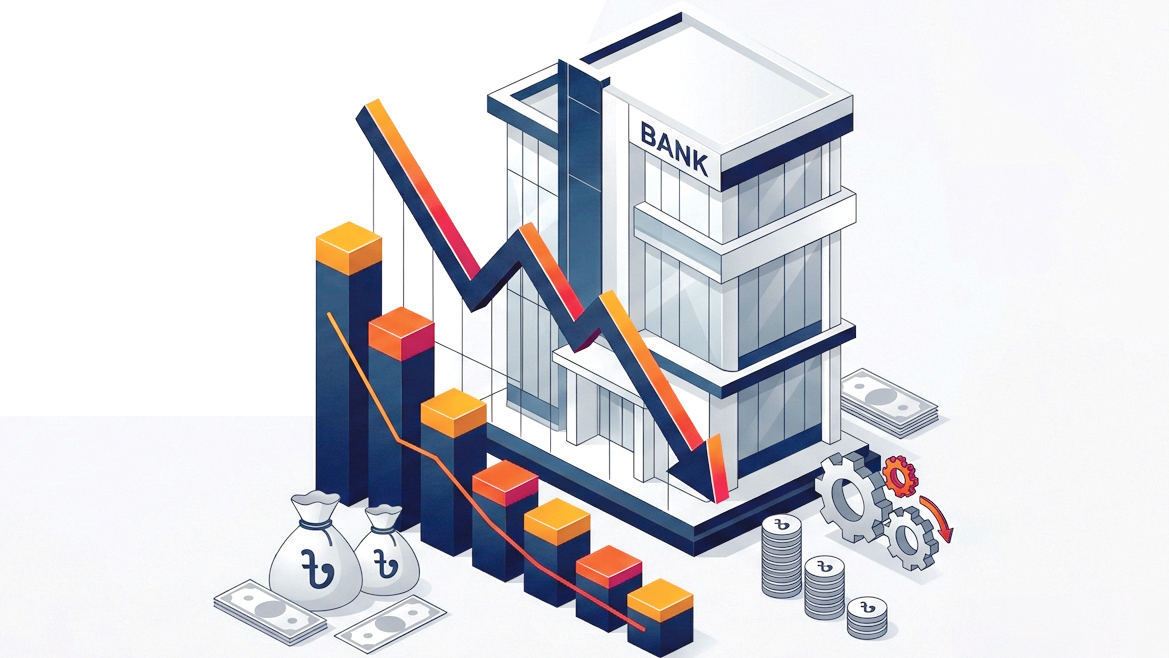
Growth in bank lending to the country's private sector has fallen to its lowest level in more than three decades. According to Bangladesh Bank data, private sector credit growth fell to 4.17 percent in September.
According to the central bank's data, private sector credit growth has been unable to cross the 5 percent ceiling for seven consecutive months.
In March this year, private sector credit growth was 4.72 percent. In April it rose to 4.75 percent and in May it stood at 4.98 percent. But in June it fell to 4.47 percent. In July it rose slightly to 4.62 percent and in August it was 4.75 percent. In September it fell to 4.17 percent, the lowest in more than three decades.
The report said prolonged economic uncertainty has brought investment in the country's private sector almost to a standstill. Entrepreneurs and traders are losing interest not only in new investment but even in expanding existing businesses. As a result, demand for new loans from banks has also fallen sharply compared with before.
Although Bangladesh Bank cut its policy rate to encourage investment, it has had no positive effect on demand for private sector credit. On July 30, the central bank cut the policy rate by 50 basis points to 9.50 percent.
According to traders, high interest rates, gas and electricity shortages, a deterioration in the law and order situation and various VAT and tax-related complications are standing in the way of new investment. Added to this, a rise in fuel prices and fears of a fresh supply crisis have increased traders' concerns. Many have said they have no new plans to expand their businesses in the coming year in this situation.
Mohammad Hatem, president of the Bangladesh Knitwear Manufacturers and Exporters Association (BKMEA), said there is currently no favourable environment for doing business. Because of high interest rates on bank loans and the deterioration in law and order, traders do not consider the environment for new investment to be safe. He said more than 400 factories have closed since January. He also said a message has been received from the government that the electricity situation will not improve before 2030. In this situation, traders will not be interested in new investment. He added that a fresh rise in fuel prices is creating additional problems for business, alongside VAT and tax-related complications.
Bankers say commercial banks are also in a cautious position on lending because of the high rate of defaulted loans and business uncertainty. Syed Mahbubur Rahman, managing director and chief executive officer of Mutual Trust Bank, said private sector credit growth has fallen below 5 percent because of various structural obstacles and weak demand.
A continuous downward trend in private sector credit growth has developed since the political changeover in August 2024. During this time, factories of several large industrial groups in the country have closed. Production has also fallen by 30 to 40 percent in many factories that remain open. As a result, demand for new loans in the industrial sector has shrunk further.
Dr Zahid Hussain, former lead economist at the World Bank's Dhaka office, said private sector credit growth will also rise if momentum returns to the economy. In the past seven months, no such change has occurred that could increase demand for bank loans. He said the government must take the necessary initiatives to set up new industrial factories and increase foreign investment.