
After Wage Board Formation, Labour Leaders Urge Savar-Ashulia Workers to Return to Work
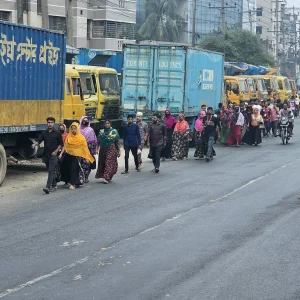
Amid worker unrest and halted production in factories across the Savar-Ashulia industrial belt, labour leaders are not in favour of continuing the movement on the streets for now. They have urged workers to return to production in the factories immediately.
In their view, the workers' main demand was the formation of a wage board and the implementation of a new wage. Since the government has now formed the wage board, workers should go back to their workplaces. At the same time, they called on the government to take the necessary steps to ensure workers' safety.
Several Savar-Ashulia labour leaders spoke on these issues by phone on Thursday (5 November) night.
Khairul Mamun Mintu, legal affairs secretary of the Bangladesh Garments and Sweaters Workers Trade Union Centre, said: 'If the factories had effective trade unions, the workers' movement would not have reached a violent stage. The unions could have publicised the wage board formation process and the board's work among factory workers. Workers would then have understood the issues and been able to protest peacefully. They could also have properly exercised their right to strike under the labour law.'
Khairul Mamun Mintu said: 'Because there is no free trade union right in the industrial factories, the security of the industry itself is now under threat. The owners and the government administration have failed in this movement.' He also questioned whether the intelligence agencies had been active at all before the situation reached this stage.
The labour leader believes the owners of the ready-made garment industry have come under pressure over shipments because the movement turned violent. He said: 'Shipments from different factories have set deadlines. Especially with Christmas in December ahead, most products must finish production and be shipped within October and November. So many owners are in crisis over finishing production and shipping goods on time.'
He added that, according to the owners, the garment industry is already passing through various crises because of the global situation: purchase orders are falling, Bangladesh faces gas and electricity shortages, and some factories are closed. The government is arranging various initiatives and incentives for the owners to overcome this crisis — but he believes the violent situation also arose because no initiative was taken for the workers.
To get out of this situation, Khairul Mamun Mintu called on the government to quickly strengthen security in the industrial zones and implement the workers' demands. He said: 'The government must play its proper role so that production continues in the factories and the owners can ship goods unhindered and safely.'
In his words: 'If this industry suffers major damage, in the end it is the workers who will be harmed the most. Implementing the workers' new wage structure will also become difficult. If even some of the country's four million workers lose their jobs, the situation will become more complicated. Already more than a hundred thousand workers are unemployed. If the industry suffers even greater damage, more workers risk becoming jobless. So the government must take the necessary steps to solve the problem quickly, bring the workers back to their workplaces safely and reopen the factories.'
On continuing the street movement, Khairul Mamun Mintu said: 'This time the movement is based on a single point, and that is the wage demand. No other demand has been raised here. Workers have many other problems and demands. But the wage board's authority to decide is limited to wage matters only.' He said some people are bringing forward various demands including a nine-point charter; in his view, some are carrying out such activities precisely to divert the workers' wage movement away from its main demand.
The workers' main demand was the formation of the wage board and, as the government promised, a new wage effective from December. The owners have also promised in this regard, he said. Yet doubt remains among the workers. Despite that doubt, he believes production should be kept running while waiting for the wage announcement; if necessary, the movement can resume after the announcement.
Khairul Mamun Mintu said: 'We hope the government will announce the wage the workers want. If the announced wage does not meet the workers' expectations, then at the next wage review opportunity, the concerned parties will be informed if necessary and the demand will be raised through movement.' But for now, he believes workers should return to work: 'It is essential to go back to the workplace and keep factory production running. For that, the government too must take a flexible position.'
Pointing to a climate of fear among workers, he said he had received reports a short while earlier that police were going from house to house of workers. Local people and outsiders in the area were conducting searches and handing workers over to the police. If such a situation continues, fear will grow among workers, and workers living in fear will not want to return to work. The labour leader therefore stressed ensuring workers' security and confidence; only then, he said, will workers be able to return to their workplaces without fear and production in the factories return to normal.
Meanwhile, Rafiqul Islam Sujon, central president of the Bangladesh Garments and Industrial Workers Federation and a leading labour figure in Savar, said: 'If the labour laws were properly implemented, such problems would not have arisen.'
He said: 'The wage board was supposed to be formed in May. We had been telling the government and the concerned authorities about this for a long time. We were also carrying on the movement in a lawful and democratic way. But the owners paid no heed to our demand. That is why the workers were finally forced to take to the streets. In the meantime, some opportunists created vandalism and anarchy to serve their own interests. These are in no way acceptable. Real workers do not do such things. A worker will never tear even a thread of a machine at his own workplace, because his livelihood depends on this industry.'
He added: 'Since the government has formed the wage board, our demand now is to ensure a fair wage for the workers. The government has announced a pay structure for government employees and workers. There, a peon's basic pay is 20,000 taka and the total is about 38,400 taka. On that basis, on behalf of 35 federations, we have demanded a minimum wage of 300 dollars, or 36,000 taka, for garment workers.'
The labour leader said garment workers in Cambodia, Sri Lanka and the Philippines earn more than those in Bangladesh. Yet whenever it is time to raise wages in Bangladesh, big owners resort to various tactics; subcontract work is stopped, and then they say paying that much is impossible. He said: 'I have been seeing this since 2006. Whenever wage-hike time comes, garment owners adopt all sorts of tactics. Real workers are not involved in vandalism and anarchy. I believe some beneficiaries and some on the owners' side provoke workers and create such situations to deprive them of their fair wage demand.'


