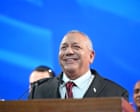
Paraguay's president resigns amid digital bank collapse

Paraguay's President Santiago Pena resigned on Thursday (5 November) in the face of an acute political and economic crisis triggered by the collapse of the digital lender Ueno.
The bank's collapse has left around 3 million customers unable to access their accounts, plunging them into deep uncertainty and dealing a serious blow to the economy of one of South America's most stable countries.
In a country of 6.5 million people, the digital bank served about 3 million customers and managed around 850 million dollars in public funds belonging to state institutions and pension funds.
The crisis began earlier this week when the central bank intervened in Ueno's operations, alleging insufficient liquidity. Since the collapse, the central bank governor has already resigned, and eight Ueno officials have surrendered after arrest warrants were issued against them.
Pena, having lost political support within the conservative Colorado Party, decided to resign just before impeachment proceedings began.
In a statement on social media, he said that as part of accountability, and to defend himself, he would appear at a Senate hearing and called for swift arrangements to repay the locked-out customers.
Opposition lawmakers have accused Pena of conflict of interest and misuse of pension funds, though he has denied the allegations. Pena, elected in 2023, is also under intense scrutiny over his past links to the former business group Grupo Vazquez.
After Pena submitted his resignation letter on Thursday, the Senate reactivated the impeachment process against him.
He was due to address the Senate on Friday morning (6 November) local time, but he requested a 72-hour extension to prepare his defence, which the Senate rejected. As a result, Paraguay's change of power, driven by the unprecedented political and economic crisis around Ueno's collapse, has now taken a complex turn.