Garment Workers' Purchasing Power Falls by a Third in Three Years as Tk 12,500 Now Buys What Costs Tk 16,087
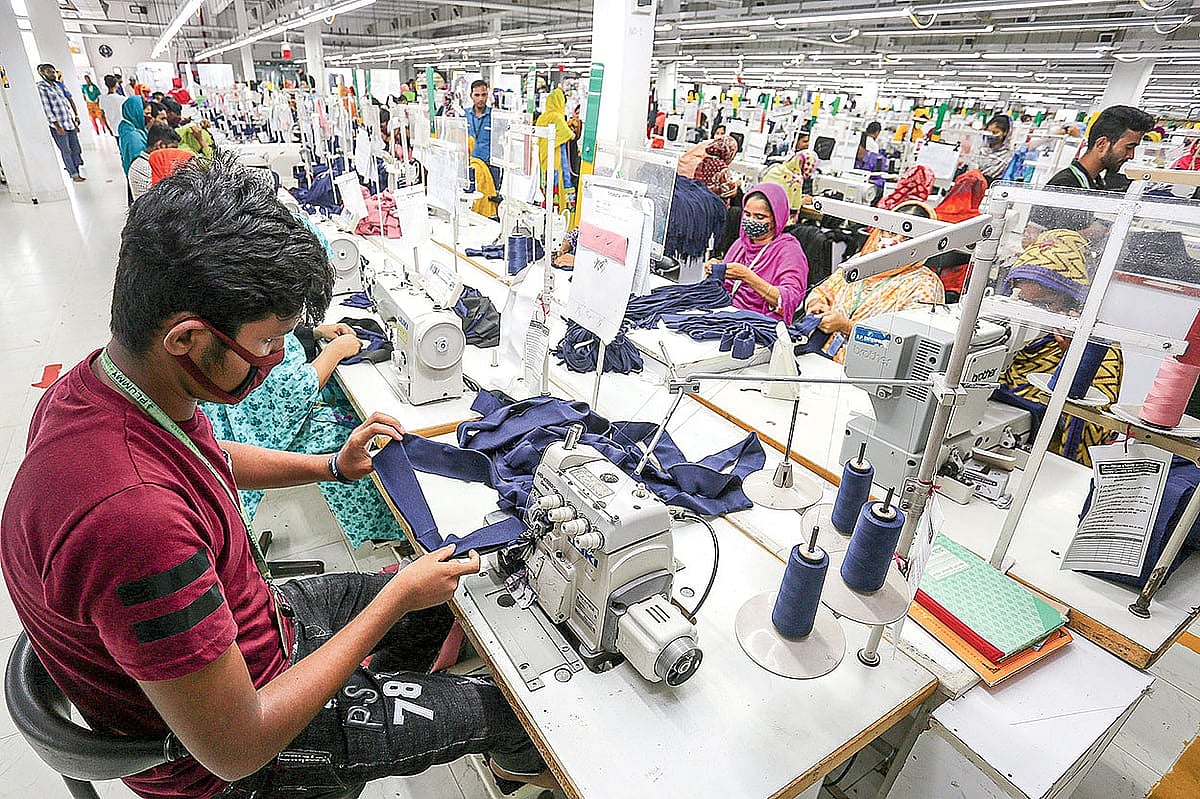
Three years ago, the minimum wage of readymade garment workers rose from Tk 8,000 to Tk 12,500. The goods and services that money could buy then now cost at least 29 percent more because of high inflation. That means garment workers' purchasing power has fallen by almost a third in three years.
Labour experts say that when the minimum wage is fixed, the cost of living of a worker's family of four must be taken into account. That was never considered in the past. In the past, wages were always set well below what is needed to live on, so even when wages rose a little, workers' standard of living did not improve. At the same time, the industry's capacity must also be considered when fixing wages.
In the early 1990s, the minimum wage of a garment worker was Tk 627. In 1994, that wage rose 48 percent to Tk 930. Over the next nearly 30 years, garment workers' minimum wage rose by Tk 11,570. Most recently, in 2023, the minimum wage rose by 56 percent.
According to the consumer price index (CPI) of the Bangladesh Bureau of Statistics (BBS), the price index rose 28.7 percent from November 2023 to last September. That means the goods and services that Tk 12,500 could buy in November 2023 would now cost Tk 16,087.
Not only that, in dollar terms workers' wages have fallen by 11.50 dollars because of the depreciation of the taka against the dollar. According to Bangladesh Bank, in November 2023 the exchange rate was Tk 110.5 per dollar, and the workers' minimum wage was 113.12 dollars. Last October, the dollar stood at Tk 123.03, and the wage came to 101.6 dollars.
Workers are paid in Bangladeshi currency, but owners earn their garment export income in dollars. Because of the taka's depreciation, owners are getting more money for those dollars. Compared with November 2023, the taka depreciated 11 percent against the dollar by last October. That means, three years ago, exporting garments worth 100 dollars earned owners Tk 11,050. Now they get Tk 12,303.
A BBS survey published last month found that the average monthly family expenditure is highest in city corporation areas — Tk 46,778. In urban areas, a family's monthly expenditure is Tk 37,344, and in rural areas Tk 32,532. At the national level, half of a family's monthly spending goes to food and half to non-food items.
Asked about it, Khandaker Golam Moazzem, president of the research organisation Knowledge Hub Institute Trust, said it is not enough to consider inflation alone; the improvement of workers' living standards must also be looked at. Decisions should be taken after impartial discussion in tripartite meetings, considering 10 factors besides inflation. The wages of other sectors should also be considered in this regard.
He said wages must be fixed in a way that allows a family to live comfortably. At the same time, we must move away from the idea that cheap wages are the strength of the garment industry's competitiveness.
Syed Sultan Uddin Ahmed, executive director of the Bangladesh Institute of Labour Studies (BILS), said, 'The wage fixed for garment workers three years ago was not an acceptable wage. It cannot be the basis for fixing wages this time. Government officials fixing wages must take the new pay scale and the BBS survey into account.'
Syed Sultan Uddin Ahmed added, 'It is not that workers are asking for much higher wages. Workers are saying they cannot manage after paying house rent on the current wage. Their children's education has stopped. So wages must be fixed so that a family can live comfortably. And we must move away from the idea that cheap wages are the strength of the garment industry's competitiveness. Otherwise the economy will not regain momentum.'
Garment workers have been agitating since last month demanding a wage increase. In response to the movement, the government formed a minimum wage board on 1 November. Even so, the labour situation in the industrial areas has not become fully calm. Against this backdrop, the minimum wage board's second meeting will be held on Monday. Workers' representatives are expected to submit a preliminary wage proposal at the meeting. It could not be confirmed whether the owners' side will submit a wage proposal at this meeting.