Though he cannot be president, Mamdani wants to be the 2028 'kingmaker'
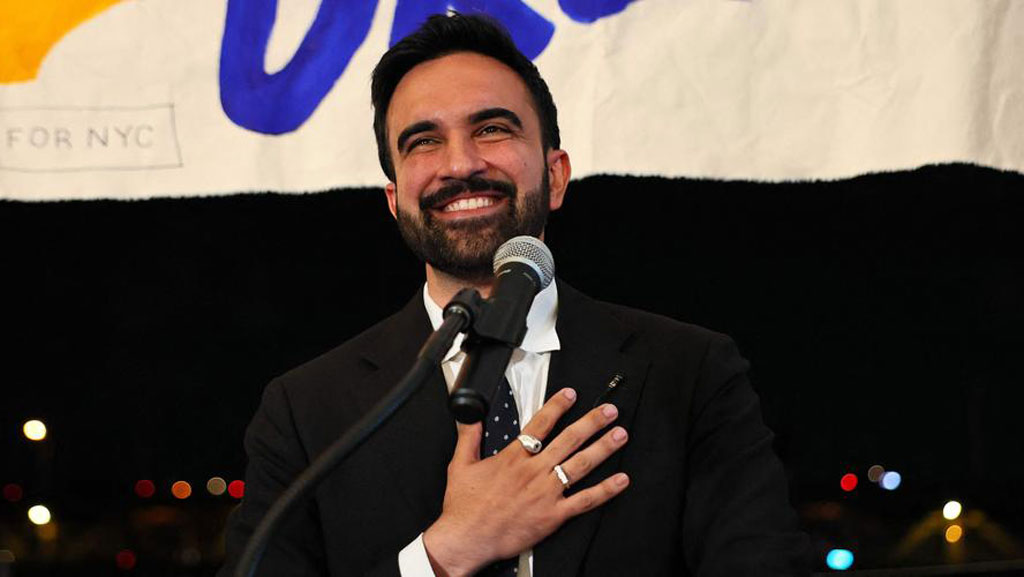
New York City Mayor Zohran Mamdani does not have the constitutional eligibility to become president of the United States. Because he was born in Uganda, under the US Constitution he cannot contest an election for the presidency.
Yet he wants to play an important role in the Democratic Party's political calculations around the 2028 presidential election. Even without the chance to be a candidate himself, Mamdani is trying to become an influential 'kingmaker' of progressive politics.
To that end, the New York mayor is holding private meetings with top leaders of labour unions. He is raising the need to put forward a pro-labour or left-leaning candidate in the 2028 election. Four people familiar with the discussions told the US news outlet Axios about this.
Mamdani's argument is that the political momentum progressives gained in the midterm elections must not be wasted. Instead, that success should be used to organise left-wing political forces before the 2028 election.
But a major uncertainty also lies behind his activism. Mamdani himself is unsure whether his close political ally and New York Congress member Alexandria Ocasio-Cortez (AOC) will contest the 2028 presidential election. Sources said Mamdani acknowledged this uncertainty in closed-door meetings with close aides.
If Ocasio-Cortez does not run, the equation of the Democratic Party's primary contest could change. At the same time, the party's progressive and rebellious left wing could find itself in the race without a strong candidate. In this situation, Mamdani wants to build early coordination among progressive leaders. Part of his plan is to unite left-wing forces if a centrist candidate pulls ahead in the Democratic nomination race and progressives cannot accept that candidate. A source who spoke with Mamdani told Axios, 'When a centrist candidate clearly starts to pull ahead, Mamdani wants the progressive political world to be able to organise quickly, strategically and effectively.' Mamdani's aides are citing the 2020 presidential election as an example. At that time, former president Barack Obama was believed to have played a role in consolidating Democratic support behind Joe Biden. As a result, Biden's position against Bernie Sanders was strengthened. Mamdani's plan also hints at a similar political coordination.
The US labour movement is a central focus of Mamdani's initiative around the 2028 presidential election. Last month, he invited Jimmy Williams Jr., president of the International Union of Painters and Allied Trades (IUPAT), to Gracie Mansion. At the meeting, Mamdani asked which potential presidential candidate Williams preferred and how his union decides to formally endorse a candidate in an election. He even asked whether Williams himself had ever thought of contesting an election.
Mamdani's outreach is not limited to Williams. He recently met Sara Nelson, president of the Association of Flight Attendants-CWA, to discuss the 2028 election and other matters. He also plans to meet Shawn Fain, president of the United Auto Workers (UAW), soon. Williams, Nelson and Fain are considered among the most progressive labour leaders in the United States. Mamdani's contact with them is therefore seen as an attempt to use the organisational strength and political influence of labour unions in the 2028 election. Williams told Axios that he 'fully supports' labour movement people becoming candidates at various levels of elections. He said, 'We sent an ironworker to Congress. We sent a member of IUPAT to the Senate.' He made the remark citing the victories of Democrats linked to the labour movement in the midterm elections. He has no interest in contesting an election himself, however. Meanwhile, spokespersons for Mamdani, Fain and Nelson did not comment on the matter.
Ocasio-Cortez's political future is now one of the most discussed topics in the progressive camp. Many believe she is leaning more towards contesting the Senate election than the presidential election in 2028. Although AOC has said she is considering both possibilities, some of her close aides hope that the progressives' success in key battleground states in the midterm elections will encourage her to take part in the presidential election.
But in last week's elections across the country, through voters' stance against the Trump administration, candidates of both the centrist and left wings of the Democratic Party won. As a result, it cannot be said with certainty that the midterm results have made a stronger case for a left-wing candidate in 2028 than for centrists. In an interview last month, Mamdani was asked whether he wanted to see Ocasio-Cortez run for president. He replied, 'I want AOC to do whatever she wants to do.' He also described her as a 'source of inspiration'.
With AOC's decision uncertain, a section of progressives has begun looking for an alternative candidate. Some hope that Michigan's newly elected Senator Abdul El-Sayed will consider contesting the 2028 presidential election. Others are rallying behind California Congress member Ro Khanna, and it is thought Khanna may also become a candidate. Bhaskar Sunkara, president of the liberal magazine The Nation, has also spoken about the progressives' choice of candidate. He worked as a supporter of Bernie Sanders in the 2020 election. In an opinion piece last summer, he called on Ocasio-Cortez to run for president. More recently, however, he has been giving greater importance to the idea of choosing a candidate from the labour movement.
Sunkara told Axios, 'Progressive thinking only wins elections when working-class voters see themselves as part of this fight. And there is no better way to ensure the representation of working people than to field a real worker for the presidency instead of a professional politician.' Among labour leaders, Shawn Fain is known for his harsh words against billionaires. Sara Nelson joined Sanders' 'Fighting Oligarchy' tour. Jimmy Williams wrote in 2025, 'I am proud that my organisation was among the first labour unions to call for a ceasefire in Gaza.'
There is also talk of Fain as a presidential candidate. The support of the United Auto Workers under his leadership helped Michigan's newly elected Senator El-Sayed win his election. Some left-wing activists and organisers have encouraged Fain to consider contesting the 2028 election. But last month he told the Detroit News that he has 'no plans' to take part in an election. All in all, Mamdani's goal in the 2028 election is not merely to support one candidate, but to build a coordinated political force for progressive politics. Ocasio-Cortez's decision, the position of labour unions, and the contest between the centrist and left wings of the Democratic Party will ultimately determine the success of his plan. Even if he cannot become president himself, if Mamdani can influence who the candidate will be in the 2028 election and behind whom progressives will unite, he could truly become an important kingmaker in American politics.