
Cox's Bazar coast is vanishing into the sea, leaving hundreds of families homeless
Mohammad Alam once had a homestead and a house — everything. He served three terms as a member of the union council. Coastal erosion has taken it all from him. This resident of Tablerchar in Ali Akbar Dail union of Kutubdia upazila in Cox's Bazar now lives with his family at Kutubdiapara beach in Cox's Bazar town, nearly 100 kilometres from his ancestral home. He has lived there for 16 years.
Alam is not alone. Hundreds of people have taken shelter in Cox's Bazar town after losing their homes to the sea. Oceanographers, climate experts and others say erosion along the vast Cox's Bazar coast is intensifying under rough weather, turbulent waves and the pressure of higher tides. Its impact stretches from Kutubdia, Matarbari and Dhalghata in Maheshkhali, through Cox's Bazar town, to Shahparir Dwip in Teknaf.
In places, sand dunes and casuarina forests are vanishing; elsewhere, settlements, roads and important installations are under threat. The beach itself is shrinking. The erosion is no longer confined to the beach or the dunes.
Alam, now past seventy, spoke about the erosion. He said his first homestead was swallowed by the sea after the cyclone of 1991. He built another house a little farther away. A few years later, that too went into the sea. Losing ground bit by bit, all his land eventually vanished into the sea.
He said, "From 1983 I was elected a member of the union council three times in a row. I helped so many people in disasters and hardship and gave them advice. In those days I had service trawlers and businesses. Now I live only on those memories."
Like Mohammad Alam, many displaced people are taking shelter in hilly areas and khas land in Cox's Bazar and Bandarban. Scientists of the Bangladesh Oceanographic Research Institute (BORI) and officials of the Water Development Board say erosion in the sea has increased since 2021. This year it has become even more visible in some areas.
They said, however, that there is no integrated, updated data on how much land has been lost, how far the erosion rate has risen, or whether waves, tides, storm surges or rising sea levels play the bigger role behind it.
From June to 2 November this year, warning signals were hoisted at the country's four seaports, including Cox's Bazar, on at least 12 occasions because of rough weather. Turbulent waves struck the coast during that time. In some areas, tidal water overflowed the embankments and entered localities. Over the past four to five years, adverse weather and its impact have become more visible.
Abu Sharif Md Mahbub-e-Kibria, chief of BORI's marine environment and climate change division, believes erosion is intensifying due to climate change and rising global temperatures. He said a higher erosion trend has been seen since 2021 in Kutubdia, Matarbari and the stretch from Cox's Bazar town to Teknaf.
Citing research on shoreline erosion conducted in September 2024, the oceanographer said, "Different kinds of plastic have been found in several layers of the dunes of Cox's Bazar town. As a result, the natural bonding of the shoreline soil is being disrupted. Because of this, erosion is increasing, and the dunes are not rebuilding either."
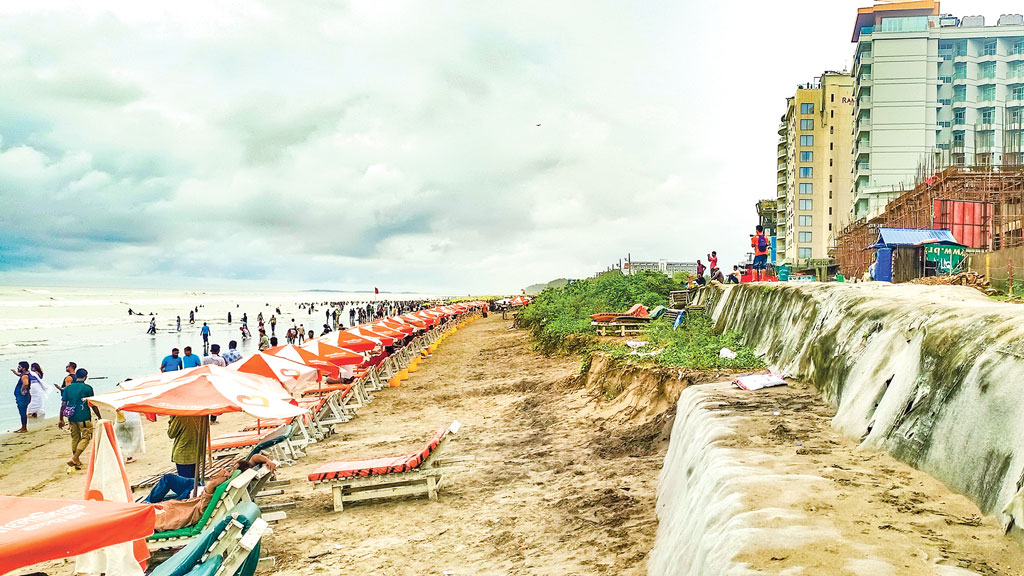
The beaches from Nazirartak in Cox's Bazar town to Himchhari, Patuartak and Teknaf are popular with tourists. But erosion is damaging dunes and casuarina forests in various places. To stop the erosion, the Water Development Board built embankments with sand-filled geo bags, but they are not working. Most of the geo bags have torn apart and sunk into the sea.
Abdul Quddus, a kitkat vendor at Motel Shaibal point in the town, has watched the beach erode for 45 years. In his words, 20 to 25 years ago the sea was about half a kilometre away from the casuarina forest at Shaibal. Since then, erosion has swallowed even Shaibal's walkway. Now, at high tide, tourists have no place left to walk on the beach.
A tour of the nearly 40-kilometre beach from Nazirartak to Patuartak found deep pits under the water in several places. This has raised the risk for tourists who go in to bathe. Accidents happen frequently. Fifteen tourists have died so far this year.
Mohammad Zakaria, a senior scientific officer in BORI's geological oceanography division, said most of the natural streams that once carried water from the hills of Cox's Bazar down to the sea have been lost.
Installations including the Air Force base in Nazirartak, Motel Shaibal, the international cricket stadium and the Tourist Police office in Cox's Bazar town are now at risk of erosion. The Marine Drive road is also facing the sea's erosion. Nearly 500 acres of land of the Sabrang Tourism Park have vanished into the sea in a few years. The Matarbari power plant and houses and installations from Kairbil to North Dhurung in Kutubdia are also at risk.
Various studies show that multiple natural and man-made causes lie behind the coastal erosion. A study published on 30 December 2025 in the Turkish Journal of Remote Sensing assessed erosion risk across a 72.46-square-kilometre area from Nazirartak to Inani in Cox's Bazar. It found 47.65 percent of the area at high erosion risk, 25.9 percent at medium risk and 27.26 percent at low risk.
Another study published in July 2025 analysed 35 years of satellite images, from 1989 to 2024, of the coast from Cox's Bazar to Teknaf. It found that 1,085 hectares of land had been lost along this coast. On the other hand, silt deposition created 284 hectares of new land in the area.
A study conducted by the Center for Environmental and Geographic Information Services (CEGIS) found that in recent years the sea level has been rising by an average of 5.05 millimetres a year in Cox's Bazar and 7.5 millimetres a year in Maheshkhali.
Commodore Sheikh Shahid Ahmed, director general of the Bangladesh Oceanographic Research Institute, said, "More research is needed to know how far the sea level has risen along the Cox's Bazar coast." He also believes an integrated initiative is needed to tackle climate change.

