
Gen-Z: a generation, or an identity made by the market?
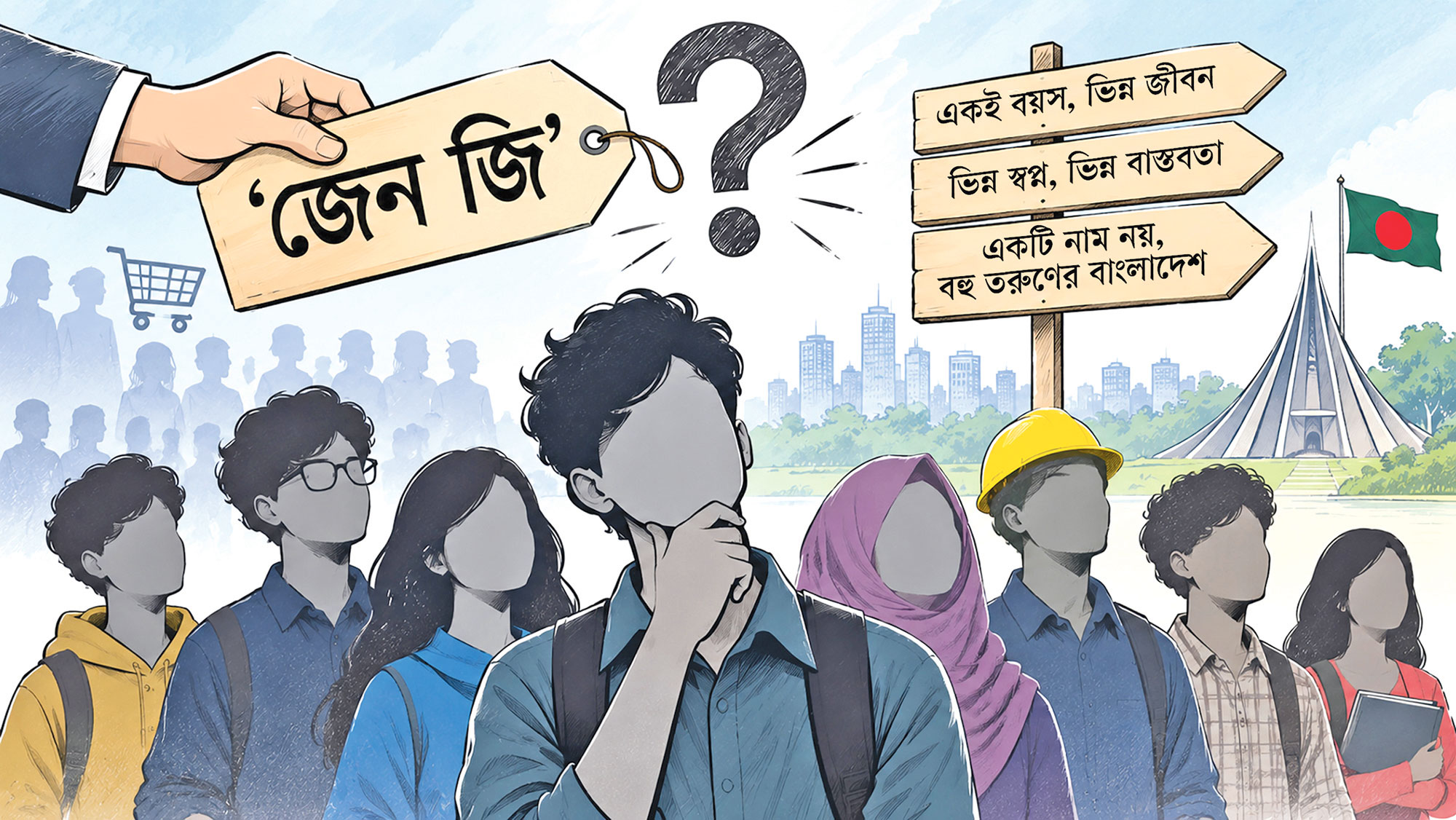
The term "Gen-Z" is now so familiar that we often do not feel any need to question what it means. Whenever young people protest, a social movement rises, political change happens or a new lifestyle trend appears, it is casually said to be the work of Gen-Z, as if the thoughts, values, political aspirations and behaviour of young people born within a certain period were all woven from the same thread. But does being born at the same time mean people think alike?
In Bangladesh, the question is especially important. The gap between the lives of one section of young people and another is so deep here that forcing them all into a single shared identity hides a large part of reality.
First, consider how these generational identities were born. After the Second World War, rising birth rates in the West gave currency to the term "baby boomer". The term "Generation X" became known through Douglas Coupland's 1991 novel "Generation X". William Strauss and Neil Howe popularised generational analysis in their book "Generations", and later explained American history through cycles of generational change in "The Fourth Turning". The "millennial" identity was established in the same tradition, and Australian demographer Mark McCrindle named the generation after Gen-Z "Generation Alpha".
But does the popularity of these identities mean they rest on a strong sociological foundation? There is doubt about that. According to Philip N. Cohen, a sociologist at the University of Maryland, dividing people by age into generations often creates artificial categories instead of identifying real social groups. The media, opinion polls and commercial firms popularise these identities, and then a generation is labelled technology-dependent, consumerist, anti-authoritarian or politically conscious.
Putting people into a box with a single name is easy, but understanding a life through that name is hard. A young person from a wealthy family of the same age may study at a prestigious institution, travel abroad and build a life of their choosing. Another young person of the same age works alongside their studies, supports their family or moves from a village to a city in search of a livelihood. Even with the same birth year, their experiences, dreams and problems differ enormously.
Here the generational theory of German sociologist Karl Mannheim is important. In his famous essay "The Problem of Generations", he showed that being born at the same time does not by itself create a shared generational consciousness. That requires being connected to the same historical experience and forming a joint understanding from it. Even then, the same experience does not lead everyone to the same thinking or political position.
The same applies to young people in Bangladesh. Among those born at the same time, some take to the streets for political change, some stay away from politics having lost faith in it, some want religious values at the centre of political life, and others give priority to personal freedom and civil rights. Some want job security, some dream of becoming entrepreneurs, some look for a chance to settle abroad, and some want to see the possibility of change within the country.
Another question arises here. Is the "Gen-Z" identity merely a harmless age-based classification, or does it also carry a particular lifestyle and political character? When Gen-Z is described as technology-dependent, independent-minded, anti-authoritarian or distrustful of conventional values, are we really describing an entire generation, or imposing the traits of one visible section on everyone?
In Bangladesh, this question matters even more. Young people here are divided by class, religion, gender, region, education and profession. The life of a young person from an affluent urban family is not the same as that of a young person from a poor farming family in a village. The opportunities and obstacles differ for those in public and private universities, madrasas and technical education, and for those who never had the chance to study. Young women face different problems of safety, mobility and employment from young men, and young people with disabilities face different challenges again.
There is also a large divide in the digital world. The opinions of those most active on social media are often taken to be the opinions of all young people. But who listens to those who have no internet or smartphone, or who cannot spend time online under the pressure of earning a living? The views of the young people visible online are not everyone's views.
That is not to say the "Gen-Z" identity has no practical value. Marketing agencies, advertisers and technology manufacturers can use age-based classifications of young people to understand their preferences, technology use and buying habits. But an identity created for the convenience of the market is not the same as a category suited to understanding society and politics.
The problem arises when advance conclusions are drawn about young people's political behaviour and aspirations on the basis of this identity. Then, instead of listening to them, ready-made ideas are imposed on them. Those who do not fit the idea are called exceptions, and those who do fit are held up as proof that the idea is true. Yet among young people there are differences of opinion, conflicts of interest and political divisions.
To understand young people in Bangladesh, then, it is not enough to know their birth year or their social media identity. One must look at what kind of education they are receiving, what obstacles they face in the job market, how the prices of goods and house rents affect their lives, how much opportunity they have for political participation, and what they think about the future. For some, the cause of frustration is unemployment; for others, shrinking political rights.
In the end, the question is not whether the word "Gen-Z" can be used. The question is what we are trying to understand through this identity, and what we are hiding. A generational identity can help a discussion, but it cannot be the final explanation of people's political character. Young society is not a picture in one colour; it is a collection of many voices, many experiences and many futures.


