The Horse, the Violin and the Bookcase: Humayun Ahmed's Memories of His Father Faizur Rahman
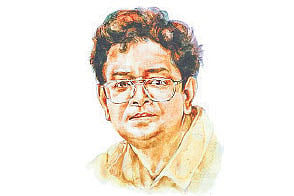
His father appears again and again in Humayun Ahmed's writing. In that writing the father is sometimes very grave, sometimes strangely humorous, and sometimes a distant figure to his children. Humayun Ahmed's father was named Faizur Rahman. He was a police officer, he loved reading books, he had many dreams for his children, and he put his children through strange experiences that they could not forget even after growing up.
Faizur Rahman had a transferable job. Because of that, in childhood Humayun Ahmed travelled with his family from one place to another. Piecing together the fragments scattered through his autobiographical books gives a fresh sense of who Humayun Ahmed was. His father was at once whimsical, brave, book-mad and deeply affectionate. Humayun wrote: 'I do not know whether my father was one of the best people in the world, but I can say he was a strange man.'
One winter morning the young Humayun woke to his parents arguing. His mother kept saying, 'What will you do with a horse? Explain it to me — who will look after this horse?' His father reassured her that something would be arranged. Going outside, they found a huge horse tied to a betel-nut tree. To the young Humayun it seemed almost as big as the sky; the horse was stamping its feet and snorting. But after buying the horse, arranging to keep it was not easy, and in the end it had to be sold.
His father's whims did not stop at buying a horse. He had a passion for learning the violin. Once, returning home at the start of the month, he told his wife he had bought a violin for only 70 taka, cheap because it was second-hand. But from the money he was supposed to hand his wife for the household, after deducting the violin's price only 10 taka remained. He never did learn to play it; the violin lay unused, and in time the children began using its case to make a dolls' house.
Another of his father's great passions was reading. He worked in the police, but after duty he spent his time in the library. From his salary he set aside household expenses, kept money to send to the village home, and also kept a fixed amount for buying books. His love of books spread to his children too. The young Humayun began secretly reading books from his father's bookcase. One day he was caught. His father asked, are you reading these? Do you understand any of it? Then he took his son to the Central Muslim Sahitya Pathagar in Sylhet and made him a member. Regular reading began there; in Humayun's words, he developed the habit of reading two books a day.
When their father fell ill, the children were rather pleased, because when he was ill he stayed home. He would sit the children in a circle and a session of poetry reading and recitation would begin. Once Humayun recited from memory his father's favourite poem 'Ebar Firao More'. Delighted, his father gave him four annas. Humayun wrote jokingly that it was his first earning from literary work.
His father also experimented with Humayun's name. After his birth he was named Shamsur Rahman, matching his father's name Faizur Rahman. He had to live with that name until the age of six. In his seventh year his father changed it to Humayun Ahmed. Two years later, when another change was attempted, the young Humayun objected: the name could not keep changing. Amusingly, after his father's death the family had considerable trouble withdrawing his pension and gratuity money, because the names written for the children in the documents had later been changed; his father had changed the names but had not corrected the necessary papers.
Faizur Rahman also wrote himself. He wrote stories and essays for newspapers. He printed one of his books himself on a letter press. Its cover showed the figure of a woman, and in the place for the cover artist's name was written Humayun Ahmed. Humayun was then studying at Bogura Zilla School, probably in class eight or nine. He had not drawn the cover himself, but his father had printed his name in the book as the cover artist. The book was a collection of stories. His father's pen name was 'Sandhani'. He wrote for various periodicals including the police Detective magazine. Bound copies of his writings and printed magazines were kept at home. To the children, their father's identity as a writer was a matter of pride; wherever they went somewhere new, Humayun would tell his friends his father was a writer. There is also a story of the younger siblings playing with their father's books: standing them side by side and flicking one so the others fell one by one, their mother would scold them — are books a thing to play with? And when guests came to the house, the siblings would gift them their father's books.
In 1971, after Pakistani soldiers killed Faizur Rahman, their house was looted. Many of his father's writings were lost along with papers and periodicals.
One of the most heartbreaking memories of his father is in Humayun Ahmed's piece 'Amar Babar Juta' ('My Father's Shoes'), where he returns to May 5, 1971. His father had a pair of red leather shoes. He wore them with ordinary clothes as well as with his police uniform. Polishing the shoes often fell to the children, and they enjoyed the task — the smell of the polish, the rubbing of the brush and the shoes shining at the end were part of the joy. When the shoes were cleaned, his father would say, 'Oh my, you have turned them into a mirror.'
That day too, his younger sister had polished their father's shoes. He praised them as usual, then put the shoes on and left home. He never returned. In the evening came the news that Pakistani soldiers had shot him dead on the bank of the Baleshwar River. But his mother would not believe it; she believed such a good man could not die like that — perhaps he had been taken away, and would return when the country became independent. The family counted the days in that hope. Later came news that a body washed up in the river had been recovered and buried, and that the shoes had been removed to identify the body. Humayun was sent to fetch the shoes. He went and saw that the pair was indeed his father's. He returned home crying, carrying the shoes. But his mother still would not accept it; she said many people could have the same kind of shoes.
After the country became independent, Humayun went with his mother to Pirojpur. The grave was dug up and his father's remains were raised. The body had decayed, but from the socks, teeth and hair his mother was certain the man was her husband. Then one evening his mother took out the shoes wrapped in paper. She cleaned them for a long time, polished them afresh with red polish until they shone, then placed them beside her pillow and lay down holding them.