Russia is 'setting traps' in Ukraine talks, EU foreign policy chief Kallas warns
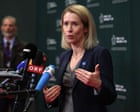
The European Union's foreign policy chief, Kaja Kallas, has warned against 'walking into the traps that Russia is setting' in the Ukraine talks. She said Moscow was trying to start a debate about European security in order to divert attention from its aggression.
Arriving at an EU leaders' summit in Dublin, Kallas said: 'We have one aggressor and one victim, and the aggressor does not have security concerns.' She added: 'Nobody has ever attacked them. They have attacked others. I mean, keep the focus, people.'
In talks on the Ukraine war, Russia has revived its hardline demands for a total overhaul of European security — demands that were rejected in 2021 because they were seen as an infringement of the sovereignty of central and eastern European countries. The latest round of talks between Ukraine, Russia and the US was held this week in Abu Dhabi.
Donald Trump's envoy and son-in-law, Jared Kushner, said on Thursday night that Russia and Ukraine had agreed to expand the next round of peace negotiations to include the Europeans. However, Russia quickly contradicted that assurance.
European leaders have long said they will support Ukraine in any peace talks, but want to see a ceasefire before negotiations. They also stress that the continent has an extensive web of security agreements that Russia has violated.
German Chancellor Friedrich Merz said Russia wants to talk about questions of a European security architecture, but that architecture already exists and does not need to be discussed. He added that it was a 'given' his country would be part of any European delegation.
European Commission President Ursula von der Leyen said it was 'self-explanatory that Europe is included in the peace talks to safeguard our interests, but also to support Ukraine'. The Kremlin said on Friday that once it understood Europe's real intentions and willingness to contribute to the peace process, a decision could be made on holding talks in an expanded format. Russia's lead negotiator in Abu Dhabi, Vladimir Medinsky, said it was 'unclear what there is to discuss' with Europe.
The US call to involve Europe in the talks has turned the spotlight on who would represent it. Despite more than two years of on-off talks, the EU has not settled on a choice. But there is a growing view that Europe should not be represented by a single person, but by different interlocutors from the wider continent.
Paris and Berlin support a continued role for their own envoys in the E3 format of Britain, France and Germany, alongside EU representatives. Smaller member states put the emphasis more firmly on the EU representatives: European Council President Antonio Costa and Kallas, the EU's high representative for foreign affairs and security policy.
Sweden's Prime Minister Ulf Kristersson described the discussion on who should represent Europe as 'slightly overstated', as it had differing interests. He said some issues in the peace talks were 'pure EU interests', citing financing Kyiv and Ukraine's future membership in the bloc. He also supported formats such as the E3 and the E5, which includes Italy and Poland, saying: 'I am quite flexible on that. I think what we actually say is more important than the exact configuration of the people in the room.'
Several leaders at the summit, including Kallas, also pointed to the importance of including the UK, a founder member of the coalition of the willing, a broad group of countries committed to future peacekeeping in Ukraine. Ireland's Taoiseach Micheal Martin said the UK and Norway each had a significant role, because it is a European, continent-wide issue. The British prime minister said it was for the EU to decide who would represent the bloc, and that there was a strong view among European leaders that it was for Europe, in the wider sense, to decide its own arrangements on security.