Counting penguins in Antarctica: a seasonal job paying up to €2,500 a month
The British charity UK Antarctic Heritage Trust (UKAHT) recruits people every year for an unusual seasonal job. The work is based around Port Lockroy in Antarctica during the southern summer: welcoming tourists, stamping postcards and counting penguins. Only a small team of four or five people is chosen each year.
The workplace is Goudier Island in the Palmer Archipelago, a small piece of land roughly the size of a football field, covered in rock and ice, where Port Lockroy stands. It was built as a British military base in 1944 as part of Operation Tabarin during the Second World War. It closed in 1962 and was restored some 30 years later. It is now a protected historic site under the Antarctic Treaty.
The site has a small museum, a gift shop and a penguin post office — the southernmost post office in the world that is still operating. Every year between November and March, thousands of tourists arrive there by cruise ship. The selected team shows visitors around, tells them the base's history, runs the gift shop and sorts and stamps more than 80,000 postcards each season.
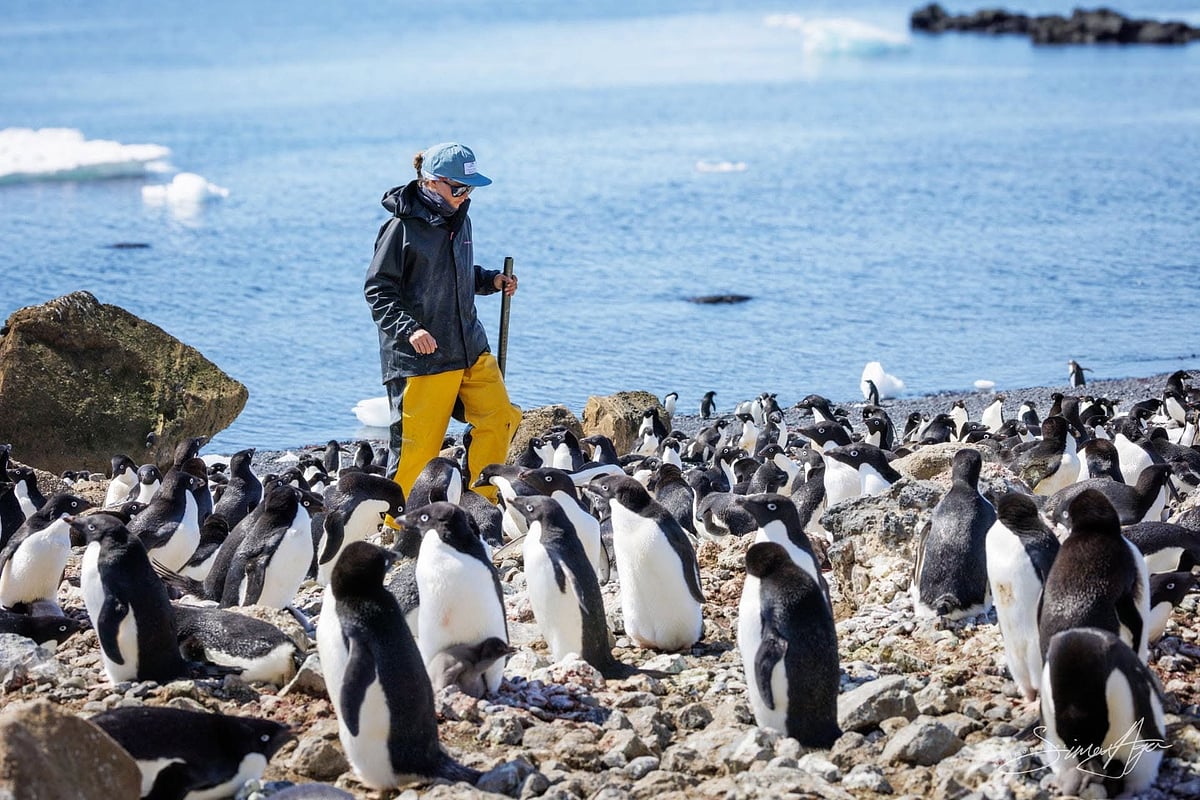
The most appealing part of the work is counting penguins. The island's gentoo penguins have to be monitored constantly. According to UKAHT, there are around a thousand penguins there, and they have lived on the island for more than 30 years.
The British polar research institute BAS has carried out this counting work regularly since 1996. Its purpose is to observe how the penguins are breeding and to understand whether the presence of tourists is harming them. Port Lockroy is the only place in Antarctica where researchers can work with penguins throughout the entire breeding season.
Great care is taken not to disturb the penguins. For the first few weeks the staff do not go beyond set boundaries. When eggs have appeared in about 95 percent of nests, the whole team counts every penguin on the island. In December 2024, 571 nests and 938 eggs were counted there. At the end of the season, when the chicks have grown and move around in groups, they are counted again. The counting continues until two consecutive counts give nearly the same result.
Pay varies by role. Alongside general assistants there are also base manager and store manager positions. Monthly earnings of roughly €1,700 to €2,500 are possible, equivalent to about 250,000 to 350,000 Bangladeshi taka.
The money is not simply handed over in full. Those who work there do so independently, as self-employed workers paid according to the work done, so they must pay their own tax from the income as required. Accommodation, food costs and the warm clothing needed against the biting cold are, however, provided free by the charity.
Life there is hard. The island has no running water; drinking water has to be carried in 20-litre containers from boats arriving from outside. As a result, there is a chance to bathe only once a week, and if bad weather stops the boats, the team may have to go two weeks without a bath.
Solar panels are the only source of electricity, so power-hungry items such as hair dryers or microwave ovens cannot be used. There is no ordinary mobile network either; communication depends on slow satellite internet or the Wi-Fi of large ships that call there. A portable toilet system has to be cleaned by the team themselves every day. Sleep is in bunk beds. Temperatures inside the barracks are usually between 14 and 15 degrees Celsius, while outside they range from five degrees below freezing to five above.
There is no maximum age limit for applying, but applicants must be at least 18. No science background is required either. Physical fitness, however, must be very good, because daily work includes clearing snow, unloading supplies from boats on slippery rocky ground and carrying heavy boxes weighing 15 kilograms. Smoking is completely prohibited on the island. Applicants must also be eligible to live in the UK and have legal permission to work there. Applications are expected to open again on UKAHT's official website early next year.
For those who cannot go but love penguins and want to help, UKAHT offers another option: adopting a gentoo penguin from home. The package includes the chance to adopt a penguin for twelve months, a postcard sent from Antarctica, a penguin toy, an information-filled booklet and welcome pack, an adoption certificate and regular penguin news from Port Lockroy. All the money from the scheme goes directly to penguin care and conservation; it even covers the cost of sending a wildlife researcher there in the summer. All the penguin research data can be viewed by anyone on the Port Lockroy data portal.