Toddler Falls to His Death From Unprotected Balcony at Rajshahi Medical, Certificate Records 'Brought Death'
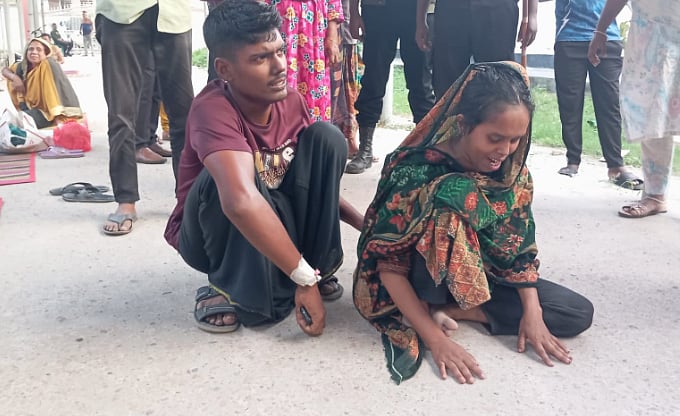
Abu Hurayra, the two-year-old son of a family that had come to Rajshahi Medical College Hospital for treatment, fell to his death from the unprotected second-floor balcony of a hospital building. The hospital authorities described the incident as merely an 'accident,' and the child's death certificate recorded the cause as 'brought death.'
The child's father, Hridoy Ali, is a very poor rickshaw puller from Kushtia. He himself was admitted to the hospital with dengue, and his sick six-year-old daughter, Umme Khadija, was admitted alongside him. His wife, Selina Begum, had come from their village in Kushtia hoping to take her husband and child home well again. With her was two-year-old Hurayra, who had just learned to walk.
At the time of the incident, Selina Begum was running around to buy medicine for her husband and daughter. It was then that the child fell from the second-floor balcony of the hospital's four-storey building. The account of the incident notes that the balcony had no protective railing or grille.
Although Kushtia has a government medical college hospital and a general hospital, the family had to travel a hundred miles to Rajshahi for treatment. With severe shortages of doctors and health workers at union, upazila and even district level, people from remote areas are forced to rush to divisional cities for care.
As a result, medical college hospitals in divisional cities such as Rajshahi carry two to three times their capacity in admitted patients. In the extreme crowding, many patients are forced to receive treatment lying on floors, balconies and even under staircases.
Under World Health Organization standards there should be at least three hospital beds for every 1,000 people; in Bangladesh the ratio is less than one. International standards call for at least 5 to 6 percent of GDP to be allocated to health, but Bangladesh's allocation has stayed below 1 percent of GDP for years.
Citizens bear about 70 percent of the total cost of treatment out of their own pockets. Apart from a nominal amount of medicine and tests, government hospital patients depend on outside sources for almost everything; accounts describe patients being forced to have tests done at high prices at private diagnostic centres because of 'this test is not done here,' 'the machine is broken,' or long queues.
Had the mother not had to leave the child in the ward and rush outside to buy medicine, this accident might not have happened — a question the account of the incident also raises. Going outside for medicine or tests has become a routine task for the relatives of patients at government hospitals.
The incident has raised questions about safety and infrastructure at government hospitals: why a crowded government hospital balcony should have no grille or protective barrier, and whether writing 'brought death' on a document ends the matter. The account demands strict reforms — a bigger health budget, expanded infrastructure, stronger safety, and good governance and discipline in medical care.