Class 1 admission by lottery for 2027, written tests for classes 2 to 9 under new school admission policies
Students will be admitted to class 1 at government and non-government secondary schools for the 2027 academic year through a lottery. For classes 2 to 9, students will be admitted in order of merit in a written test against vacant seats. The Secondary and Higher Education Division of the Ministry of Education issued two separate policies for government and non-government secondary schools on Wednesday (11 November) and Thursday (12 November), setting out the application process, the distribution of marks, fees and how the admission process will be run.
For admission to class 1, a student must be at least six years old but under seven. For the 2027 academic year, a class 1 applicant's date of birth must fall between 1 January 2020 and 31 December 2020 — that is, the student must turn six by 1 January 2027, but must not have turned seven.
An attested copy of the online birth registration certificate must be submitted with the application as proof of age. For students with special needs, a relaxation of up to five additional years may be allowed in determining age.
In both types of school, the academic year will run from 1 January to 31 December. Each section of every class will have 55 students. Students may be admitted into a school's entry class and, subject to vacant seats, up to class 9.
In 2027, applications, application fee collection, result processing and publication for all government secondary schools in the country will be done online. For class 1, a student may list up to five government schools in order of preference. If both shifts of a double-shift school are chosen, that will count as two school choices. If more than one application is submitted to the same school, all of the applications will be cancelled.
The class 1 lottery will be conducted centrally by the Directorate of Secondary and Higher Education (DSHE). Alongside the list of students selected in the lottery, a waiting list equal in number to the vacant seats will also be prepared. If selected students do not enrol within the stipulated time, admissions will be taken from the waiting list in sequence. For classes 2 to 9, students will be selected in order of merit through a written test, and a waiting list equal to the number of vacant seats must likewise be kept ready alongside the list of selected students.
At non-government schools, the admission process will be run by the institution concerned. The date and time of the admission test will be fixed at a meeting of the school's managing committee. To ensure that different institutions in the same catchment area do not hold tests on the same day, the schedule must be set in consultation with the relevant thana or upazila secondary education officer. At non-government schools, students must be selected for class 1 through a lottery, with an equal-sized waiting list kept alongside the selected list. For classes 2 to 9, admission must be made in order of merit in a written test against vacant seats. For admission to class 9, selection will be made from students who have passed class 8 or an equivalent examination. Application forms for the written test can be collected from the school office or, if the school has a website, from there; the dates for distributing and submitting forms must be stated in the notice.
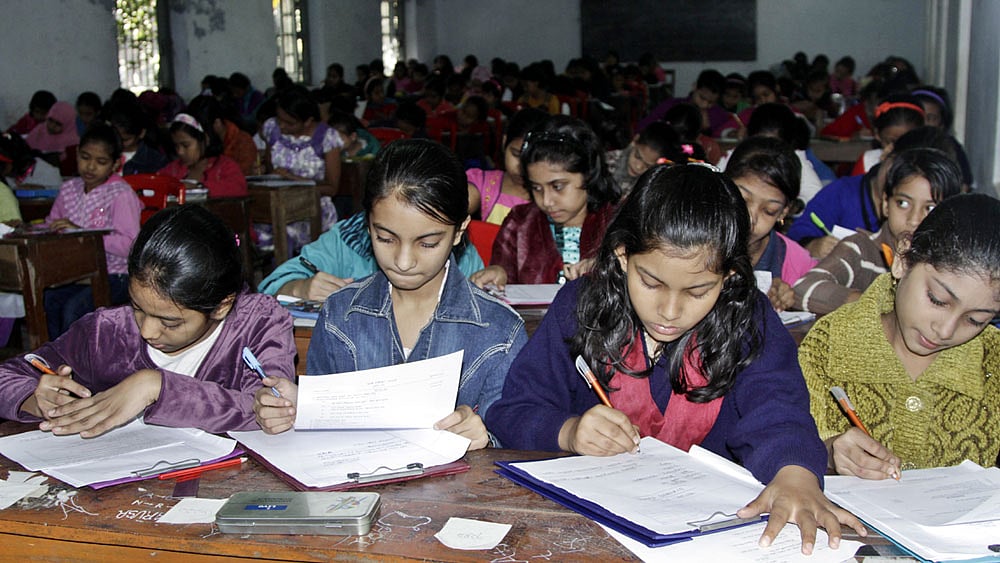
There are some differences in the mark distribution for admission tests at government and non-government schools. At government schools, the test for classes 2 to 5 carries a total of 50 marks — 15 in Bangla, 15 in English and 20 in mathematics — with a duration of one hour. The admission test for classes 6 to 9 is out of 100 marks — 30 in Bangla, 30 in English and 40 in mathematics — with a duration of two hours.
At non-government schools, the test for classes 2 and 3 carries a full mark of 50 — 15 in Bangla, 15 in English and 20 in mathematics — with a duration of one hour. The test for classes 4 to 9 carries a full mark of 100 — 30 in Bangla, 30 in English and 40 in mathematics — with a duration of two hours.
At government schools, the online application fee for class 1 is a maximum of 110 taka, and for classes 2 to 9 a maximum of 250 taka. The admission fee including the session charge must be set in accordance with the education ministry's instructions.
The non-government school policy also sets the price of the online application form at a maximum of 110 taka for class 1 and 250 taka for classes 2 to 9. However, a later clause of the same policy states that a maximum of 200 taka may be charged for the admission application form at all institutions — MPO-listed, partially MPO-listed and non-MPO — including those in the Dhaka metropolitan area. The clauses on the price of the application form therefore contain two different figures.
At non-government schools, the admission fee including the session charge has been fixed by area: a maximum of 500 taka in mofussil areas, 1,000 taka in upazila municipal areas, 2,000 taka in district headquarters municipal areas, and a maximum of 3,000 taka in metropolitan areas other than Dhaka.
At MPO-listed non-government institutions in the Dhaka metropolitan area, a maximum admission fee of 5,000 taka may be charged. At partially MPO-listed institutions, a maximum of 8,000 taka may be charged in the Bangla medium, including monthly tuition, session charge and development fee, and a maximum of 10,000 taka in the English version. No institution may collect more than 3,000 taka under the development head. When a student passes the annual examination at the same institution and moves up to the next class, a session charge may be taken each year, but no re-admission fee may be charged. The policy also calls for fee waivers for poor, meritorious and special-needs students.
Neither policy specifies fixed start and end dates for applications. For government schools, applications must be made through the designated software in line with the notice published by the Dhaka Metropolitan Admission Committee. For non-government schools, the institution concerned will announce the dates for form distribution, submission and examinations through its own notice. The dates for applications, tests and results will therefore depend on the relevant admission notices.