BJS written examination: time management and clean presentation bring the extra marks, advises Touhidul Islam
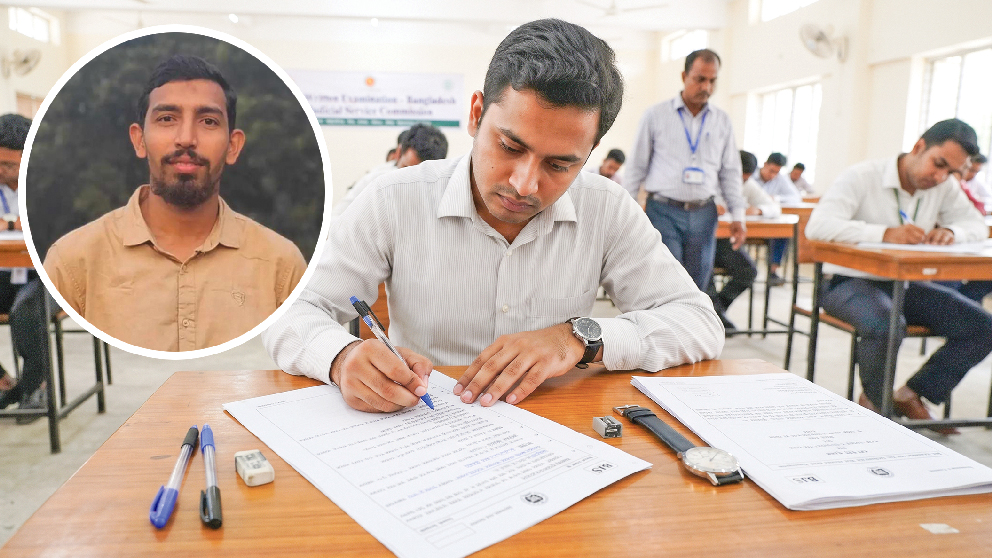
In the Bangladesh Judicial Service (BJS) written examination, every mark is valuable. Even a slightly higher mark can put a candidate ahead of others. Md Touhidul Islam, who was recommended as an assistant judge in the 18th BJS, has shared experience-based advice on last-moment preparation, time management, answer presentation techniques and caution. Shah Bilia Zulfikar wrote it down from his advice.
According to Touhidul Islam, the current job market is extremely competitive. In this competition, scoring two marks more means being far ahead. So the written examination script must carry proof of one's skill, intelligence and clean presentation.
Good or bad results in the written examination depend largely on the correct use of time; so the exam can be called a game of time. Time cannot be controlled; instead, one must acquire the skill of adjusting oneself to time.
For this, as soon as the question paper is in hand, candidates should check the marks distribution, how many questions must be answered and whether there is any compulsory question. The total exam time, the number of questions and the time allotted for each question should be calculated in advance.
Ten to fifteen minutes should be kept for reading the question paper and the remaining time divided up. Even if an answer is well known, it must not be written excessively long; again, an answer that is less known should not be made unnecessarily short. The length of an answer must be fixed according to its marks. To gain this skill, candidates should practise writing at home with a clock.
In competitive examinations, many candidates write answers in almost the same style. But clean and organised presentation can catch the examiner's eye. Regular practice is needed to gain this skill too.
In the BJS examination, pens with blue and black ink are permitted; pens of other colours cannot be used. Without drawing a margin with a round scale, a one-inch space should be left at the top and on the left side as the margin.
Answers should be written maintaining the sequence of the questions, which makes the script easier to examine. Handwriting should be medium-sized, straight and clean. Each answer should be written arranged in a few steps. Unnecessary description should be avoided and the answer presented in points.
On each page, at least one notable fact, section, subsection, quotation or case reference may be written in blue ink. However, those whose writing speed is low should be careful about using a blue pen, as it can create problems in time management.
To indicate points or steps, marks such as 1, 2, 3; I, II, III; or arrows and stars can be used. Care should be taken with spelling and punctuation. If weak in mathematics, the solution can be roughed out on the left-hand page first. Putting an end mark at the end of each question helps the examiner understand.
Answers to law questions must be relevant and subject-based. There is no need to weigh down the script with irrelevant information; that wastes both time and pages. For a law question, the name of the relevant statute and the applicable section or subsection should be mentioned first. Then the main point of the section, a relevant example or, if possible, a related case reference should be given. Finally, a conclusion should be written in two or three lines.
If the subject of a question also appears in another statute, that statute's name can be mentioned and its relevant section briefly presented. This enriches the scope and presentation of the answer.
If one has a good grasp of law, problem-based questions can be chosen; they offer the chance to give analytical answers in comparatively less time. But without adequate knowledge, theoretical questions are better to answer. Not even a one-mark answer should be left blank.
In general subjects, rather than writing only short answers, they should be presented in some detail as needed. Instead of writing in prose form, it is better to write arranged step by step. On each page, an attempt should be made to highlight at least one notable fact or word in blue ink; for this, subject-wise information should be collected beforehand.
In answers on Bangla and English essays, Bangladesh and international affairs, relevant graphs, charts and maps can be used. Bangla and English essays should be attempted at at least 10 pages. In grammar, however, writing only the answer is enough; there is no need to rewrite the question, which saves valuable time.
After receiving the question paper, the whole paper should be read attentively. Questions should then be selected carefully, considering one's preparation and skill, because once a question is left for another, recalculating the time becomes difficult.
Every question must be given equal importance. The standard should be kept such that each answer can earn at least half to one mark more than others. Trying to gain a small extra mark in every question in this way can ultimately create the margin of success, Touhidul Islam advises.