Wild peacocks spotted on Panchagarh border after 52 years, seven birds come down on Bangladesh soil
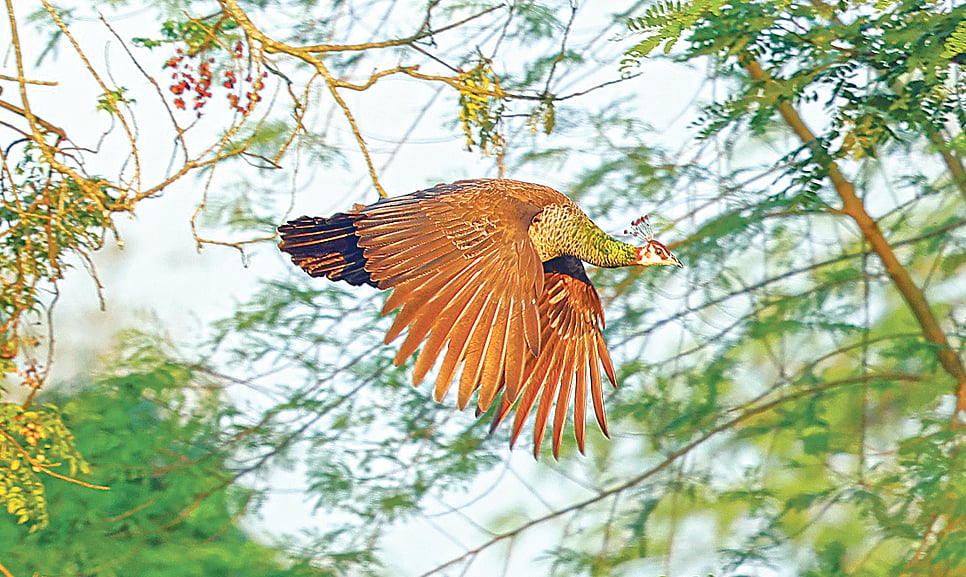
A flock of wild peacocks has been spotted in a border area of Panchagarh. Searching for the bird, officially declared 'extinct' in Bangladesh, a survey team first counted four peacocks, then five, and finally seven — and all seven had come down onto Bangladeshi soil.
Acting on information from local bird lovers, the survey team travelled to the Panchagarh area. Its aim was to locate the birds, observe their movements and, if possible, document evidence of them using habitat on the Bangladesh side. Carrying cameras, binoculars and large telephoto lenses, the team reached the spot and found the trees believed to be the peacocks' regular night roost. It was midday, however, and the birds were nowhere to be seen, so the team decided to return in the afternoon.
The search was made possible by IUCN Bangladesh, which the government has tasked with implementing the project to update the country's fauna data. The team included the project's co-team leader, Professor Mohammad Mostafa Firoz, and project coordinator Jennifer Azmiri.
The team returned to the spot at around three in the afternoon. As the autumn sun dipped towards the horizon, the first peacock was seen in the fading light, just beneath the leaves of a tree — partly hidden in the darkness, but unmistakable. Within a short while, four peacocks emerged one by one and gathered near the roosting trees.
By 5:30 the next morning, team members were waiting at vantage points around a tea garden for the birds to come down from the trees. Within half an hour, five peacocks flew down one after another and settled on open ground across the border, on the Indian side. Their movements, the manner of their descent and how they spread over the ground provided important clues about their daily routine.
Returning to the same place after four that afternoon, the team saw several peacocks perched on a dead tree trunk close to the ground. Soon the entire flock of five gathered there before slowly making its way towards the familiar roost. A clear pattern emerged in the birds' movements — they use this area regularly; this was no accidental presence.
On the morning of the third day, the birds crossed the border and came down onto Bangladeshi soil. They moved about naturally and pecked for food, showing no sign of fear despite people being present at a distance. Then came the peacocks' alarm call — the first call faint, the next, seconds later, sharp and loud. Immediately afterwards, peacocks flew up one after another into two adjacent trees. Counting them revealed not five but seven peacocks — and every one had come down on Bangladeshi soil. The team believes a predator such as a fox, a jungle cat or a python was probably hidden beneath the dense tea bushes, although its presence could not be confirmed.
Every location from which peacock sightings had previously been reported was close to the border, especially around India's barbed-wire fence and the adjoining no man's land. An important scientific question has arisen for the ongoing Red List assessment: should the peacock still be classed as 'extinct', or should it be moved into another threatened category? Occasional crossings of the border alone cannot determine a species' conservation status — it was essential to know whether the birds are temporary visitors from India or have begun using Bangladesh as a regular part of their habitat.
This survey has provided a basis for answering that question: the birds are not fleeting guests that have strayed off course; they are using the land on this side of the border as a regular range. The observation is therefore expected to form an important scientific basis for updating the Red List.
The sighting of one flock does not, however, amount to a permanent return. That will require protecting the peacocks' roosting trees and grazing land, involving local farmers and tea workers to prevent hunting and pesticide harm, controlling tourist crowds, and joint conservation initiatives with India.