A community school inside Ukhiya's Rohingya camp: children learn their own language and culture, and teacher Ikram's dream comes true
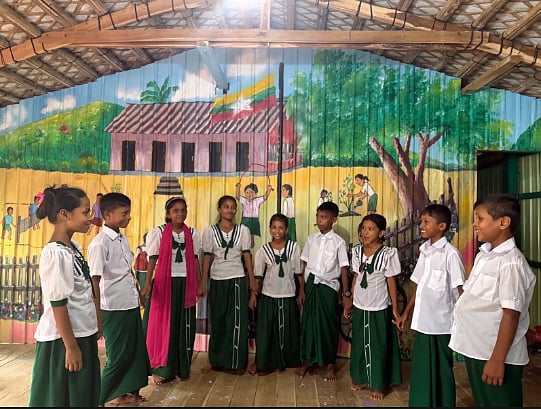
In a room on the upper floor of a building in a Rohingya refugee camp in Ukhiya, Cox's Bazar, a group of children are dancing and singing a rhyme in tune. Some hold the hand of the friend beside them, others turn in rhythm. That room is a small school built by local Rohingya themselves.
The school was built amid uncertain refugee life. Funding has come from the non-governmental organisation Human Concern. Here children learn to read and write; alongside that they learn their own language, songs and culture. The rhyme the children sing is also part of that learning; in the Rohingya language such rhymes and stories are called 'kissa', passed down by word of mouth for generations.
The Rohingya have no state of their own and no recognition of citizenship in Myanmar. Hundreds of thousands who fled Rakhine State in 2017 to save their lives and took shelter in Bangladesh now live confined to refugee camps. Nine years have passed since the recent large displacement, yet children's education opportunities in the camps remain limited.
According to Ethnologue, a language database, Myanmar has more than a hundred living languages; one of them is the Rohingya language, or 'Rohingya Zuban'. Although large numbers speak this Indo-European language, opportunities to learn it institutionally are limited.
Learning centres run with the Bangladesh government's approval and support from UNICEF and various humanitarian agencies follow Myanmar's national curriculum, so children can fit into that education system if they return home. But in 2025, because of a funding shortfall, UNICEF had to scale back teaching and assessment for various grades, and many children dropped out of education.
Language is another major reason for dropping out. Rohingya children's mother tongue is Rohingya, not Burmese. A study conducted in the Kutupalong refugee camp and published in 2022 in the International Journal of Educational Research Open found that many children fell behind because they could not understand lessons and instructions given in Burmese and English, and some left learning centres altogether. The study also identified gaps in teacher training and the lack of formal recognition for learning achieved as major problems.
A 2025 report by the Burma Task Force of the US-based human rights organisation Justice for All carried a survey of one thousand women. Of 720 mothers who gave an opinion on the type of school, 77 percent believe community schools run by the Rohingya themselves provide better education than NGO-run learning centres. The same survey also raised parents' concerns about education quality, higher education opportunities and recognition of learning.
The school's only teacher so far is Mohammad Ikram. He too is a Rohingya refugee; in 2017 he also fled to Bangladesh in the face of violence and persecution in Myanmar. Before that he had studied up to higher secondary in Myanmar's education system and had received special honours for good results in physics and biology. His dream was to become a teacher.
One day Ikram learned that a learning centre run under the supervision of Future of Rohingya would recruit a teacher. He applied and got the opportunity. Ikram says he loves teaching the children; not only do they learn from him, he also learns many things from them constantly, especially how to hold on to hope.
Camp 4 in Ukhiya covers about 1.16 square kilometres, or 287 acres. According to UNHCR, the UN refugee agency, about 46,000 Rohingya were living in this camp in May this year. In this densely populated setting there is almost no separate space for children to run or play, and there are security concerns as well. In this environment the learning centre's large room is a place for children to study, play and find joy.
Teacher Ikram says English is his students' favourite subject. Jahana Khatun, 11, spoke in English without pause about her name, her age and her dream of becoming an English teacher. Another student, Mohammad Ayas, 11, is learning Rohingya, Burmese and English, along with mathematics and science; but his favourite subject is drawing, especially animals, and among animals he likes horses most. Ayas said he wants to ride a horse and travel when he grows up.
Children have been given uniforms, books and exercise books, and colours for drawing from the learning centre. On weekdays the centre runs in two shifts, morning and afternoon; each shift lasts three hours.
At parents' request and with Human Concern's funding, expansion work is under way. A new classroom is being built, scenes of space are being painted on the walls, and the process of recruiting another teacher is also under way. There is a plan for Rohingya women to use the same place in the afternoon after children's classes end.
Masum Mahbub, head of Human Concern's US branch, said there is a plan to teach women nakshi kantha work in the unused afternoon time; the possibility of selling their products abroad is being examined and an e-commerce website is also being considered. He said their goal is that the time spent waiting for repatriation is used well, and that when the Rohingya can return to their own land, they are prepared to start life anew. Local Rohingya youth Rafiqul Kader Ayub worked as interpreter in gathering the information.