Third US carrier enters the Middle East, as intelligence estimates Iran still holds up to 2,500 missiles
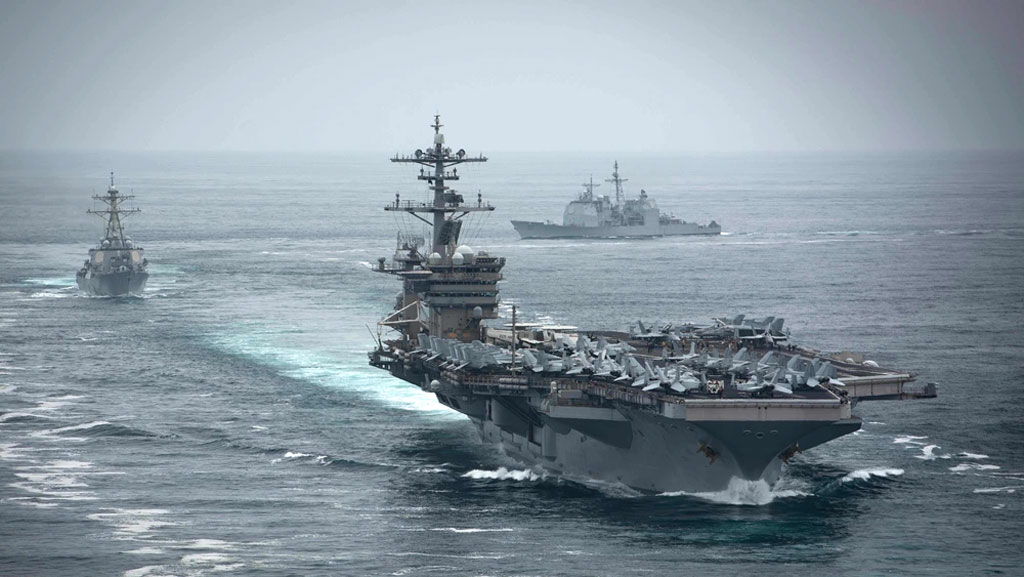
As Washington discusses the possibility of a renewed military operation against Iran, the United States has deployed another aircraft carrier to the Middle East. The USS Theodore Roosevelt entered the region on Sunday, raising the number of US carrier strike groups there to three.
A US official said the Theodore Roosevelt entered the area under US Central Command (CENTCOM) on Sunday. The USS George Washington and the USS George H. W. Bush were already positioned in the Middle East.
The presence of three US carrier strike groups in the Middle East at once is being seen as a significant show of military force. The United States deployed three carriers to the region in the same way in April this year; before that, such a deployment had not been seen since the 2003 Iraq war.
How long all three carriers will stay in the Middle East is not yet certain. It had earlier been assumed that the Roosevelt would replace one of the other two carriers there. US officials have said, however, that all three could remain in the region if needed.
At the same time, US intelligence agencies have assessed that, despite extensive US and Israeli strikes, Iran still holds between 1,500 and 2,500 missiles. The Wall Street Journal reported the assessment on Sunday.
Confidence in the estimate is low, however. Officials said it is difficult to determine how many of Iran's missiles are operational and how many are in storage. Even so, the assessment says Tehran still has the capability to pose a significant threat to US troops and their allies in the Middle East if the conflict escalates.
President Donald Trump, meanwhile, has not yet decided on launching a new large-scale strike against Iran. He has told his senior advisers that he may not order additional military strikes if Iran or the Iran-backed Houthis do not attack US interests again.
Saudi Crown Prince Mohammed bin Salman and Turkish President Recep Tayyip Erdoğan have urged Trump not to raise military tensions again. According to a Reuters report, however, Israeli officials have continued to press Washington to consider resuming military operations against Iran.
Trump is meanwhile due to leave Washington early on Monday, travelling first to the Philippines and then to China. On Tuesday he will meet Southeast Asian leaders in Manila, and on Wednesday he will go to Shenzhen in China. On Thursday, after attending the Asia-Pacific Economic Cooperation (APEC) summit, he will join Chinese President Xi Jinping for a bilateral meeting and a working lunch.
Towards the end of the China trip, Trump is expected to take part in a trilateral summit with Xi Jinping and Russian President Vladimir Putin. The White House has confirmed to The Jerusalem Post that the meeting will discuss the Iran situation as well as the possibility of reducing the three countries' nuclear stockpiles.
At a briefing on Friday, however, senior US officials said Washington does not expect a nuclear arms control agreement from this initial meeting. One official described it as "a gateway, a first discussion" that could begin a long-term diplomatic process, and said Trump has no separate bilateral meeting with Putin planned during the China trip. Officials said that although the Iran war will be discussed, the Ukraine conflict will not be on the trilateral agenda, as Washington and Moscow already have separate diplomatic contacts on Ukraine.