Electra's hybrid-electric 'Ultra Short' plane needs just 150 feet to take off
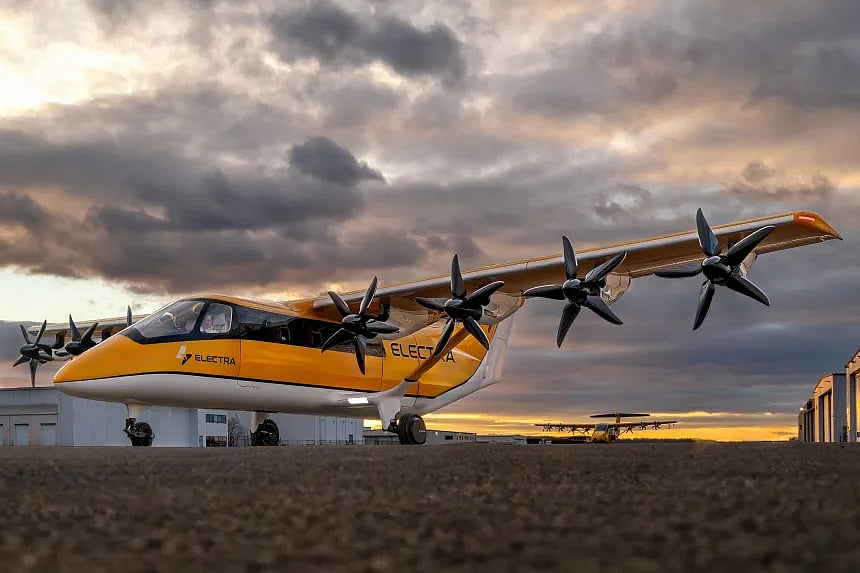
Virginia-based US company Electra is building a hybrid-electric aircraft called the 'Ultra Short'. The company says the plane will need just 150 feet, or about 46 metres, of flat ground to take off and land.
The company's goal is to change regional travel. It wants to build a system in which people can fly directly from one place to another without depending on airports or long runways.
Electra chief executive Mark Allen says today's air transport system works well for very long distances but is less convenient for travel between nearby cities. Driving takes a long time, while the distance is also short for a conventional flight, leaving passengers caught in between.
Electra believes a future advanced aircraft must ensure six things, which it calls the 'Rule of Six': it must be quiet, be able to take off and land easily in different places, carry more passengers or cargo, travel longer distances, be safe, and remain affordable. According to Mark Allen, no aircraft in aviation history has yet met all six conditions at once.
A technology called distributed electric propulsion is being used to overcome those limits. Small electric motors are placed at various points on the wing and body, helping to move the aircraft alongside or instead of a conventional engine. Electra is using this technology in the Ultra Short.
The full version of the Ultra Short is called the EL9. It has one turbo generator and eight electric motors connected to eight propellers. The manufacturer says the plane can carry 9 passengers or 3,000 pounds (about 1,361 kg) of cargo up to 380 miles, or about 612 kilometres.
The Ultra Short is not a fully battery-powered aircraft; it is hybrid-electric, meaning it has both fuel and electric systems. During take-off and landing the electric motors run on battery power, and once airborne the batteries are recharged with electricity generated by the turbine engine, which uses ordinary jet fuel. Electra claims it will use 40 percent less fuel than comparable aircraft, and that its operating cost could be 70 percent lower than a helicopter's.
The aircraft is also relatively quiet. Its noise level during take-off is about 75 decibels, roughly the sound of a vacuum cleaner.
The Ultra Short's most striking feature is the space it needs to take off and land — just 150 feet, less than 2 percent of the length of the shortest runway at New York's John F. Kennedy International Airport. Its eight propellers blow air rapidly over the wing, allowing the wing to generate more lift. Special flaps and a control system called droop on the wing also help.
Electra tested the wing's performance in a wind tunnel. The company says the EL9's lift coefficient was measured at more than 20. According to Mark Allen, that figure can be up to eight times higher than the wing of a modern large passenger aircraft.
The Ultra Short is not an eVTOL, because eVTOL aircraft can take off and land vertically like a helicopter, which the Ultra Short does not do. According to Allen, the plane can start flying once it reaches just 30 miles per hour, about 48 kilometres per hour, and then leaves the ground within three to four seconds.
Electra calls the new system 'Direct Aviation'. A 'mesh network' of small take-off and landing centres will be built for it. A helicopter landing site, an open field, a parking lot or any flat place with 150 feet of space could become such a centre.
Electra has already tested a sample of the system. Last month a two-seat test aircraft, the EL2, landed on a 300-foot floating platform used for helicopters in Lower Manhattan, New York, and then took off from there again. A demonstration of the aircraft's take-off and landing was also held at Downtown Skyport on 26 October.
According to Electra's research, the Ultra Short would take about 1 hour 45 minutes to travel from a shopping mall parking lot in Washington DC to a heliport in New York City. The same journey by car or conventional passenger aircraft could take more than twice as long.
Several hurdles remain before commercial launch, the most important being government approval and safety testing. Certification must be obtained from the US Federal Aviation Administration (FAA), which must examine the aircraft's design, safety and flight capability. PricewaterhouseCoopers director Alexander Buchkovski says demand for such an aircraft could emerge on routes where road links are poor, but construction and operating costs must be kept at a level where passengers can afford the fare and operators can still make a profit.
Electra has already received more than 2,200 advance orders for the Ultra Short from more than 60 aircraft operators. The company says the total value of those orders is about 15 billion dollars.
Trial flights of the EL2 are due to begin at five locations in Norway towards the end of 2027. If everything goes to plan, Electra wants to start commercial passenger transport in 2030. Meanwhile, it plans to build a factory on 88.5 acres in Springfield, Ohio, at a cost of about 850 million dollars. The company has also signed contracts with the US Air Force, Army and Navy.
Another possible use of the aircraft is power supply. Electricity generated by its turbine could run equipment on the ground, and could even meet the electricity demand of 15 homes, Mark Allen claims. However, each aircraft could cost about 10 million dollars commercially, so it will take more time to come within ordinary people's reach.