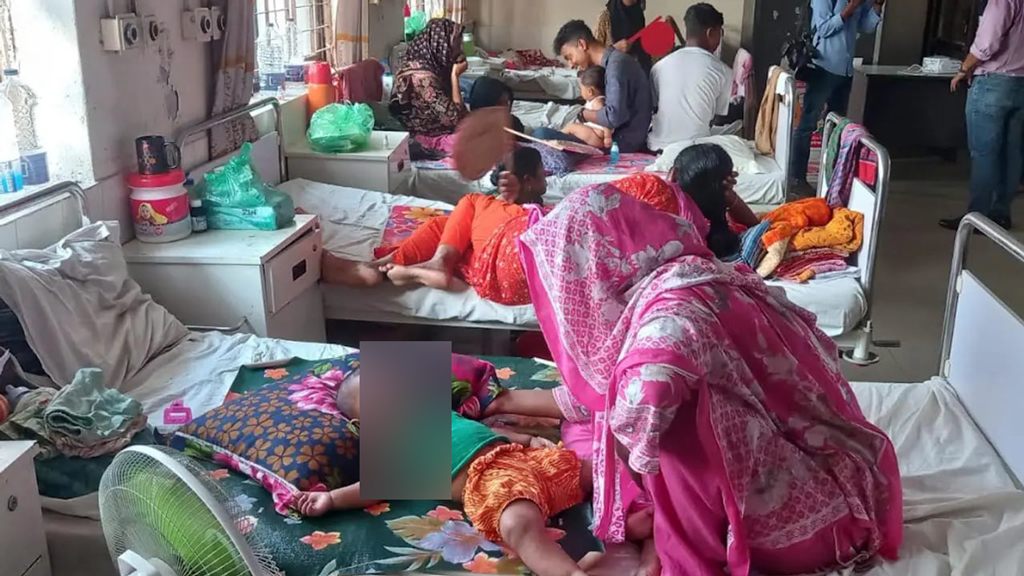
43% of England's maternity units do not meet safety standards, and ministers do not know the repair cost

Ministers have been accused of 'gambling with the safety of mothers and babies' after admitting they do not know how much repairing decrepit maternity units in England would cost.
NHS chiefs said last year that shoddy infrastructure meant 43% of maternity and neonatal units in England did not meet basic safety standards. NHS England said infrastructure problems hampered the delivery of clinical care thousands of times every year.
The Care Quality Commission (CQC) watchdog has also voiced concern that lack of space, ageing facilities and a shortage of operating theatres presents 'serious safety risks' for mothers and babies.
The latest warning was made by the Liberal Democrats amid growing concern that leaks, broken equipment and cramped treatment areas are disrupting maternity care. However, Karin Smyth, the NHS minister at the Department of Health and Social Care (DHSC), admitted in responses to recent parliamentary questions that the department could not put a figure on how much it would cost to upgrade maternity and neonatal units that NHS England believed either needed significant repair or replacement soon or were running 'a serious risk of imminent breakdown'.
Smyth made the admission in response to questions tabled by Helen Morgan, the Liberal Democrats' health spokesperson. Morgan said: 'NHS England has spelt out in black and white just how serious this is, with dozens of maternity units falling apart and some at serious risk of imminent breakdown.' She added: 'It is appalling that, despite those warnings, the government still has no idea how much it would cost to make every maternity unit fit for purpose. Ministers are gambling with the safety of mothers, babies and NHS staff caring for them.'
The maternity unit at Musgrove Park hospital in Taunton, Somerset, is 'old and not designed to deliver 21st-century care', Baroness Valerie Amos's review of childbirth services concluded in the summer. She found 'leaking roofs, poor temperature control with rooms often too hot or too cold'.
The unit's antenatal ward is in such a state of disrepair that it is being propped up by metal poles. Musgrove Park bosses acknowledged in September that its maternity unit is 'old, outdated and cramped' after CQC inspectors found that water had leaked into clinical areas and mould had formed on the walls and ceilings of the postnatal ward, although they rated the care staff provided as good.
Last week, Jules Wilkinson described how he had to hold up a light that had come loose from the ceiling for an hour while his wife was giving birth to their daughter Cora in the maternity unit at Stepping Hill hospital in Stockport, Greater Manchester. The light narrowly missed a midwife as it came off the ceiling. So much of the 121-year-old hospital is falling apart that 'it's almost in a death spiral', Wilkinson added. Stepping Hill, which regularly suffers leaks, needs £400m to ensure it is safe for patients and staff, its chief executive, Karen James, believes.
NHS England's review of the infrastructure of maternity and neonatal units, published in September 2025, concluded: 'There is a clear link between the condition of service infrastructure, the experience of service users and staff, and safety.' It added: 'In the last three years there have been 14,519 formally reported instances in the maternity and neonatal estate where clinical services have been interrupted or service delivery has been impacted as a direct result of poor physical conditions.' Problems such as power outages and faulty nurse call systems put 'additional pressure on already stretched staff' and 'can lead directly to procedure delays, such as planned caesarean sections', it said.
In 2024, the CQC warned in a report that 'too many maternity units are currently not fit for purpose, lacking space, facilities and, in a small number of cases, the appropriate levels of potentially life-saving equipment. We are concerned about the serious safety risks this presents for women and babies.'
St Helier hospital in Sutton, south London, is being forced to relocate its maternity services because of urgently needed repairs. The 'significant [repair] work' planned cannot be done 'while maintaining a good birth, gynaecology and fertility experience and safe environment for babies and families in the building', said Mat Shaw, the chief executive of the NHS trust that runs St Helier.
In last month's budget, ministers cut £1bn from the NHS's capital budget over the next four years, to help boost defence spending. The cut comes despite the fact that the cost of eradicating the NHS's massive backlog of maintenance has risen to £17.3bn, according to the most recent official figures.
Ciarán Devane, the chief executive of the NHS Alliance, said: 'A lot of maternity units are located in outdated, decaying buildings, making it much harder to ensure safe, high-quality care. This comes on top of wider challenges including staffing, the size and location of some units and the increasing complexity of care.'
The DHSC blamed the Conservatives' failure to properly maintain the physical fabric of the NHS during their time in office for the poor state of so many childbirth units. 'This government inherited struggling maternity services in buildings left to crumble,' a spokesperson said. The spokesperson said the government had invested £271m since April 2025 into schemes related to critical safety risks in the maternity and neonatal estate and recently announced more than £1.5bn to improve NHS buildings and facilities, adding that the capital budget for health would rise to £15bn in 2029-30 and that a 10-year capital plan would put investment on a long-term footing.