Seven great hornbills in two groups at Bandarban's Alikadam, as old trees vanish and hunters close in on the 'king of the hills'
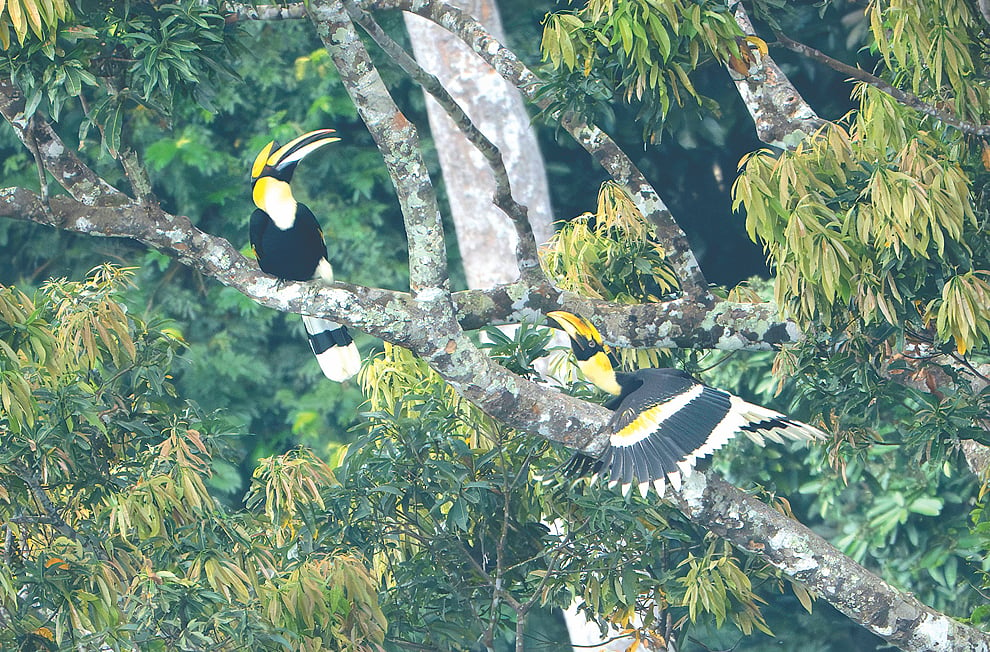
Great hornbills have been seen regularly for several weeks at Alikadam in Bandarban. Hill people know the bird as 'Rungrang'. On the 8th of this month, birdwatcher Askar Russo photographed the bird from unusually close range in Bandarban.
From Alikadam one travels to a place called Top in Naikhongchhari. A small lodging called Hung Chut stands there, and Rungrang can be sighted from that spot. Seven of the birds live in the area in two groups. Local Mro people say they see them regularly.
To breed, the great hornbill needs a large old tree, ideally one with a natural cavity. The female enters the cavity and seals the entrance with mud, her own droppings and food remains, leaving only a narrow slit.
The male feeds the female through that slit. Incubating the eggs and raising the chick are all done by the female from inside the cavity. The full breeding season takes three to four months.
The female usually lays one or two eggs, though most of the time only one chick survives. The eggs take about 40 days to hatch. During this period the female sheds her flight feathers. The male stores fruit in his throat and, standing at the nest opening, passes the food in beakful by beakful.
This way of life is exactly what puts the bird at risk. In the Chattogram Hill Tracts or Sylhet there are hardly any large old trees left, and the few that remain rarely have natural cavities.
Because it nests in one area for three to four months, the bird easily becomes a target for hunters. Hunters set artificial traps to catch the birds and eat them. If either the female or the male falls to a hunter, the whole family is finished.
Four hornbill species are found in Bangladesh. The rarest sighting is the wreathed hornbill, recorded only twice in recent times. The great hornbill is a resident bird of the hill forests; once seen regularly in deep forest, very few now survive.
The pied hornbill can still be seen in the hills, but it too needs good forest to survive. The fourth species, the Indian grey hornbill, is only occasionally seen in Bangladesh.
During five days of camping in the Kasalong forest, about a hundred pied hornbills were seen but not a single great hornbill. By contrast, on 24 September 2021, a pair of great hornbills was spotted while returning by boat through the Sangu forest.
The report stresses that conservation steps must be taken now to save this bird, known as the king of the hill forests.