Japan Scrambles Jets After Suspected Russian Planes Enter Its Airspace, Lodges Stern Protest With Moscow
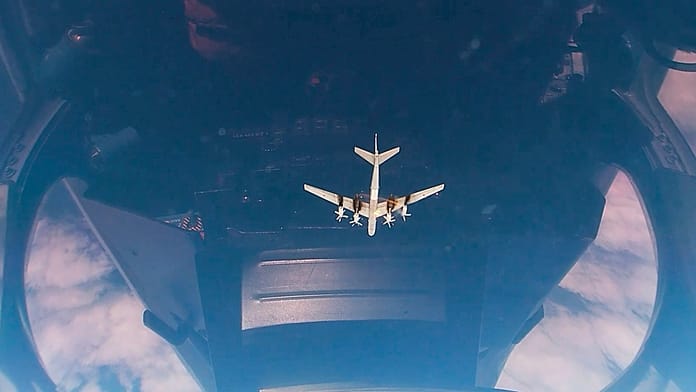
Japan said on Tuesday it scrambled fighter jets after suspected Russian aircraft violated its airspace, prompting Tokyo to lodge a protest with Moscow in a further deterioration of relations between the two countries.
Top government spokesman Minoru Kihara said the two "suspected Russian" planes entered Japan's airspace close to Okinoshima, in the southwestern area of Fukuoka, shortly after 4:00 am on Tuesday. Japanese jets sent warnings to the aircraft, which breached the country's airspace for around three minutes each.
"The violation of our national airspace by Russian aircraft is not only a grave infringement of our country's sovereignty, but also a threat to our security and is completely unacceptable," Kihara said. He said Japan lodged a very stern protest with Russia through diplomatic channels and strongly demanded measures to prevent any recurrence.
According to Kihara, the aircraft travelled through the Tsushima Strait and went between Yonaguni island and Taiwan before heading to the Pacific.
Tokyo's announcement came hours after South Korea said it had deployed fighter jets and conducted tactical manoeuvres after several Russian military aircraft entered its air defence zone. The Joint Chiefs of Staff (JCS) in Seoul said an unspecified number of Russian aircraft entered and later exited the Korea Air Defence Identification Zone (KADIZ) over the East Sea, also known as the Sea of Japan, in the early hours of Tuesday.
Seoul said the Russian aircraft did not violate South Korean airspace. An air defence identification zone is not sovereign airspace but a buffer area in which countries identify approaching aircraft for security purposes. Military aircraft are generally expected to notify the relevant country before entering its air defence zone, although such notification is not legally required.
Russia and Japan have a decades-old dispute over the status of a string of islands in the Pacific Ocean, but their relations have further soured in recent weeks following the arrest of a Japanese journalist on spying allegations and the seizure of assets belonging to a Japanese tobacco firm.
Japan lodged a "very serious protest" with Moscow in 2024 after a Russian patrol plane entered its airspace three times. That was the first confirmed incursion since 2019.
Earlier this month Japan demanded the immediate release of Japan Tobacco's assets in Russia, which were seized in the latest move against a foreign company's Russian operations. In October, Russia's FSB security service arrested Japanese journalist Yuki Imai from the Hokkaido Shimbun newspaper on allegations of "conducting espionage activities on Russian territory". Russia's foreign ministry has also accused Tokyo of systematically using journalists for espionage operations inside the country. Japan has denied the allegations.
Japanese Prime Minister Sanae Takaichi and Russian President Vladimir Putin are both due at an Asia-Pacific summit in the Chinese city of Shenzhen this week. Multiple Japanese media outlets reported that Tokyo had asked for a meeting between Takaichi and Putin at APEC, while the Kremlin said on Monday it hadn't ruled out the possibility of talks.