Rooppur to test first power supply to national grid today, 240-300 MW expected
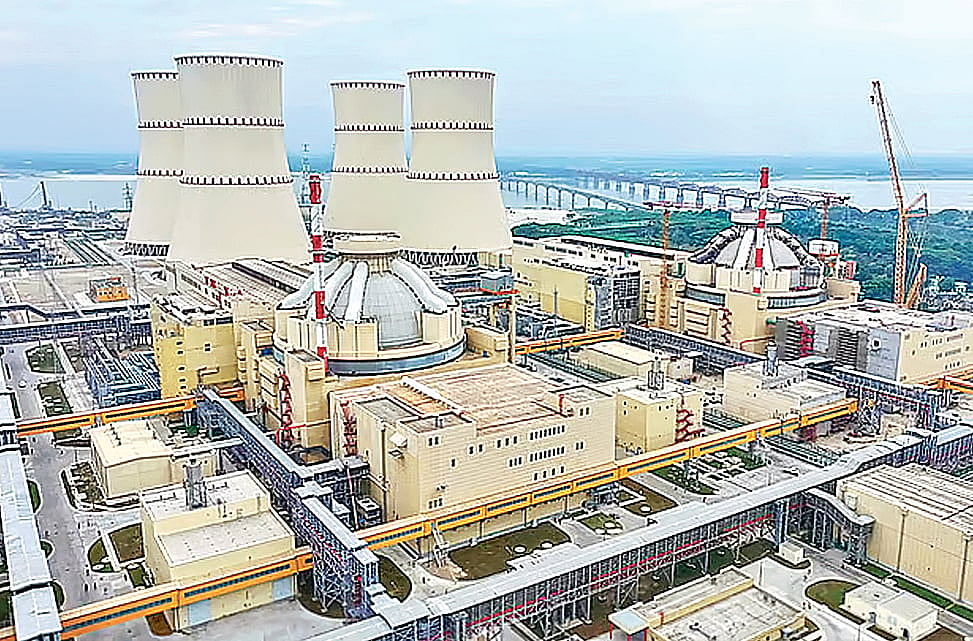
The Rooppur Nuclear Power Plant in Pabna may begin supplying electricity to the national grid for the first time today, Tuesday. But this will mainly be for testing.
Through it, 'grid synchronization' will be carried out. That means checking electricity production and supply, voltage and frequency to understand the grid's capacity. The nuclear reactor vessel, turbine and other equipment will also be tested at the same time.
Rooppur plant sources say Science and Technology Minister Fakir Mahbub Anam may be present when the supply to the grid begins. It is scheduled to start this afternoon. Alongside Rooppur's top officials, responsible officials of the Power Development Board (PDB) and Power Grid Company PGCB will be present.
Professor Shafiqul Islam of Dhaka University's Department of Nuclear Engineering has said grid synchronization is a very important step. The country's power transmission grid runs by a traditional process, estimating demand; it is not a smart grid. So a risk remains in supplying nuclear power, and the test must be done very closely.
Professor Shafiqul Islam also said that if everything is in order, the test could be finished in two days. If a fault appears, the test will have to be done again in the same way. No compromise on quality can be made, to avoid any future disaster.
During the test, 240 to 300 megawatts of electricity may be supplied to the grid. Production will then be stopped and the test report sent to the Bangladesh Atomic Energy Regulatory Authority (BAERA). BAERA has directed that the supply begin in the presence of the PDB and PGCB. If BAERA approves the result of the supply, Rooppur will move to the next step.
Trial supply of electricity will then continue. Commercial supply will begin after a purchase agreement between the plant and the PDB.
The process of producing energy through nuclear reaction was planned to start in September. It was delayed after a fault was found in a safety valve test. After the fault was fixed, the nuclear reaction was started on 11 October with BAERA's permission. On 29 October the results of the physical tests received BAERA's approval.
Rooppur is now moving to the next phase, the C stage. The plant is about to enter the stage of supplying electricity to the national grid on a limited scale for the first time. If it succeeds this time, the plant will go to the D stage, the final phase.
Rooppur is the largest single project in the country's history. It is being implemented by the Atomic Energy Commission under the Ministry of Science and Technology. Operation is being handled by the government company Nuclear Power Plant Company Bangladesh Limited (NPCBL) under the commission. Russia's contractor Atomstroyexport is building two units of 1,200 megawatts each at Rooppur.
Plant-related persons say that at Rooppur, the highest safety standards, approved procedures and regulatory rules will be followed at every step. Heat energy production begins through the reaction of nuclear fuel; that heat makes steam to turn the turbine, producing electricity. After power production begins in the reactor vessel, once capacity gradually rises to 30 percent, supplying electricity to the national grid becomes possible. Rooppur has already reached that stage.
Plant officials say trial production may continue for several months after the supply begins. But once electricity goes to the grid, Bangladesh will be the world's 33rd country producing nuclear power. Earlier, in October 2023, after nuclear fuel arrived at the project area, the Rooppur plant was recognised as a nuclear installation.
The Rooppur project's term ran until December 2025. It has been extended twice, to June 2028. Under the contract with the contractor, extending the term does not allow the project cost to rise. But the rise in the dollar's price has increased the project's cost by 26,000 crore taka. Rooppur will cost a total of 138,686 crore taka.