
Solar Power Overtakes the National Grid in Pakistan, Rooftops Now Covered in Panels
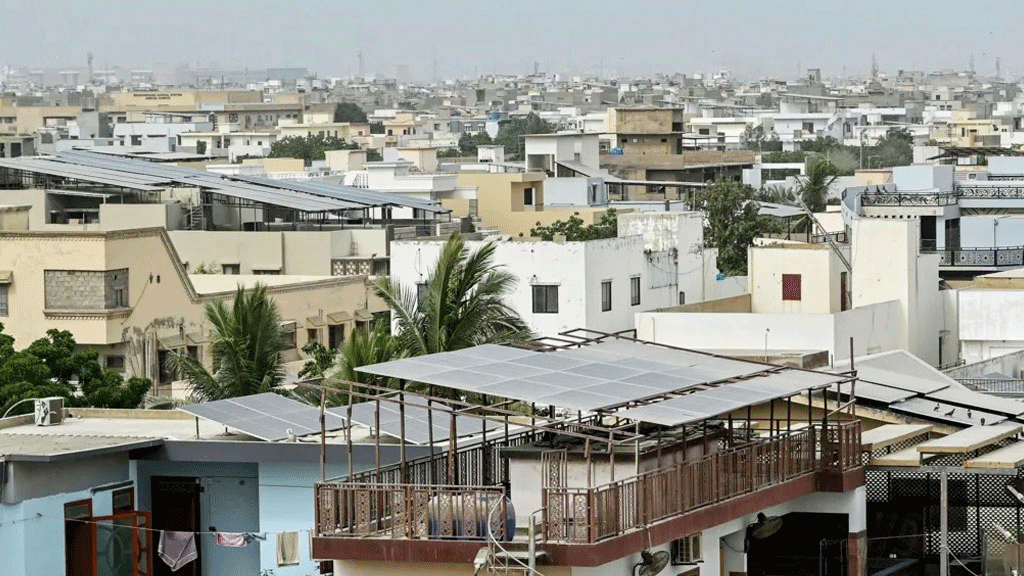
Pakistan has seen an extraordinary and silent revolution in the past few years. Defying the calculations of government policymakers and the national power grid, ordinary people and big industrialists alike have turned in large numbers to solar power. From rural villages to elite cities, blue solar panels now gleam across rooftops everywhere.
According to recent data from the Pakistan-based energy research organisation Renewables First, solar energy accounted for only 1 percent of total electricity generated in the country in 2018. By the end of 2025, that share had jumped to about 28 percent. More than 7 million households in Pakistan now use their own solar panels to meet their household needs.
There was a time when a motorcycle or expensive furniture was the customary wedding gift in rural Punjab. Now the most attractive and valuable gift at village weddings has become a solar panel and an air cooler. That small detail shows how deeply solar power has entered everyday life in Pakistan.
No huge government incentive or long-term plan lies behind this sudden solarisation. The revolution began from the struggle of ordinary people and businesses simply to survive. Over the past few years the price of electricity from the national grid has kept rising beyond the reach of ordinary people. While average monthly income in the country is about 40,000 Pakistani rupees, electricity bills alone reach 15,000 to 18,000 rupees.
Meanwhile, the price of solar panels in the global market, especially those made in China, has fallen by as much as 93 percent in recent years. Ordinary people seized on these cheap imported panels. Energy Minister Awais Ahmed Leghari described the situation positively to the media, saying people facing severe economic hardship had found another way to survive and had adapted in a highly efficient and economical way.
Solar panels are now everywhere not only in homes but also in the commercial and industrial sectors. The famous Kohinoor Textile Mills in the capital Islamabad is clear proof of that. The roof and grounds of this huge industrial establishment are now a sea of solar panels.
Utility manager Sabaun Khan said that whenever the sun is shining, hundreds of the mill’s heavy yarn and fabric machines run smoothly entirely on solar power. The heavy furnace-oil engines once used to keep the factory running now lie stored in a warehouse.
Industrialists say, however, that to get the full benefit of solar power, large industrial-scale battery storage is now essential. Many establishments have begun installing their own battery systems alongside the national grid so production can continue without interruption on cloudy days or at night. Kohinoor Textile Mills CEO Toufiq Saeed Saigol said that, with the state treasury lacking adequate resources, they chose this path to solve the energy crisis on their own initiative.
This remarkable rise of solar power has brought relief on one hand and created a deep financial crisis for Pakistan’s state-owned power grid on the other. Economists and energy analysts call it a utility death spiral. As ordinary people and industrial establishments reduce or completely cut their connection to the national grid, there are no longer enough customers left to bear the grid’s fixed maintenance costs.
The government is therefore forced to impose extra charges on the remaining customers, which pushes even more people towards solar. Energy Minister Awais Ahmed Leghari acknowledged that over the past two years, customers turning away from the grid has created more than 500 million dollars a year in extra financial pressure on remaining ordinary consumers. To tackle the crisis, the government recently changed the policy on selling excess solar electricity to the national grid. Small and medium entrepreneurs are somewhat unhappy with that, but the government argues that keeping the earlier subsidy-oriented policy would soon have left the country’s ordinary people facing far larger losses.
The Pakistan government has adopted an ambitious plan to meet about 90 percent of the country’s total electricity demand from environmentally friendly and renewable sources — solar, wind and nuclear power — by 2036. It has also set a target of reducing import-dependent fuel from 26 percent to just 4 percent. Plans to set up solar battery manufacturing plants inside the country and to increase the use of electric vehicles are also moving ahead strongly.
In a world system battered by war and natural disasters, Pakistan’s solar revolution stands at a turning point. On one hand it has shown how ordinary people can bring about major change through their own innovation in a moment of crisis; on the other, it has thrown a new structural challenge before a fragile state-owned grid system. If solar and the national grid can ultimately build a sustainable partnership side by side, it will remain a unique role model not only for Pakistan but for the entire developing world.

