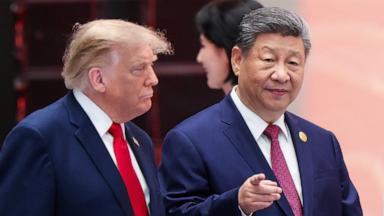
Trump Faces a 'Two Against One' Showdown with Xi and Putin in Shenzhen, Congressional China Watchdog Warns

President Donald Trump faces a potentially dangerous "two versus one" negotiating scenario when he meets Chinese President Xi Jinping and Russian President Vladimir Putin, two senior members of a congressional China watchdog warned on Wednesday, raising concerns that Beijing could seek concessions on Taiwan while Moscow pushes for greater US pressure on Ukraine.
"I think it is two versus one. We have China and China's junior partner, Russia," Randell Schriver, chairman of the US-China Economic and Security Review Commission, told Fox News Digital in a Zoom interview. "Largely they come to the table as a team versus President Trump and the United States," he said, citing China's support for Russia's war in Ukraine.
The warning comes ahead of Thursday's planned trilateral meeting in Shenzhen, China, on the sidelines of the Asia-Pacific Economic Cooperation summit. The talks are expected to address issues including the wars in Ukraine and Iran, trade and nuclear weapons.
Mike Kuiken, the commission's vice chairman, echoed Schriver's assessment, arguing that Moscow's growing dependence on Beijing puts Trump at a disadvantage. "Putin is a client state of Xi Jinping, and that essentially means that President Trump is in the room with a two against one scenario, and the stakes are significant," Kuiken said. "China is fueling Russia's war machine in Ukraine, and they are basically the lifeblood of the Russian economy at this point," he added.
The commissioners spoke as the bipartisan body released its 2026 annual report to Congress, detailing Beijing's expanding military, technological and economic capabilities and the growing challenges they pose to American national security.
Asked what would constitute success or failure at the summit, Kuiken suggested Beijing would not have agreed to the meeting without assurances that its interests would be protected. "My assessment is that the Chinese would never have agreed to this meeting if they had not had significant assurances that essentially nothing would happen," Kuiken said.
Schriver warned that both Xi and Putin would seek opportunities to advance their strategic objectives. He suggested Beijing would pursue gains related to Taiwan, while Moscow would hope Trump emerged from the meeting prepared to increase pressure on Ukrainian President Volodymyr Zelenskyy. "If Putin had his way, Trump would emerge from the meeting and put more pressure on Zelensky," Schriver said.
Schriver also questioned whether sufficient diplomatic groundwork had been laid for meaningful nuclear arms control discussions, one of the issues Trump has indicated he wants to address. He said he was not sure the front-end interagency, bilateral or trilateral work at a lower level had been done to have a productive discussion there. Nevertheless, he suggested that avoiding concessions could itself represent a successful outcome for Washington: "I think holding ground and just a restatement of US interests is probably a victory of sorts for us."
Beyond the summit, the commissioners warned that the United States faces mounting challenges as China approaches 2027, the benchmark year associated with Xi's directive for the People's Liberation Army to develop the capability to conduct a Taiwan military operation. Asked whether Washington was doing enough to deter Chinese military action against the self-governing island, Schriver gave a blunt assessment: "I think the short answer is no, we're not doing enough."
Schriver pointed to a pause in congressional notifications for US arms sales to Taiwan, saying the commission wants those notifications to proceed and supports stronger security assistance for the island. He also warned that Beijing's increasingly sophisticated coercion tactics extend beyond conventional military operations to include actions involving its coast guard, describing a blended lawfare with China's coast guard east of Taiwan.
Kuiken emphasized Taiwan's importance to the global technology supply chain, particularly its role in manufacturing advanced semiconductors used in artificial intelligence. "Taiwan is the island at the center of the world. Xi Jinping is obsessed with it," he said. Pointing to Taiwan Semiconductor Manufacturing Company, or TSMC, he warned of the broader implications for American technological leadership if Beijing were to take military action against the island, and urged Washington and its partners to develop a coordinated strategy to make an invasion or other Chinese coercive measures against Taiwan unattractive to Beijing.
Responding to concerns about Taiwan, a US official told Fox News Digital: "There is no change to our policy with respect to Taiwan." Asked about the commissioners' warnings, a White House official emphasized Trump's diplomatic approach to China and said the president would conclude his visit to China with a trilateral meeting between the presidents of the United States, China and the Russian Federation, and that among other topics he would discuss the reduction of nuclear weapons in the world, whose proliferation Trump believes is very dangerous.
The commissioners also raised alarm about China's rapidly expanding capabilities beneath the ocean. Asked whether China could disrupt critical American communications during a conflict, Kuiken was unequivocal: "Simple answer is absolutely yes." He said the Chinese had spent a long time studying the global communications network and had developed the capabilities to sever undersea cables around the globe, and that he was confident China had probably conducted exercises involving such operations, although he did not identify specific exercises during the interview.
Schriver pointed to China's advances in undersea warfare and ocean mapping as among the most concerning developments identified in the commission's research. He said the commission is urging Congress to strengthen protection of undersea communications cables through improved real-time threat detection, rapid repair capabilities and greater coordination with US allies. The commission has separately warned that cables linking the United States with Taiwan, Japan and the Philippines are vulnerable to disruption, with damage potentially forcing communications onto slower and less direct routes. The Chinese Embassy in Washington did not respond to Fox News Digital's request for comment in time for publication.