Iran's Guard warns Bahrain's monarchy its survival is at risk amid push to evict US Fifth Fleet
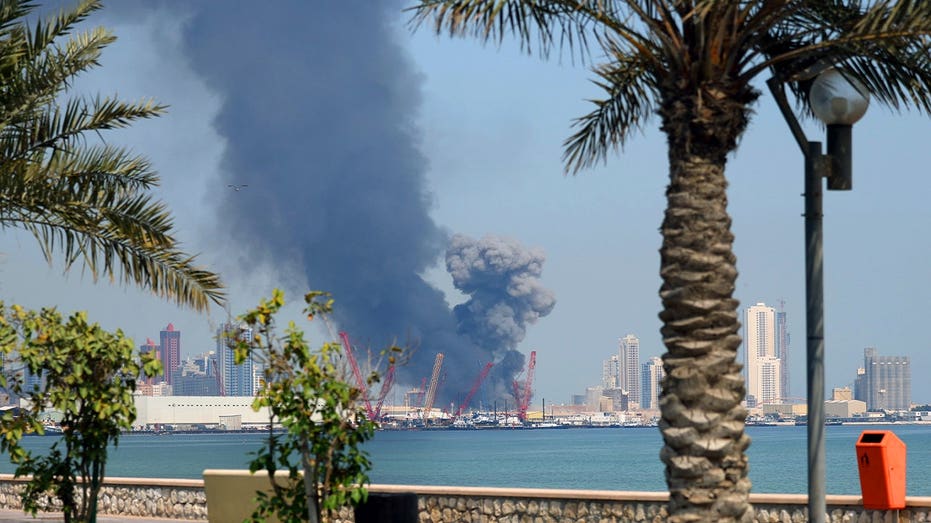
Iran's Islamic Revolutionary Guard Corps (IRGC) warned on Wednesday that Bahrain's ruling monarchy faces an existential threat. The warning came as Iranian drones and missiles targeted American military installations in the Gulf kingdom.
Bahrain hosts the headquarters of the U.S. Navy's Fifth Fleet. The fleet is a critical hub for American naval operations across the Persian Gulf, the Strait of Hormuz and surrounding waters.
Behnam Ben Taleblu, a senior fellow at the Foundation for Defense of Democracies, said Iran's regime has tried to inflame tensions in Bahrain for quite literally several decades and has claims to the island nation as well. He said the Islamic Republic is also trying to use military force to evict the United States from the region.
In a statement directed at Bahrain's ruling Al Khalifa family, IRGC Brig. Gen. Hossein Mohebbi accused the monarchy of cooperating with military action against Iran, relying on U.S. protection and challenging Shiite religious authority.
Writing on X, Mohebbi said: 'Colluding in the aggression against Islamic Iran, living inside the American security bubble, and encroaching on the authority of the Shiite religious leadership are three fundamental mistakes being made by the Al Khalifa regime.' He warned that if it persists in them, its survival under the new regional security order will be in doubt, adding: 'A word to the wise is enough.'
The threat followed a Bahraini crackdown on Shiite religious leaders. On Monday, a criminal court sentenced dozens of Shiite clerics to life in prison on terrorism-related charges, after prosecutors accused them of collaborating with Iran and plotting to undermine the government.
Bahrain's Public Prosecution agency said investigators uncovered communications between some defendants and Iranian authorities, including the IRGC. It accused the clerics of supporting terrorism and sabotage aimed at overthrowing the monarchy.
The latest escalation follows repeated Iranian drone attacks targeting American military equipment in Bahrain, including a U.S. radar installation Tehran claimed to have targeted for the third time in less than a week. U.S. Central Command (CENTCOM) said the attacks were intercepted.
Bahrain also reported intercepting Iranian attacks early on Wednesday, a day after the IRGC claimed to have struck a base used by American forces.
Taleblu said Iran is looking for places close to its territory where it can land blows against the United States on the cheap. He said the strategy is designed not only to damage American military assets but also to limit the space for the U.S. to operate from the region and to create tougher political conditions for Bahrain's ruling family to keep that U.S. force presence there.
He warned that the growing missile and drone threat could force Washington to reassess its long-term military presence in the Persian Gulf. He said the test case of what the U.S. does with the Fifth Fleet in Bahrain, and with the radars in that country, could be a harbinger of what the future of the U.S. footprint in the CENTCOM area of responsibility, and in particular the Persian Gulf, looks like post-war with Iran.