China, Russia and US agree 'peace declaration' with no mention of Ukraine and Iran wars
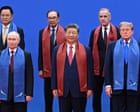
China, Russia and the US have said they have agreed a peace statement after an unprecedented trilateral summit, but the declaration made no mention of the wars in Ukraine and Iran triggered by two of the participants.
The declaration on Thursday also outlined a set of priorities that included changing the UN, boosting oil supplies and what it said was the protection of diplomatic immunity.
The statement affirmed that 'a nuclear war cannot be won and must not be fought', but stopped short of suggesting the beginnings of a framework for denuclearisation.
The meeting between Xi Jinping, Vladimir Putin and Donald Trump has dominated the Asia-Pacific Economic Cooperation (Apec) summit this week, with China, the host, promising it would be 'groundbreaking'.
'We are really making history,' Trump told Xi and Putin at the start of the meeting. 'No peace was ever forged by declining opportunities for engagement.'
Putin told a press conference later that the three men had had a 'free discussion' and a 'mutual understanding' had taken place.
Some had hopes that the talks, which lasted about one hour and 20 minutes, could be used to discuss reductions in arms between the world's three largest nuclear powers. Beijing has previously rebuffed advances by Trump to join such talks, pointing to the larger US and Russian stockpiles. On Thursday, though, Xi called for nuclear weapons to 'be completely prohibited and thoroughly destroyed over time to make the world free of [them]'.
The language of the declaration around nuclear war is the same as that previously issued before by the five permanent members of the UN security council, which includes France and the UK. 'The real test will be whether the three countries follow through on their stated commitment to discuss nuclear risk reduction and preventing nuclear proliferation,' said Patricia Kim, an expert on Chinese foreign policy at the Brookings Institution, a US thinktank. Even the suggestion that China would engage was significant, said Yun Sun, a senior fellow at the Stimson Center.
Analysts had warned that the meeting's primary significance was in its optics. 'Overall, very little of substance seems to have been accomplished … This summit appears to have been all about the symbolism and prestige value,' said Prof William Hurst, from the University of Cambridge's Centre for Geopolitics. Putin pushed back at the suggestion the summit had just been a photo-op. 'It is a serious collaborative work,' he said.
In the declaration, the men 'committed themselves to maintaining strategic stability and international security'. First among their concerns was 'promoting UN reform so that it may respond more effectively to global challenges'. Sun said this was a favourite topic of China's and showed that Beijing was 'flexing its diplomatic muscles'. She said: 'It is able to set the agenda and the deliverables according to its priorities … and make other great powers accept them.'
The declaration also agreed that 'the international criminal court [ICC] and other similar institutions must not abuse their jurisdiction'. Putin is subject to an ICC arrest warrant and so the clause added to the perception that he has done well from the summit. Since the 2022 invasion of Ukraine, the Russian president has been treated as an international pariah by Kyiv's allies and he has not been to an Apec summit in years.
Hurst said: 'This was no Yalta moment, but it was certainly a solid public demonstration of Russia's (and Putin's) continuing relevance and power. It's yet another example of Putin playing a poor hand to maximum effect.'
Xi, his status as a global powerbroker now assured, began the morning by addressing Apec leaders, reiterating the themes of trade openness and innovation he has emphasised throughout the summit. He made an appeal for regional harmony, saying: 'Members of Apec are like passengers riding the same ship. To navigate the waves of the Pacific, we must unite as one and look out for each other.'
However, Apec affairs appeared to take a back seat for most of the day, with business dominating the discussions. For all the camaraderie on display, relations are complex. Russia is under US sanctions over the Ukraine war, while China and the US spent much of the last year engaged in an escalating tit-for-tat trade war before Trump and Xi called a truce.
Trump and Putin earlier held a separate meeting – their first since August 2025 – with the US president calling the Russian his 'friend'. The peace declaration said the three countries planned 'to increase the production and supply of refined petroleum products for the benefit of all nations'. That was important, said Shan Guo from Hutong Research, a Shanghai-based advisory firm, but 'now let's see if the US will lift sanctions'.
Trump and Xi then held their third bilateral of this year. Xi said the US-China relationship was 'generally stable and positive', according to state media. But he warned Washington over Taiwan, saying the US 'must keep doing the right thing to avoid major setbacks in US-China relations'.
Another watched-for topic lacking detailed findings was that of AI. Xi said the two countries should 'enhance communication and coordination to guard against security risks … and ensure that AI remains under human control at all times'.
Ultimately, the lack of breakthroughs might suit China, which has no appetite to move beyond the role of convener, said Kim. 'Beijing has little interest in taking on the diplomatic risks of brokering an actual peace agreement in Ukraine or resolving the conflict with Iran. That would entangle China in conflicts it would rather avoid,' she said.