Tears in The Hague, cheers in Cox's Bazar camps as Rohingya hail genocide verdict
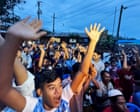
There were tears in the halls of The Hague in the Netherlands and an eruption of applause in the refugee camps of Bangladesh as scattered Rohingya communities watched the UN's top court rule that the Myanmar military had committed genocide against them.
For almost a decade, the Rohingya have awaited this moment: recognition from the International Court of Justice (ICJ) that Myanmar in 2017 intentionally tried to destroy the mostly Muslim minority group through a campaign of mass killings and rape. More than 10,000 Rohingya were killed and more than 700,000 fled to neighbouring Bangladesh.
As they spilled into the court's halls after the ruling, the relief was evident. A Rohingya community leader gave a big thumbs up as he left the courtroom, and others immediately took out their phones to call family in the refugee camps.
The verdict was reached by a majority of nine votes to six. ICJ president Yuji Iwasawa said Myanmar had the intention to destroy a substantial part of the Rohingya population. It is the first time a state has ever been found to have committed genocide by an international court.
Salma, 30, a Rohingya survivor who lost family members in the 2017 genocide, said: 'Everyone worked hard and struggled for this justice, for this cause. When they hear it today, everyone will be happy, thank God. I don't know how to express it or even what to do with myself.'
Another Rohingya present, who cannot be named for safety reasons, said they cried as the judge went through each of the rulings. 'During the last few minutes I couldn't even sit down any more, I had to move to the back because I didn't know how I'd react,' they said. 'I saw some of the other Rohingya around me crying. They were so emotional.'
That Rohingya added: 'Now the responsibility is with the international governments. It has been declared genocide now and they have to act.'
In Bangladesh, where most of the Rohingya population has lived in the world's largest refugee camp since being forced to flee in 2017, the verdict was translated into the Rohingya language for the crowds who had gathered to watch on screens specially set up for the purpose.
They immediately leapt up, cheering, applauding and shouting gratitude to The Gambia, the faraway African nation that brought the case to the ICJ on behalf of the stateless minority. Many held posters reading 'Thank You Gambia' and 'Justice = Safe Return'.
Farida Khatun, 50, who has been a refugee in Bangladesh since 2017, said: 'Since we arrived here, we have been waiting and looking forward to this justice.' Her village, Tula Toli, was targeted by soldiers. The village in north-western Myanmar, near the Bangladesh border, was the scene of a massacre in August that year, with reports of mass killings and gang rapes.
Farida Khatun, however, does not expect to be able to return home. Tula Toli was completely destroyed by Myanmar's forces and no longer exists. 'Even though today's verdict makes us happy, my heart still cannot believe that they will take us back in true peace,' she said.
The case has taken seven years to reach this point, with Rohingya researchers working to collect testimony from survivors. The initial hope for justice had faded during the long wait for a ruling. Many were also left deflated during early hearings when the one-time pro-democracy hero Aung San Suu Kyi defended the Myanmar military at The Hague.
In its ruling, the court highlighted the use of sexual violence and attacks on children alongside the killing of Rohingya who tried to flee violence, which it said meant the violence amounted to more than ethnic cleansing.
The court ordered Myanmar to provide reparations for the Rohingya and to end continuing breaches of the Genocide Convention.
There is now also an International Criminal Court investigation into the violence of 2017, looking specifically at the crime of mass deportation, for which prosecutors in 2024 sought an arrest warrant for Myanmar's leader, Min Aung Hlaing.
With continuing violence against the Rohingya, the possibility of a return to Myanmar, as happened after previous exoduses to Bangladesh in 1978 and the early 1990s, remains unlikely, the report said.
But many hope the ICJ ruling will be the start of a process of ensuring justice and lead to real international pressure to ensure their safety in Myanmar. 'We will be able to return to our homeland — with our rights, with our citizenship, and having received our full security. We will be able to return,' Salma said.