
Trump Calls Putin 'My Friend' at Shenzhen Summit as Xi Warns Him Over Taiwan
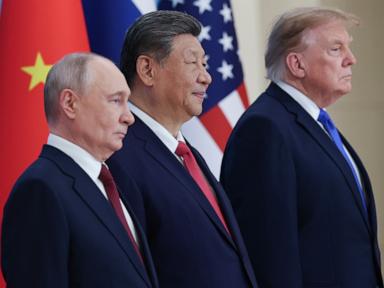
At the trilateral meeting in Shenzhen between President Donald Trump, China's President Xi Jinping and Russian President Vladimir Putin, Trump embraced Putin as "my friend," despite years of the West trying to isolate the Russian leader.
The meeting lasted only around 90 minutes and produced a four-point joint declaration on "peace," even as Putin wages his full-scale war in Ukraine more intensively — a war that has already claimed hundreds of thousands of lives as it approaches its fifth anniversary.
Drones targeted central Kyiv on Thursday even as the three leaders met. While Putin told Trump and Xi they all have "responsibility for maintaining international peace" and strengthening international law, his military is conducting a bombing campaign against civilian infrastructure in Ukraine, aimed at leaving millions without power and water, according to the report.
Before the cameras, Trump attacked the International Criminal Court (ICC), which in 2023 indicted Putin for war crimes, as being "out of control." The United States once endorsed the arrest warrant for Putin. The final joint declaration included a point that criticized the ICC, suggesting it had abused its power. The ICC did not have an immediate response to Trump's comments.
Jonathan Eyal, associate director at the London-based Royal United Services Institute, wrote: "Just about the only substantial outcome of the Shenzhen summit was the rejection of international law and institutions." Boris Bondarev, a former Russian diplomat who resigned in 2022 in protest over the invasion of Ukraine, said before the meeting that Putin has long wanted an event that confirms he is "a full member of the club" of "great powers."
Taking extended questions from the media afterward, Putin made clear his demands for ending the war are unchanged, insisting Ukraine must surrender its eastern regions. Kremlin media has framed the Shenzhen meeting as a Yalta 2.0, a reference to the 1945 Yalta Conference that divided postwar Europe.
Xi Jinping, meanwhile, used his meeting with Trump in Shenzhen on Thursday to urge bilateral cooperation on issues including AI, but also warned against the creation of "turbulence" over Taiwan. Xi and Trump met on the sidelines of the Asia-Pacific Economic Cooperation summit, first privately and then in the trilateral sit-down with Putin.
According to a readout from the state-run Xinhua News Agency, Xi said: "On the Taiwan issue, the United States must keep doing the right thing to avoid the emergence of great turbulence in the China-U.S. relationship." During their meeting in May, Xi warned Trump that China and the U.S. could "come into conflict" if the issue of Taiwan is handled "improperly."
Taiwan is an independent island nation that Beijing considers a wayward Chinese province. Washington does not officially recognize Taiwan as an independent state, but U.S. administrations have traditionally backed the maintenance of the status quo and provided significant military, diplomatic and economic backing for Taipei. Xi has been pushing for the U.S. to curtail its arms sales to Taiwan, including a proposed $14 billion deal that would include American missiles, anti-drone weapons and air-defense systems.
The arms package was approved by the US Congress in January but has been held up by the White House, awaiting final approval from the president. Trump has previously said the deal could serve as a "negotiating chip" in talks with Beijing. Speaking in Taipei, Taiwanese Deputy Minister of Foreign Affairs Chen Ming-chi said Taiwan faces a severe situation in the Taiwan Strait and believes the U.S. understands its defense needs.
From Wednesday into Thursday, Taiwan's Defense Ministry reported one sortie of Chinese military aircraft plus the presence of seven Chinese naval vessels and two other "official ships" around Taiwan. The ministry also reported that two Russian Tu-95 bombers flew into the island's air defense identification zone on Thursday.
According to a White House official, during a telephone call into a meeting of Ukraine's "Coalition of the Willing" European allies — at which Ukrainian President Volodymyr Zelenskyy was present, along with U.S. envoy Steve Witkoff and Jared Kushner — Trump said he was "super upbeat about the prospects for peace" following the summit. Zelenskyy emphasized that U.S. and European cooperation is crucial, that pressure is needed, and that Europe is ready with new sanctions and new steps to support Ukraine.
The report said the meeting's immediate impact is ultimately unclear. It noted Ukraine's strikes this week, using Ukrainian- and European-made missiles, that partially collapsed Putin's bridge to Crimea, while adding that the Shenzhen meeting may also have reinforced Putin's perception that the war is going his way.

