AI Becomes a New Assistant in Scientific Research, With a Major Advance in Predicting Protein Structures
Finding answers to many scientific questions takes years of experiments. Now, in some complex areas of research, artificial intelligence is showing scientists new possibilities.
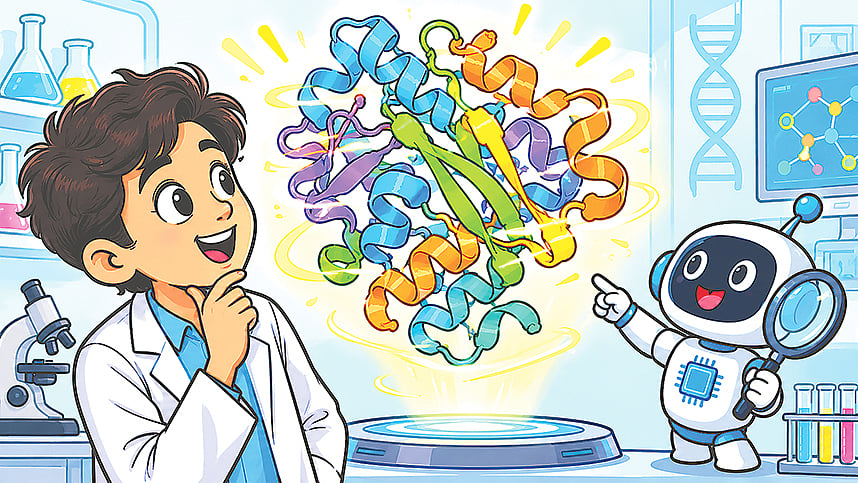
One example is determining the structure of proteins. Understanding how a protein folds into a specific shape is an important task in biology. AI can analyse vast amounts of biological data and predict a protein’s likely structure.
Google DeepMind’s AlphaFold has brought notable progress in this field. According to the company, the technology has predicted the structures of more than 200 million proteins.
In recognition of this research, the Nobel Prize in Chemistry was also awarded in 2024.
But an AI prediction is not the same as a proven scientific result. A young researcher, Arman (a pseudonym), obtained an idea of a protein’s likely structure with AI’s help; whether that prediction is true, however, he will have to verify in the laboratory.
That is because AI forecasts are not always correct. Relying on wrong information can send research in the wrong direction. Human observation and judgement therefore remain essential.
AI can point to a new path, but proving a discovery still falls to the scientist. The advance is thus seen not as a contest between humans and AI, but as a journey the two make together.