Government wants radical change in transport in five years with second Padma bridge and other big projects: Minister Sheikh Rabiul Alam
The government has taken initiatives to implement important transport projects including the second Padma bridge, the Dhaka-Chattogram elevated expressway and the Dhaka-Cumilla chord line. Road, Rail and Naval Transport Minister Sheikh Rabiul Alam hopes that implementing these projects over the next five years will bring radical change to the country's transport and infrastructure sector.
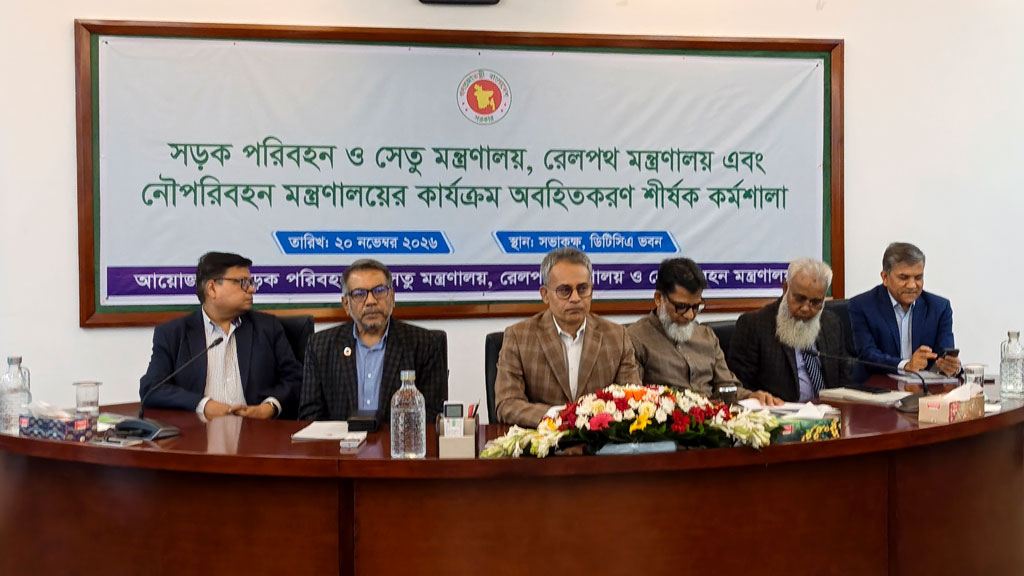
A workshop titled 'Briefing on the activities of the ministries of road transport and bridges, railways and shipping' was held on Friday in the conference room of the Dhaka Transport Coordination Authority (DTCA). Members of Reporters for Rail and Road (RRR) took part.
The minister said some of these publicly important projects are at the preparation stage, some at feasibility study and some at the stage of preparing a development project proposal (DPP). The feasibility study for the second Padma bridge has begun, and work on its detailed design is also under way.
On the Dhaka-Chattogram elevated expressway, the minister said three alternatives had been worked on. The second alternative, building a partial elevated road rather than a fully elevated one, appears cost-effective. A proposal will be placed before the prime minister, and if it is approved, work on the project could begin within a year.
On the Dhaka-Cumilla chord line, he said the project, worth about Tk 83,000 crore, is planned to be built entirely as an elevated route. That will require less land acquisition, reduce complications and make faster implementation possible.
Sheikh Rabiul Alam said several institutional processes must be followed before a project is taken up and implemented. For that reason, it takes one to one and a half years after a project is adopted just to start implementation, and then a further three to four years to complete it.
The minister said the rail, waterway, road and bridge projects were taken up considering the government's election manifesto and public importance. If they are implemented over the next five years, big change will come to the transport sector.
The minister urged journalists to publish news after verifying full information rather than relying on fragmented information or assumptions. The government's mistakes and deviations must certainly be highlighted, he said, but journalists also have a role in helping institutions correct and develop themselves, not only in making them controversial.
State Minister for Road and Rail Habibur Rashid said responsible journalism is not limited to highlighting the government's development work. Journalists also have a role in ensuring government transparency and accountability, exposing irregularities and improving service quality through constructive criticism. He said a government elected by the people's vote is accountable to the people, and the government is working to ensure sustainable development under the prime minister's direction.
The day-long workshop had six sessions. They discussed public procurement law and rules, Bangladesh's integrated transport system, progress, challenges and tasks in the road, bridge, rail and waterway sectors, and the government's initiatives, achievements and future plans for a modern transport system. An open discussion and a special 'Ministers Session' were also held.
The workshop was attended by Reporters for Rail and Road president Anwar Hossain, general secretary Tawhidul Islam and other members of the organisation. Also present were Railways Secretary Md Fahimul Islam, Bridges Division Secretary Mohammad Abdur Rouf, Road Transport and Highways Division Secretary Dr Mohammad Ziaul Haque and Shipping Secretary Md Ataur Rahman Khan.
Also present were Bangladesh Railway Director General Md Afzal Hossain, Roads and Highways Department Chief Engineer Md Moniruzzaman, Bangladesh Inland Water Transport Authority (BIWTA) Chairman Md Muhidul Islam and Bangladesh Bridge Authority Chief Engineer Md Abul Hossain. Professor Dr Md Asif Raihan of BUET's Accident Research Institute also took part.