Myanmar Legally Bound to Obey ICJ Ruling, Says Gambia's Lead Counsel; Naypyidaw Rejects Verdict
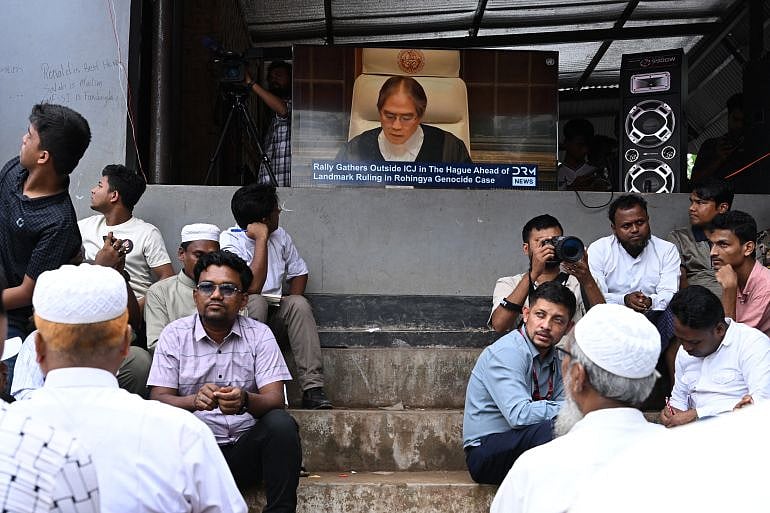
Myanmar is bound under international law to comply with the International Court of Justice (ICJ) ruling holding it responsible for genocide against the Rohingya, the lead counsel for the applicant state, Gambia, Arsalan Suleman, has said. He said Naypyidaw has no credible basis to evade the ruling or delay its implementation. Myanmar, however, has rejected the verdict.
The ruling, delivered on Thursday in The Hague, Netherlands, ordered measures for the safe return of the Rohingya to their homes, payment of reparations, and trial of those involved in the genocide. The ICJ itself has no power to enforce its rulings; if a ruling is not obeyed, the matter can be taken to the UN Security Council.
Speaking to the Anadolu news agency after the verdict, Suleman said the ruling is binding under international law and that Myanmar had actively taken part in the entire proceedings. Myanmar has no opportunity to put forward any credible argument as to why it would not implement the ruling, he added.
Suleman described the court's orders on Rohingya repatriation, the reunification of separated families and reparations for victims as 'far-reaching'. He said the ruling, in which the UN's highest court for the first time held a state responsible for genocide, will set an important precedent for future genocide cases.
Gambia filed the case at the ICJ in November 2019, after more than 700,000 Rohingya fled to neighbouring Bangladesh during Myanmar's 2017 military operation in Rakhine. Suleman said the victims have spent nearly nine years in refugee camps and justice had seemed out of reach; today's ruling will give them a message of hope and ensure accountability for the genocide they suffered.
Suleman called on the world community and international organisations to press Myanmar to implement the court's orders.
In Naypyidaw on Friday, however, Myanmar government spokesperson Khaing Khaing Soe alleged that the ruling, delivered by a 9-6 majority among the 15 judges, was 'unjust' and not unanimous. Claiming the army had operated only against insurgents, she said Myanmar had been wrongly accused.
Immediately after the ruling, Bangladesh and India stressed the swift and safe repatriation of the Rohingya. Welcoming the verdict, Bangladesh said Myanmar is legally bound to implement it and that the decision will smooth the path to the safe and dignified repatriation of the Rohingya.
Indian foreign ministry spokesperson Randhir Jaiswal restated New Delhi's position in favour of the 'safe, swift and sustainable repatriation' of the Rohingya. He noted that, besides delivering large amounts of relief to the camps in Bangladesh under 'Operation Insaniyat', India has been working to create conditions for sustainable repatriation through housing and socio-economic development projects in Rakhine.
International human rights organisations have spoken strongly in favour of the ruling. According to an AP report, Amnesty International Secretary General Agnes Callamard urged world leaders not to welcome Myanmar's junta chief on any international platform. She also demanded an immediate halt to all supplies of arms, security and surveillance equipment to the country and a global arms embargo. She further recommended referring the whole situation to the International Criminal Court (ICC).
The Organisation of Islamic Cooperation (OIC), in a message on X, praised the ruling, saying victims will receive reparations through it and the culture of impunity will end. The UN refugee agency UNHCR said the ruling is an important step towards granting the Rohingya citizenship and creating conditions for safe repatriation. It said more than 1.3 million Rohingya are currently displaced, most of them sheltered in Bangladesh.
Former UN special rapporteur on Myanmar Yanghee Lee said a decision for justice has been made, but it has not yet been implemented. Through 'Justice For Myanmar', 219 Myanmar civil society organisations demanded full implementation of the ruling and criminal trials of the military leadership, including then army chief and current President Min Aung Hlaing. Rohingya rights activists Nay San Lwin and Wai Wai Nu said the ruling has shattered the state falsehood through which Myanmar denied the Rohingya's very existence.
At the United Kingdom's request, the UN Security Council has scheduled closed-door consultations next Wednesday and a special discussion on 7 December. Before that, the UK government expelled Myanmar's defence adviser in London and summoned the country's charge d'affaires.
However, Daniel Forti, head of UN affairs at the International Crisis Group, told AP that the prospect of immediate action in the Security Council is very slim, because permanent members China and Russia could veto it. Since 2021, Beijing has discouraged any Security Council step on Myanmar. In this situation, Gambia may later move to pass a non-binding resolution in the General Assembly, he thought.
The United States reacted cautiously to the ICJ ruling. A US official told Al Jazeera that Washington is examining the ruling's full implications. He said it is important to ensure a proper interpretation of the 1948 Genocide Convention and that the highest court is not used for political purposes. The official expressed solidarity with the people of Myanmar and deep concern over the continuing persecution of Rohingya Muslims and other minorities.
Chinese foreign ministry spokesperson Guo Jiakun, at a regular briefing, called for a 'comprehensive solution' to the Rohingya crisis, saying that given Rakhine State's complex historical, ethnic and religious context, the International Court of Justice should exercise its powers with caution. He added, however, that China will play a constructive role in keeping dialogue going on the repatriation of the displaced.
Notably, in late 2024 ICC prosecutors applied for an arrest warrant against Myanmar's then army chief and President Min Aung Hlaing on charges of crimes against humanity, a decision that is still pending.