RAPID study: VAT burden on the poorest families is seven times heavier than on the richest
The burden of value added tax, or VAT, falls far more heavily on the poor than on the rich, according to a study by the private research organisation Research and Policy Integration for Development (RAPID).
According to the study, VAT equivalent to 20.37 percent of income goes to the state treasury from the poorest 10 percent of families in the country. For the richest 10 percent of families, the VAT burden is only 2.80 percent of their income. In other words, relative to income, the VAT burden on the poorest is seven times heavier than on the richest.
Similarly, the richest 10 percent of families pay only 11.03 percent of their income as income tax. Poor families' incomes remain below the taxable income threshold.
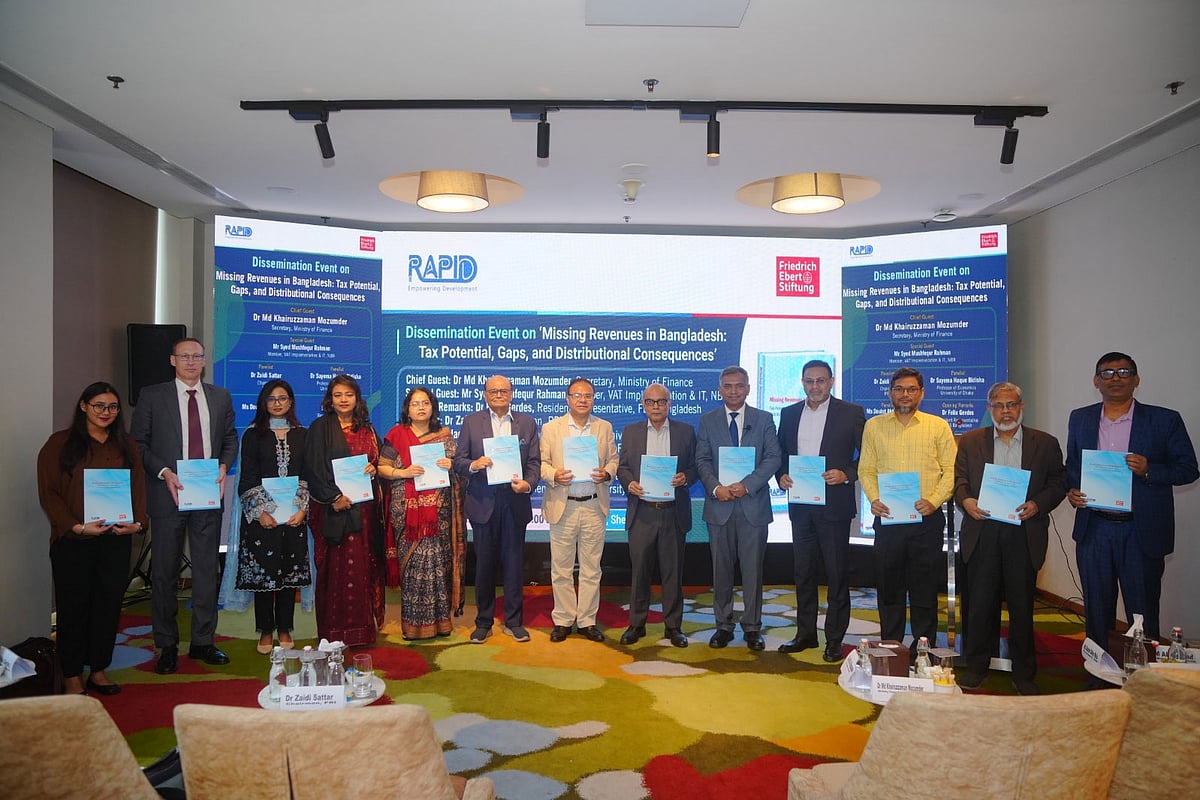
The findings were published today, Saturday. The study, titled 'Missing Revenue in Bangladesh: Tax Potential, Gaps and Distributional Consequences', was conducted with support from Friedrich-Ebert-Stiftung (FES) Bangladesh. It was led by RAPID chairman M A Razzaque.
A discussion and publication event was held at a local hotel today to release the findings. Finance Secretary Md Khairuzzaman Mozumder, National Board of Revenue member (VAT implementation and IT) Syed Mushfiqur Rahman, Policy Research Institute chairman Zaidi Sattar, Dhaka University economics professor Sayema Haque Bidisha and Economic Reporters' Forum president Doulat Akter attended.
The study said potential personal income tax revenue is mainly concentrated among high-income families. The top 10 percent of families earn more than 40 percent of total household income. Under prevailing tax rates, more than 93 percent of potential personal income tax is supposed to come from these families.
By contrast, the bottom 70 percent of families have effectively no personal income tax liability. The study therefore said the main focus in expanding the income tax base needs to be on high-income families.
RAPID also said the number of active taxpayers registered for personal income tax is extremely low. Only 3.57 percent of the total labour force is registered as active income taxpayers.
Even among Taxpayer Identification Number (TIN) holders, the rate of filing income tax returns is limited. The rate is 43.1 percent for individuals and other categories and 23.6 percent for companies. The study said much taxable income remains outside the effective tax system.
RAPID chairman M A Razzaque said the success of revenue collection cannot be judged only by how much money is collected. How fair and transparent the tax system is, how free taxpayers are from harassment, and how much quality public service people receive in return for their taxes must also be considered with equal importance.
According to the study, inequality in wealth distribution is much greater than in income. The wealthiest 1 percent of families hold 47.4 percent of the country's total real personal wealth. The top 10 percent hold 76.4 percent of wealth.
By contrast, the half of families with the least wealth hold only 3.4 percent. In urban areas, the wealthiest 1 percent of families hold more than 53 percent of real personal wealth there. Researchers calculated net wealth by deducting loans from the estimated value of family land, houses, financial assets and other assets.
The study also said that although consumers bear the VAT burden, not all of it reaches the state treasury. Businesses are responsible for collecting VAT and depositing it with the government. But inadequate registration, concealment of sales information and failure to deposit VAT properly create opportunities for revenue evasion. RAPID said that instead of raising tax rates, significant additional revenue can be collected by increasing effective compliance and administrative oversight.
The RAPID study made seven recommendations on the revenue sector: expanding the income tax base with priority on high-income groups; improving collection efficiency and compliance instead of raising VAT rates; reassessing the rationale for corporate tax exemptions and special benefits; seriously considering introducing inheritance tax in view of the large concentration of wealth; completely avoiding coercive measures and taxpayer harassment in the name of revenue collection; working jointly with local communities and professional organisations to expand the tax net; and improving the quality of public spending alongside modernising tax administration.