Islamic University at 48: 83 percent of students outside halls, classroom and security crises unresolved
The Islamic University in Kushtia has completed 47 years and entered its 48th year. Although it was founded to combine Islamic education with modern education, over this long period the university has not overcome its housing crisis, insecurity, teacher and classroom shortages, confusion over its name, transport crisis, administrative hassles and difficulties in collecting certificates. The university also lags comparatively in quality research and international standards.
Campus sources say that although the university was founded with the aim of full residential facilities, about 83 percent of students remain outside residential halls. Of the university's roughly 19,500 students, about 16,000 live in private messes nearby and in Kushtia-Jhenaidah. With a transport crisis, they suffer in commuting, and female students also face harassment at times in messes and on public transport.
The university currently has 415 teachers teaching in 38 departments under 9 faculties. Of these, about 15 departments face a classroom crisis. There are not enough labs, common rooms, seminar libraries and research facilities. However, construction of 4 halls and 1 academic building is under way to resolve the crisis; concerned people believe the housing crisis will ease considerably once the ongoing work is finished quickly.
There is also confusion over the name. Although the university's law gives the name 'Islamic University', several names are used in documents — 'Islamic University', 'Islamic University Kushtia', 'Islamic University Kushtia-Jhenaidah' and 'Islamic University Bangladesh'. As a result, students fall into confusion in various fields including jobs.
Even after nearly five decades, the university's activities run in the traditional way. Although an e-payment system was introduced with two banks for paying various fees, neither of them saw the light of day. For form fill-up, certificates and various papers, students have to run from one building to another. The university has also been in discussion at various times over trade and corruption in teacher and officer recruitment, and despite students' demands, a central student union has still not been formed.
Insecurity is also acute. Recently, a teacher of the university was hacked to death in his own room in broad daylight, and a student's body was recovered from a campus pond. Alongside this, there was an incident of local political leaders and activists openly brandishing local weapons on campus. The trial process of these incidents is also moving slowly.
It will soon be a year and a half since the killing of Sajid Abdullah, a student of the Al Quran and Islamic Studies department, but there is no progress in the investigation. On July 17 last year at around 5pm, police recovered Sajid's body from the pond of the university's Shah Azizur Rahman Hall. The Criminal Investigation Department (CID), which was most recently given charge of the investigation, has also not been able to show much progress.
Meanwhile, on the afternoon of March 4, Asma Sadia Runa, chair of the university's Department of Social Welfare, was killed in her own office room. Fazlur Rahman, a daily-wage employee of the university, was rescued from that room in a bloody state. When the two were taken to Kushtia General Hospital, doctors declared Runa dead. Fazlur Rahman, the main accused in the murder case, was sent to Kushtia district jail after treatment; the other three accused are still absconding and the charge sheet in the case has not yet been submitted. On this, IU police station OC Mamunur Rashid said: 'We have finished our work. We will submit the charge sheet very soon after talking to the university.'
The university's current number of students is 19,971. Among them, regular students (undergraduate and postgraduate) number 19,668 — 11,887 male students and 7,781 female students. There are 151 MPhil researchers and 152 PhD researchers. So far, more than 800 researchers have earned MPhil degrees and about 750 have earned PhD degrees, and they are working in various countries.
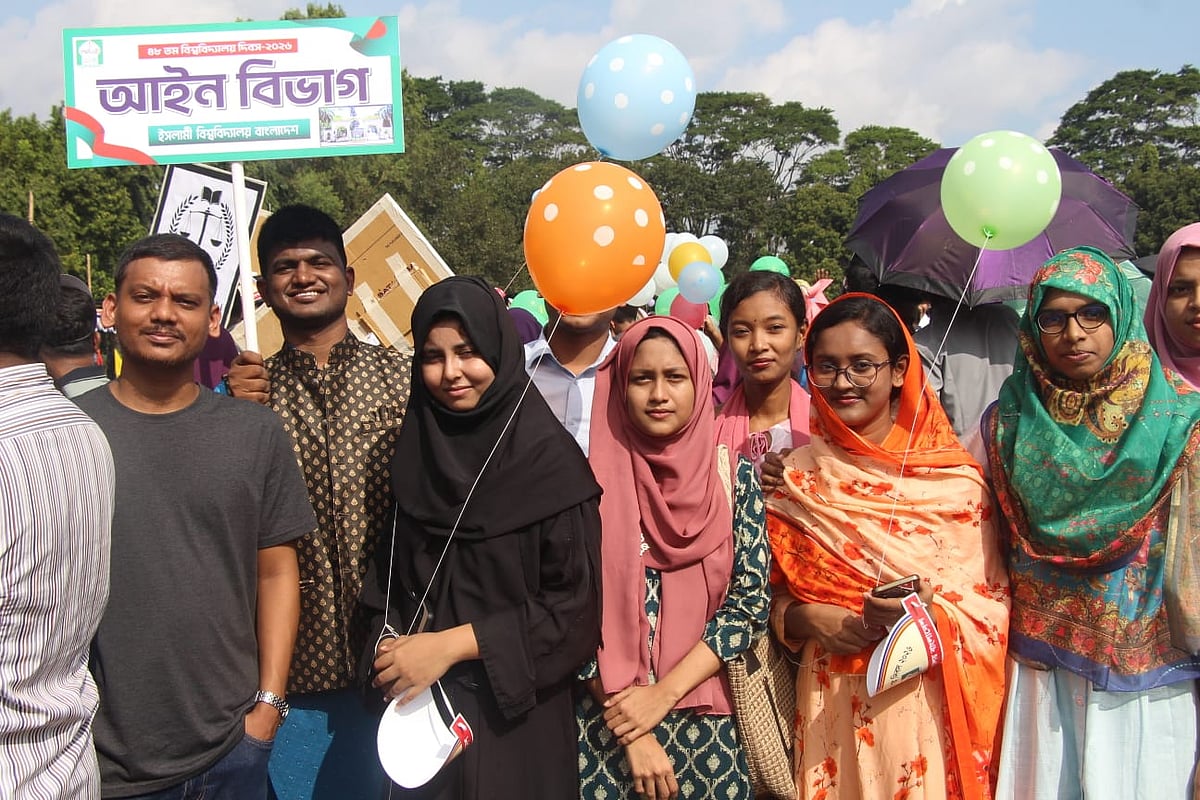
On November 22, on the occasion of University Day, Vice-Chancellor Professor A K M Motinur Rahman inaugurated the programme at the central football field by hoisting the national and university flags, performing the national anthem, and releasing pigeons and balloons. Present at the time were Pro-Vice-Chancellor Professor Emtaz Hossain, Treasurer Professor Idris Ali, Registrar (acting) Professor Md Atikur Rahman, along with deans, department chairs, hall provosts, teachers, officers, employees and students.
The vice-chancellor said: 'Those who get admitted to public universities come here after passing competitive examinations. So if the curriculum is made up to date for the meritorious, it will not become a factory for producing the unemployed. The administration is working to raise the university to international standards. We are trying to collaborate with various institutions and companies at home and abroad for the development of the university. We want to take the university forward by erasing its past history of crises and corruption.'
The university's history says that in 1977, the first World Muslim Education Conference held in Makkah recommended establishing a university combining modern and Islamic education. In that context, under the patronage of the OIC, then President Shaheed Ziaur Rahman formed the 'Islamic University Committee' with Dr M A Bari as chairman. On the basis of the Bari Commission's final report, the university's foundation stone was laid on November 22, 1979.
However, the picture of lagging in international rankings is clear. Malaysia's International Islamic University (IIUM) is ranked 691st in the 2027 QS World University Rankings, and Pakistan's International Islamic University (IIUI) is ranked 1,401st or below. In contrast, Bangladesh's Islamic University, which began its journey at the same time under OIC patronage, has still not found a place in the QS rankings.
As part of returning to its aims and objectives, the vice-chancellor said an Islamic Studies course has been made compulsory for Muslim students of all departments of the university. Alongside this, a separate subject modelled on Malaysia's International Islamic University has been included in the curriculum for non-Muslim students. In addition, Bangladesh Studies and an industry-related course have been made compulsory for all students.